
Why filming in Trang belongs on your Andaman shortlist
Filming in Trang gives an international production the Andaman coastline it came for without the boat traffic, hotel pressure and permit congestion that now define the stretch north of it. Trang sits directly below Krabi on Thailand’s west coast, holds roughly a hundred kilometres of shoreline and a scatter of limestone islands, and receives a fraction of the production volume that Phuket and Phang Nga absorb every dry season.
The volume matters. In the first half of 2026, 302 foreign productions applied to film in Thailand, representing around 4.03 billion baht of declared investment — more than half of the total recorded across the whole of 2025, which was itself a record year. That growth is concentrated on a small number of well-known coastlines. Producers who need the same look with more room to work are moving one province south.
Trang also has a live promotional tailwind. The Tourism Authority of Thailand’s 2026 international campaign work put Trang and Krabi at the centre of its southern coastal storytelling, including a campaign film shot around Ko Muk and Ko Kradan that premiered in London in March 2026. Provincial and national bodies are actively courting screen work here, which changes the tone of every conversation on the ground.
What filming in Trang actually gives you
Trang is not a single look. Filming in Trang divides cleanly into four production environments, and most schedules use two or three of them rather than trying to cover all four.
- Limestone island coast: karst towers rising straight out of shallow green water, hidden interior beaches, sea caves and undercut cliffs. The classic Andaman frame.
- Mainland beach and mangrove: long, flat, largely undeveloped sand backed by casuarina and mangrove channel systems, with almost no built horizon.
- Inland agricultural interior: rubber plantation, oil palm, small-scale farming, waterfalls and cave systems in the low hills toward the Banthat range.
- Sino-Portuguese town: Trang town’s shophouse grid, morning market, coffee-shop culture and the southern railway terminus — a working provincial town, not a restored heritage set.
That combination is unusually efficient. A unit basing in Trang can shoot open ocean, jungle interior and period-adjacent street in the same week without a domestic flight, which is rarely true on the Andaman.
The islands: Koh Mook, Koh Kradan, Koh Ngai and Koh Libong
Most of the case for filming in Trang rests on its offshore group, which sits within an easy run of the mainland piers. That proximity is the single biggest practical advantage over shooting the outer Andaman islands.
Koh Mook holds the province’s most photographed feature and a working fishing village on its eastern side. The village gives you populated coastal texture; the western cliffs give you the karst face.
Koh Kradan is the postcard island — a long white beach on the eastern shore with a clean reef edge and an uninterrupted sightline back toward the mainland karsts. It has very little permanent development, which makes it clean to frame and difficult to service. Everything comes in by boat.
Koh Ngai (Koh Hai) sits at the northern end of the group, technically closer to Krabi’s waters, and carries slightly more resort infrastructure. It is often the practical compromise when a schedule needs island frames but also needs beds and power near the unit.
Koh Libong is the largest of the group and the least cinematic in the conventional sense — it is a seagrass and mangrove island with a substantial Muslim fishing community and internationally significant dugong habitat. For documentary, conservation and natural-history work it is the most valuable location in the province. For drama it is a texture location rather than a hero one.
The Emerald Cave and the tidal window
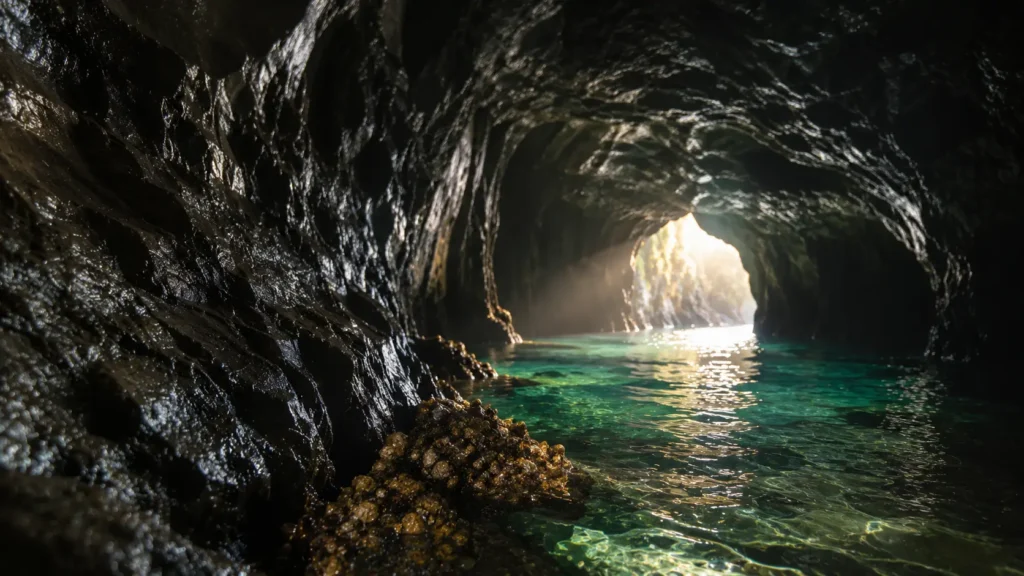
Tham Morakot, the Emerald Cave, is on Koh Mook’s western face. You enter through a sea tunnel roughly eighty metres long and swim or float through in near-darkness before it opens into a collapsed sinkhole with a small sand beach ringed by vertical rock. Nothing else in the region looks like it.
It is also the hardest single element of filming in Trang. The tunnel is only passable around low water, the usable window is short, and it is a fixed astronomical constraint — you cannot buy your way into a longer one. Day-trip boats arrive from mid-morning, so any clean plate has to be captured at first light. Interior lighting has to be swum in, and there is no dry route for a genny or a distro run.
Treat it as a marine-unit day with its own call sheet, its own safety plan and its own contingency date. Our notes on underwater filming in Thailand cover the safety-diver and housing requirements that apply here, and the tidal logic is close to what we describe in filming on a beach in Thailand.
Mainland coast and Hat Chao Mai
The mainland shoreline runs from Pak Meng in the north down past Hat Yao and Hat Chao Mai to the Palian estuary. Much of it falls inside Hat Chao Mai National Park, which also covers the island group’s marine area.
Pak Meng is the main departure pier and the most developed point on the coast — useful as a marine base, less useful as a frame. Hat Yao gives you several kilometres of empty flat sand with karst islands on the horizon and effectively no buildings in shot. For a unit that needs a big, clean, uninhabited beach that a truck can actually reach, it is the best value location in the province.
The mangrove channels behind the coast are separately worth scouting. Narrow tidal creeks under closed canopy read as far more remote than they are, and they are drivable-to at several points.
Inland Trang: rubber, waterfalls and caves
Trang was one of the first provinces in Thailand to plant rubber commercially, and the interior is still largely plantation. Rubber lines read very differently from jungle — ordered, vertical, repeating — and are a genuinely distinctive backdrop that most Thailand-shot productions never use.
Toward the Banthat range on the Phatthalung border the terrain lifts into evergreen forest with waterfall systems and limestone cave networks. These are protected-area locations with their own access constraints, and they sit at the far end of a long single-lane approach, which limits how much kit realistically arrives. Scout them as small-unit environments.
Trang town and the southern railway
Trang town is a working southern market town with an intact Sino-Portuguese shophouse grid, a strong coffee-shop and dim-sum culture, and the terminus of the southern railway line from Bangkok. It has not been restored into a tourist heritage district, which is precisely why it is useful: the street dressing is real, signage is Thai and Chinese, and the pace is provincial.
For period work the shophouse frontages hold up well with modest set dressing, though the requirements are the same as anywhere else in Thailand — see our guidance on period drama production in Thailand. For contemporary work the market and the railway station give you populated, unglamorous Thai daily life without the tourist layer that Phuket Town now carries.
Access, basing and unit movement when filming in Trang
Trang has a domestic airport with scheduled service from Bangkok. It does not take international arrivals, so most crews route through Bangkok, Phuket or Krabi. The road approach from Krabi is straightforward; from Phuket it is materially longer and crosses the Sarasin bridge bottleneck.
The basing decision usually comes down to three options:
- Trang town. Best for inland and town work, adequate hotel stock, real hospital capacity, furthest from the piers.
- Pak Meng / Hat Chao Mai coast. Shortest boat legs, thin accommodation, correct choice when the schedule is marine-heavy.
- Krabi with day runs south. Best crew comfort and equipment access, but it turns every island day into a long transfer and eats the schedule.
Whichever you pick, unit movement is the cost you will underestimate. Our production transport in Thailand guide covers the vehicle, ferry and driver-hour realities in detail, and they bite harder here than in Bangkok.
The marine unit reality of filming in Trang
Almost every hero location in Trang is reached by boat. That single fact reshapes the schedule.
Longtails handle shallow approaches and beach landings but carry very little and offer no working deck. Speedboats move crew fast but are unpleasant to work from and poor camera platforms. Larger dive or tour boats give you deck space, shade and a place to charge and change, and they are the right base vessel for any multi-day island block. Most units end up running a mixed fleet.
Sea state, not rainfall, is what actually kills days on the Andaman. A grey sky is a colour-grade problem; a two-metre swell is a cancelled day. Build your contingency around wind and swell forecasts rather than precipitation, and put mainland cover scenes in the schedule that can be pulled forward at short notice.
You will also want a dedicated marine coordinator — a role we treat as non-negotiable on island schedules and describe in our Thai film crew overview. This person owns boat contracting, tide tables, safety cover and the relationship with local boat operators, and they are the difference between a smooth island block and a chaotic one.
Permissions: the protected-area layer
Filming in Trang runs two permission processes in parallel rather than one. The national permit route for foreign productions goes through the Thailand Film Office and is set out in our Thailand film permit guidance. Separately, the island group and much of the mainland shoreline sit inside Hat Chao Mai National Park, and protected-area access carries its own approval process administered by the Department of National Parks, Wildlife and Plant Conservation.
These are not interchangeable and they are not sequential in a way you can shortcut. Start both early, and treat protected-area access as the one that determines whether your hero location is actually available. Our national park filming in Thailand guide sets out how the two processes interact.
Koh Libong’s dugong and seagrass habitat carries an additional conservation sensitivity. Any work involving marine wildlife should be planned around the guidance in our wildlife filming and filming with animals notes, and coordinated with local conservation groups rather than around them.
Seasonality: when to plan filming in Trang
Trang is on the Andaman side, so it follows the southwest monsoon. The practical shoot window for marine and beach work runs from roughly November through April, with the cool-dry months at the front of that window giving the cleanest light and the lowest humidity.
Through the southwest monsoon, from around May to October, offshore work becomes unreliable — not impossible, but not schedulable with confidence. Some island operators reduce or suspend service, underwater visibility drops, and the swell pattern makes small-boat transfers uncomfortable and occasionally unsafe. Inland, town and plantation work remains perfectly viable year-round; monsoon rain in the south is typically heavy and short rather than continuous.
If your window is fixed and it falls inside the monsoon, restructure rather than cancel: move the marine block to the Gulf side and keep the inland Trang material where it is. Our best time to film in Thailand guide compares the two coasts season by season.
Crew, kit and what has to travel
Filming in Trang means arriving self-sufficient. The province has no standing production infrastructure. There is no rental house, no grip supply and no local crew base of any depth. Everything technical comes from Bangkok, with Phuket as a partial secondary source for marine and lighting support.
That is normal for Thai regional work and entirely manageable, but it has to be budgeted honestly. Kit travels by road from Bangkok on a multi-day run; crew fly in. Local hire is realistic for boat operators, fixers, security, base-camp support, drivers and extras, and those people are worth engaging properly — see our film fixer in Thailand and location scouting pages for how we structure that.
Camera, lighting, grip and sound all come with the travelling unit. Details on sourcing sit in our film equipment rental and production sound guides, and if you are bringing kit into the country, in importing film equipment into Thailand.
Aerial work over the karsts
Filming in Trang from the air is one of the more rewarding aerial propositions in Thailand — the karst faces, the shallow reef gradients and the near-total absence of built structures make for clean plates in almost any direction. Airspace is quieter than Phuket’s, and there is no commercial airport traffic to work around.
Protected-area status still applies over the marine park, and aerial permissions are handled separately from ground permissions. Our aerial filming in Thailand guide covers how we sequence those approvals alongside the main permit.
What actually moves the budget when filming in Trang
Four line items consistently run over when filming in Trang, and all four are predictable at the prep stage.
- Marine charter and standby. Boats are booked by the day, not the hour, and the standby vessel you never use is still on the invoice. Multi-vessel island days add up quickly.
- Transfer time. Pier-to-location legs are unproductive hours that appear nowhere in the shooting schedule but consume the day. Budget them as crew hours.
- Dry-season accommodation. November to April is also peak tourism. Late booking on a coastal base is expensive and sometimes simply unavailable.
- Weather contingency. Marine days need real contingency, not a nominal line. One swell event can push a whole island block.
Broader cost structure is covered in film production costs in Thailand. On the incentive side, foreign productions meeting the published criteria may be eligible under the national cash-rebate scheme administered by the Thailand Film Office — the mechanics are set out in our Thailand film incentive rebate guide and handled through our incentive services.
Choosing between Trang, Krabi and Phang Nga
All three provinces sit on the same limestone coast and share a visual family, so the choice is rarely aesthetic. The differences that matter when you are costing filming in Trang against its neighbours are operational.
| Factor | Trang | Krabi | Phang Nga |
|---|---|---|---|
| Location congestion | Low | High at hero sites | Moderate to high |
| Local infrastructure | Thin | Good | Moderate |
| Boat transfer times | Short | Short to moderate | Long to outer islands |
| Air access | Domestic only | International | Via Phuket |
| Distinctive feature | Swim-through sea cave, empty mainland beach | Cliff faces, established crew base | Bay karsts, marine parks |
In practice, many Andaman schedules use two provinces rather than one. Read this alongside filming in Krabi, filming in Phang Nga and filming in Phuket, and against the wider survey in our Thailand filming locations guide.
How we handle filming in Trang
We are a Bangkok-based, Thailand Film Office-registered production service company, and we run regional Andaman work as a single end-to-end package rather than a chain of local subcontracts. That means one production office, one permit workflow covering both the national and protected-area routes, one bilingual English–Thai crew travelling as a unit, and one point of accountability for the marine contracting.
Across fifteen years and more than four hundred productions we have delivered for Netflix, Vice, Al Jazeera, the United Nations, Reuters, Universal and Warner Music. Recent long-form work includes the US feature Contra, shot in Bangkok in 2025, and the global motorsport series Lollipop Racing. The operating model for filming in Trang is the same as it is on a city schedule: structured workflows, international standards, and crew who have worked the location before.
Foreign crew logistics — visas, work permits and arrival sequencing — are handled in-house, as set out in our film crew visa guide, alongside production insurance and, where the brief calls for it, sustainable production practice, which matters more than usual inside a marine national park.
Frequently asked questions about filming in Trang
Is filming in Trang harder than filming in Phuket or Krabi?
Operationally yes, creatively often easier. Trang has thinner local infrastructure and no crew base, so more travels with the unit. In exchange you get locations with far less public traffic, shorter boat legs to the island group, and a much freer hand on scheduling at hero sites.
Do we need a separate permission to shoot inside Hat Chao Mai National Park?
Yes. Protected-area access is administered by the Department of National Parks, Wildlife and Plant Conservation and runs in parallel with the national film permit process. Both should be started early in prep, and the protected-area route is the one that determines whether a hero island location is actually available to you.
When is the best window for marine work in Trang?
Roughly November through April, following the Andaman dry season. The cool-dry months at the start of that window give the strongest light and lowest humidity. From around May to October the southwest monsoon makes offshore work unreliable, though inland and town work stays viable.
Can we shoot inside the Emerald Cave on Koh Mook?
It is possible but it is a specialist marine day. The tunnel is only passable around low water, the window is short and fixed by the tide, all lighting has to be swum in, and day-trip boats begin arriving mid-morning. Plan it as a first-light block with its own safety plan and a contingency date.
More questions about filming in Trang, Thailand
Where should the unit base?
Trang town for inland and town work, the Pak Meng and Hat Chao Mai coast for marine-heavy schedules, or Krabi if crew comfort and equipment access outweigh transfer time. Most schedules split, moving the unit once rather than commuting daily.
How do crew and equipment reach Trang?
Crew fly domestically from Bangkok into Trang, or route through Krabi or Phuket and drive. Technical equipment travels by road from Bangkok on a multi-day run, with Phuket available as a partial secondary source for marine and lighting support. There is no rental infrastructure in the province itself.
What can realistically be hired locally?
Boat operators and skippers, local fixers, security, base-camp support, drivers, extras and background talent. Camera, lighting, grip, sound and the heads of department travel with the unit from Bangkok.
Does filming in Trang qualify for the Thailand film incentive?
Eligibility depends on the production and its Thai expenditure, not on which province it shoots in. The scheme is administered by the Thailand Film Office under published criteria that are updated from time to time. We handle applications as a registered production service company.
Planning a shoot in Trang
If you are a line producer or UPM costing an Andaman block, or a location manager trying to find the Thai island look without the traffic, send us the treatment, the window and the shape of the schedule. Our Bangkok team will come back with a location assessment, a realistic marine plan, the permit route for both the national and protected-area layers, and a budget you can take into a greenlight conversation. Reach us at info@overgrownproductions.com or through our contact page.
Further reading: shooting a feature film in Thailand, filming in Southeast Asia, and the Thailand Film Office and Department of National Parks for the official positions. See how it fits against the rest of our filming locations across Thailand.