
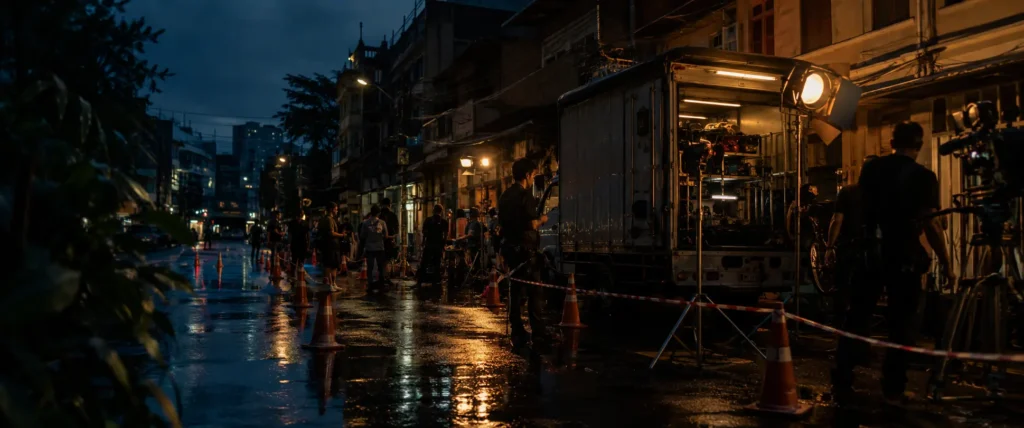
Why production insurance in Thailand starts before the first permit
Arranging production insurance in Thailand is one of the first things a financier asks about and one of the last things an incoming producer wants to think about. Thailand is in a record cycle for inbound work — a 2025 run that the Department of Tourism called a “golden year” and a Q1 2026 that kept the momentum — and the more capital that commits to a territory, the more carefully it is underwritten. For an international line producer or UPM, the insurance file is not paperwork at the edge of the budget. It is the document that lets a foreign executive producer sign off on the territory at all.
This guide sets out what production insurance in Thailand covers, who asks to see it, and how the local and home-territory layers fit together. It is written for producers and financiers, not for brokers, and it keeps to general practice. Specific limits, premiums and policy wordings always come down to your production, your financier and the cover you place — confirm those with your insurer and your service company.
What production insurance in Thailand covers

Production insurance in Thailand is not a single policy but a stack of cover that travels with the shoot. Most international productions carry a production package that bundles several lines, plus standalone local policies where Thai law or a permit condition requires them. The components a line producer should expect to account for are familiar from any major territory, with a few Thailand-specific wrinkles around location, marine and aerial work.
- Public and general liability: third-party injury and property damage arising from the shoot.
- Cast insurance: the cost of delay or recast if a key performer cannot work.
- Crew and workers’ cover: injury and compensation for the people on the unit.
- Equipment and property: cameras, lenses, lighting, grip, vehicles and rented kit.
- Errors and omissions (E&O): clearance, rights and delivery cover the distributor will require.
- Negative, faulty stock and weather/cancellation: the production-specific lines that protect the schedule itself.
How those lines are split between a home-territory production package and locally placed policies is the practical question, and it is the one the rest of this guide works through.
Who asks to see your production insurance in Thailand
Three parties drive the insurance requirement, and they rarely ask for the same thing. The financier or studio wants proof that the production is covered before funds are released. The completion guarantor, on a bonded production, wants evidence that risk is managed to its standard. And local counterparties — location owners, government bodies, equipment houses — want a certificate naming them before they let the unit through the door.
The result is that production insurance in Thailand has to satisfy an offshore financier and an on-the-ground location manager at the same time. A service company that has placed cover for inbound productions before knows which certificates each counterparty expects and in what form, which is the difference between a smooth prep and a location lost the week before the shoot.
Local policies: why production insurance in Thailand is placed on the ground
An incoming production usually arrives with a master production package arranged at home. That package does a lot, but it does not always satisfy a Thai permit condition, a Thai location owner or a Thai government department that wants to see a locally admitted policy and a local indemnity. This is why production insurance in Thailand is typically a two-layer arrangement: the home package for the production’s own risk, and locally placed cover for the liabilities that have to be answerable inside the country.
The local layer is what allows a foreign producer to give a Thai counterparty a certificate it can actually act on. A service company registered with the Thailand Film Office places that local cover, carries the local indemnities, and lines the two layers up so there is no gap a financier’s risk team can object to. Getting this structure right early is far cheaper than discovering a coverage gap on the unit’s first day on a sensitive location.
Public liability, locations and permit conditions
Public liability is the line that touches almost every shooting day. Closing a Bangkok street, working in a heritage site, filming on private land or in a national park — each comes with a counterparty who wants to be named and indemnified before granting access. Permit conditions issued through the Thailand Film Office and the relevant department frequently specify the indemnity a production must provide, and a location owner will often ask for a certificate naming them specifically.
Our Thailand film permit guide covers the approval side of this; the insurance side runs in parallel. The practical point for a line producer is that liability cover and permits are not separate workstreams. They are scheduled together, because a permit that requires an indemnity you have not arranged is a permit you cannot use.
Cast, crew and workers’ compensation
Cast cover protects the budget against the delay, abandonment or recast cost if a principal performer falls ill or is injured and cannot work. For a long shoot with named talent, it is one of the larger lines in the package, and insurers will usually want medicals before the shoot. Crew and workers’ cover sits alongside it: Thailand has its own framework for compensating workers injured at work, and a unit operating in the country has obligations to the people on it regardless of where they were hired.
A bilingual crew working to international production standards makes this layer easier to manage, because safety briefings, risk assessments and incident reporting all happen in a form an insurer and a guarantor recognise. The legal specifics of Thai workers’ compensation and the treatment of foreign versus local hires are matters to confirm with your service company and insurer against the rules in force at the time of the shoot.
Equipment, vehicles, marine and aerial units
Equipment cover protects owned and rented kit — camera bodies, lenses, lighting, grip, generators and vehicles — against loss and damage. Whether you rent locally or import under an ATA Carnet, that kit still needs to be insured for its replacement value while it is in the country and on the move. Our guides to film equipment rental in Thailand and importing film equipment cover the kit logistics; the insurance simply has to follow whichever route you choose.
Thailand’s locations also pull productions into higher-risk units. Marine work off the Andaman coast, picture boats, underwater photography, vehicle action and aerial drone work all carry their own exposures, and insurers price them accordingly. The mitigation is operational as much as financial: safety divers, qualified marine and aerial crews, and a documented safety plan reduce both the risk and the premium loading. Flagging these units at the budgeting stage, not after the policy is bound, is what keeps the cost predictable.
Errors and omissions and delivery
Errors and omissions cover — clearance of rights, titles, trademarks, music and likeness — is a delivery requirement more than a shooting-day one, but it shapes how a production documents itself from the first day. Distributors and platforms will not take delivery without it, and the clearances that support an E&O policy are built throughout production, not assembled at the end. For a producer shooting in Thailand for an international distributor, the practical task is to keep the clearance and release trail clean from day one so the E&O cover the distributor requires can actually be placed.
Completion bonds and the documentation trail
On a bonded production, the completion guarantor is the most demanding reader of the insurance file. The bond and the insurance package are separate instruments — the guarantor guarantees delivery on budget and schedule, the insurer covers defined losses — but they depend on each other, and the guarantor will want to see that risk is being managed to its standard throughout the Thailand leg. That means certificates in order, a credible safety regime, and a documentation trail it can audit.
This is where a service company earns its place in the budget. A Thai partner that can produce call sheets, risk assessments, permit indemnities, safety reports and insurance certificates in a form a guarantor recognises lets a bonded production treat Thailand exactly like any other established territory. The answer to “can Thailand document the process to a bond’s satisfaction” is yes — provided the company running the shoot is set up to deliver that trail.
How we arrange production insurance in Thailand
We are a Thailand Film Office–registered production service company, and arranging production insurance in Thailand is part of how we de-risk a territory for an incoming production. We work with the production’s existing package and its broker, place the local cover and indemnities that Thai permits, locations and counterparties require, and line the two layers up so there is no gap for a financier or guarantor to object to. We have delivered for clients including Netflix, Vice, Al Jazeera, Reuters, the United Nations, Universal and Warner Music, and most recently for the US feature Contra, shot in Bangkok.
Because we run the permits, the crew, the equipment and the locations as one workflow, the insurance and indemnity file is assembled alongside everything else rather than chased at the end. That is what lets a foreign executive producer or financier commit to Thailand with the same confidence they would bring to any major hub. For the budget context around this, see our guide to film production costs in Thailand and the Thailand film incentive 2026 guide.
Production insurance in Thailand: frequently asked questions
Is production insurance legally required to film in Thailand?
Cover is not a single statutory requirement, but in practice it is unavoidable. Financiers and studios require proof of insurance before releasing funds, completion guarantors require it on bonded productions, and many permits and location owners require a named indemnity before granting access. Treat it as a gating requirement rather than an optional line.
Can I use my home-country production insurance package in Thailand?
Usually in part. A master production package arranged at home covers much of the production’s own risk, but Thai permits, locations and counterparties often require locally placed cover and a local indemnity they can act on. Most inbound productions run a two-layer structure, and a local service company places the Thailand layer.
What does production insurance in Thailand typically cover?
A production package generally bundles public and general liability, cast, crew and workers’ cover, equipment and property, negative and faulty stock, weather and cancellation, and errors and omissions for delivery. Higher-risk units — marine, underwater, vehicle action and aerial — are priced and documented separately.
How does insurance work with a completion bond on a Thailand shoot?
The bond and the insurance package are separate instruments that depend on each other. The guarantor wants certificates in order, a credible safety regime and an auditable documentation trail throughout the Thailand leg. A service company that can produce that trail in a recognisable form lets a bonded production treat Thailand like any other established territory.
More questions about Production Insurance in Thailand
Do marine, underwater and aerial units need special cover?
Yes. Picture boats, underwater photography, vehicle action and drone work carry their own exposures and are priced accordingly. The cost is managed operationally — qualified marine and aerial crews, safety divers and a documented safety plan reduce both the risk and the premium loading. Flag these units at the budgeting stage, not after the policy is bound.
Who arranges the local insurance layer for an international production?
A Thailand Film Office–registered service company typically places the local cover, carries the local indemnities and aligns them with the production’s home package. That local layer is what allows a foreign producer to give a Thai location owner or government body a certificate it can act on.
How early should production insurance be arranged?
During prep, alongside permits and locations, not after. Permit conditions frequently specify an indemnity, and a location can be lost if the certificate naming the owner is not ready. Marine, aerial and cast cover in particular need lead time for safety planning and medicals, so the insurance file is built through prep rather than at the end of it.
Does equipment imported under an ATA Carnet still need insurance?
Yes. A carnet is a customs instrument that lets kit enter and leave without import duty; it is not insurance. Owned or rented equipment still needs cover for its replacement value while it is in the country and on the move, whether it was imported under carnet or hired locally.
Talk to our Bangkok team
If you are a line producer, UPM or financier weighing Thailand for a feature, series or branded production, we can set out exactly how the insurance and indemnity file will be built for your shoot and where the local layer sits against your existing package. Email our Bangkok team at info@overgrownproductions.com or reach us through our contact page, and we will walk you through how we de-risk a Thailand production from prep to delivery.