
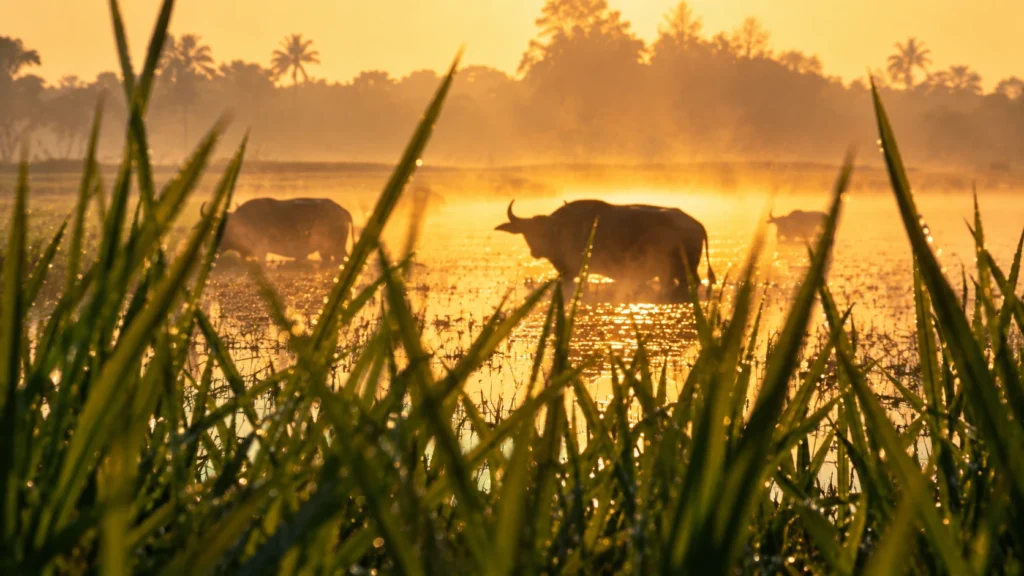
Filming with animals in Thailand is one of the few production decisions that has to be made in prep rather than on the day. An animal in frame changes the permit route, the insurance position, the call sheet and, on protected land, the documents the authority expects to receive before the unit is approved at all. Thailand is absorbing more international work than at any point in its history — 302 foreign productions declared roughly 4.03 billion baht of spend in the first half of 2026, already more than half of the record set across the whole of 2025 — and animal sequences are turning up in more of those boards, from factual series to features and car campaigns. The producers who schedule them well treat the animal as a department, not a prop. This guide sets out how filming with animals in Thailand actually works: the approval routes, the documentation, the welfare standards commissioners now enforce, and what it costs a schedule.
Three Categories of Animal Work, Three Different Approvals
Producers tend to use one phrase for three quite different jobs, and each one is approved by different people on a different timeline. Separating them at the earliest scout stage saves the schedule later.
- Handled animals brought to location. Domestic or licensed working animals — horses, dogs, livestock, birds — travelling to set with a handler. Approval sits with the location holder plus, on protected land, the park authority.
- Animals resident at a venue. Sanctuaries, farms, stables and conservation centres where the animal stays put and the unit comes to it. Approval sits with the venue operator, under its own welfare conditions.
- Wild populations in habitat. Free-ranging animals filmed where they live. This is observational work under a protected-area permit, and it is not the same discipline as staged animal action — our wildlife filming field guide covers that craft in detail.
Confusing the third category with the first is the most common and most expensive mistake. Wild animals are not directed, baited or repositioned, and any board that assumes otherwise needs rewriting before it reaches an authority. Getting this separation right at scout stage is the single biggest lever on the cost of filming with animals in Thailand.
Filming with Animals in Thailand: The Permit Stack
The national film permit coordinated through the Thailand Film Office covers the production’s presence and activity in the country. It does not, on its own, authorise an animal. Animal elements are declared within that application and then cleared again by whoever controls the ground.
In practice a shoot with animal content assembles a stack: the central film permit, the location holder’s consent, a protected-area approval where relevant, and any veterinary or transport documentation the animals themselves require. Each layer has its own lead time, and they do not run perfectly in parallel. Our Thailand film permit guide sets out the base process; animal content adds a documentary layer on top of it rather than replacing anything.
The practical rule we give incoming producers is simple. If an animal appears in a scene — even incidentally, even as background, even a street dog the director likes — raise it at application stage. Authorities respond far better to a declared animal element than to one discovered on the day by a ranger.
Filming with Animals in Thailand Inside National Parks
Protected areas are where the paperwork becomes specific. The Department of National Parks, Wildlife and Plant Conservation runs its own filming approval separately from the central permit, and it distinguishes between short single-visit shoots and continuous multi-day filming, and between productions that bring animals in and those that do not.
Where animals are brought into a park, the department’s published guidance calls for a dedicated application to bring animals in, supported by identification photographs of each animal and veterinary health documentation. Those are not formalities. They are the documents that decide whether the unit is approved, and assembling them late is the usual reason an animal day slips.
Unit size, vehicle access, gate hours and conduct near resident wildlife are all set by the park rather than negotiated by the production. Khao Yai is the clearest example of a park where resident populations, strict gate hours and capped unit sizes shape the schedule directly — we cover that in the Khao Yai location guide, and the broader route in our national park filming permit guide.
Working with Licensed Wranglers and Handlers
Every serious approach to filming with animals in Thailand starts with the handler. Thailand has an established pool of animal handlers working across features, series and commercials, most of them concentrated around Bangkok and the central provinces where the equipment and stage infrastructure sits. We engage them as a contracted department with a named lead, not as a day-rate supplier.
What that department is responsible for on our shoots:
- Animal welfare authority on set. The handler, not the first AD, decides how many takes an animal gives and when it rests. That authority is written into the schedule before day one.
- Transport and holding. Shaded holding away from the unit, water, secure containment, and journey planning that avoids the middle of a hot day.
- Documentation. Health certification, identification records and any transit paperwork the destination requires.
- Rehearsal separate from the camera. Behaviour is established away from the lighting and the crowd, then brought to the set once it is reliable.
- A stated limit. Every animal brief carries a defined stop point. If the behaviour is not there, we shoot the coverage differently rather than pushing the animal.
Staged animal action — a horse in a chase, a dog carrying a beat, livestock crossing a road — runs through this department. It is never improvised with a wild animal, and it is never handed to a location owner who happens to keep animals.
Elephants and Filming with Animals in Thailand
Elephants deserve a direct answer because they are the most requested and most scrutinised animal on any Thai board. International commissioners, broadcasters and brand clients now apply their own welfare standards to elephant content, and several will not clear footage that depicts riding, performance behaviours or direct physical control regardless of where it was shot.
Our position is straightforward. We work only with venues and partners whose welfare practice we have inspected and can stand behind, we do not stage performance behaviours, and we tell clients early when a requested image is one their own compliance team is likely to reject. That conversation is far cheaper in prep than in delivery.
Where the story genuinely needs an elephant, the workable routes are observational filming at a conservation-focused venue under the venue’s conditions, or wild-population filming under a protected-area permit with no interaction at all. Both produce usable, defensible material. Neither survives being decided in the week of the shoot.
Wild Populations, Marine Species and Observational Work
Free-ranging animals — macaques on the coast, gibbons and hornbills in the canopy, monitor lizards in Bangkok’s parks, reef species on the Andaman and Gulf sides — are filmed observationally under the conditions attached to the permit for that area. Approach distance, unit size, artificial light, drone use and baiting are all governed, and baiting in particular is a fast route to losing an approval.
Marine work adds its own layer, since the dive protocol, boat handling and any marine-park conditions sit alongside the animal question. Our underwater filming guide covers the marine unit side; the animal-conduct rules above apply on top of it.
The scheduling reality is that observational animal work is a probability, not a delivery. We budget it as a window with contingency days rather than a scene with a call time, and we say so in the schedule so that nobody upstream is surprised.
Welfare Standards Governing Filming with Animals in Thailand
Streaming platforms, broadcasters and agency clients increasingly require animal-welfare documentation as a condition of delivery, not as a courtesy. What that typically means for a production shooting in Thailand:
- A named welfare lead with authority to stop a setup, identified on the call sheet.
- A written animal plan per scene, describing the behaviour required, the handler, the rest schedule and the abort condition.
- Independent observation on set for higher-risk sequences, arranged in advance.
- A documented chain covering where each animal came from, who is responsible for it, and where it returns.
- No-harm attestation at delivery, supported by the paperwork above rather than by assertion.
We build this documentation as the shoot runs rather than reconstructing it afterwards. Productions that leave it to post routinely find they cannot evidence a day that was, in fact, run properly.
Insurance, Liability and Risk on Animal Days
Filming with animals in Thailand sits awkwardly with standard production cover. Insurers commonly treat animal work as a declared activity with its own conditions, and a policy written without that declaration may not respond. Third-party liability, cast cover where a performer works in proximity to an animal, and the animal’s own cover are separate questions that need separate answers.
Declare animal content when the policy is placed, not when the schedule is locked. Our production insurance guide for Thailand covers the broader structure; the animal declaration is the specific item that most often gets missed on a foreign production placing cover from home.
Budgeting and Scheduling for Filming with Animals in Thailand
Animal days do not behave like other days, and the schedule has to reflect that rather than absorb it. The variables that move the number:
- Handler and animal fees quoted per animal and per day, including prep, rehearsal and travel days that are not shoot days.
- Transport and holding — separate vehicles, shaded holding, and often an overnight position near location rather than a same-day return.
- Reduced shooting hours. Heat limits working windows in the Thai dry season, and welfare rest periods are non-negotiable time in the day.
- Contingency days for observational sequences, which we recommend as a matter of course.
- Documentation and veterinary time in prep, which is real cost with no on-screen output.
Against that, Thailand’s cash rebate for qualifying foreign productions is administered by the Thailand Film Office under published criteria that are updated from time to time, and qualifying local spend on handlers, transport and Thai crew counts in the same way as any other local spend. The mechanics are set out in our Thailand film incentive and rebate guide. Registration matters here: only a Thailand Film Office-registered production service company can carry an incentive application on a foreign production’s behalf.
How We Handle Filming with Animals in Thailand
Overgrown Productions is a Bangkok-based, TFO-registered production service company. Across fifteen years and more than 400 productions we have run animal content for factual, commercial and scripted clients including Netflix, Vice, Al Jazeera, Reuters, the United Nations, Universal and Warner Music, and carried full-service production on the US feature Contra and the global motorsport series Lollipop Racing.
On any board with animal content we do four things in prep. We separate the three categories above so each element goes down the right approval route. We declare every animal element in the permit application rather than managing it locally on the day. We contract the handler as a department with named welfare authority. And we build the delivery documentation from day one, so the compliance file exists when the commissioner asks for it.
Our bilingual English–Thai team runs the authority correspondence in Thai and the production correspondence in English, which is usually the difference between a clean approval and a round of clarifications. If you are still at scout stage, the location scouting guide and our film fixer service are the right starting points.
Filming with Animals in Thailand: Frequently Asked Questions
Do I need a separate permit for filming with animals in Thailand?
Not a separate permit as such, but the animal element must be declared within the film permit application coordinated through the Thailand Film Office, and it is then cleared again by the location holder. On protected land, the Department of National Parks, Wildlife and Plant Conservation runs its own approval, and bringing animals into a park requires a dedicated application supported by identification photographs and veterinary health documentation.
Can we film wild animals in a Thai national park?
Yes, on an observational basis, under the conditions the park attaches to the permit. Those conditions typically govern unit size, vehicle access, gate hours, approach distance, artificial light and drone use. Baiting, directing or repositioning wild animals is not permitted and is a reliable way to lose an approval mid-shoot.
How far in advance should filming with animals in Thailand be raised?
At the point the board is locked, and before the permit application is submitted. Animal documentation, veterinary certification and protected-area approvals each carry their own lead time and do not run fully in parallel. Producers who raise animal content at the permit stage rarely lose days to it; producers who raise it in the shooting week frequently do.
More questions about filming with Animals in Thailand
Can we film elephants in Thailand?
It depends entirely on what the scene asks for. Observational filming at a conservation-focused venue under that venue’s conditions, or wild-population filming under a protected-area permit with no interaction, are both workable. Riding, performance behaviours and direct physical control are increasingly rejected by international commissioners’ own welfare standards regardless of where the footage was shot, so we flag those requests in prep rather than at delivery.
Who has authority over an animal on set?
The contracted handler or wrangler lead, not the first assistant director. On our shoots that authority is written into the schedule before day one: the handler decides how many takes an animal gives, when it rests and when a setup stops. Every animal brief also carries a defined abort condition, so the alternative coverage is planned rather than improvised.
Does standard production insurance cover animal work?
Often not without a specific declaration. Insurers commonly treat animal content as a declared activity carrying its own conditions, and a policy placed without that declaration may not respond. Third-party liability, cast cover for performers working in proximity to animals, and cover for the animals themselves are separate questions. Declare animal content when the policy is placed.
Other questions about filming with Animals in Thailand
Does animal-related spend qualify for the Thai cash rebate?
Qualifying local spend on handlers, transport, Thai crew and local services is treated the same way as other qualifying local spend under the incentive administered by the Thailand Film Office, subject to the published criteria in force at the time of application. Only a TFO-registered production service company can carry the application on a foreign production’s behalf.
What welfare documentation will a streaming commissioner ask for?
Typically a named welfare lead on the call sheet, a written animal plan per scene covering behaviour, handler, rest and abort conditions, independent observation for higher-risk sequences, a documented chain of responsibility for each animal, and a no-harm attestation at delivery supported by that paperwork. Build it as the shoot runs; reconstructing it afterwards rarely satisfies a compliance review.
If you are planning on filming with animals in Thailand — a feature sequence, a factual series, a campaign with livestock or working dogs, or an observational wildlife window — our Bangkok team can tell you in one conversation which approval route your board needs and what the realistic lead time is. Send the scene descriptions and your shoot window to info@overgrownproductions.com and we will come back with the permit route, the handler requirement and the schedule implication before you commit to dates. Further reference on the national framework is published by the Thailand Film Office and, for protected areas and animal documentation, by the Department of National Parks, Wildlife and Plant Conservation.