
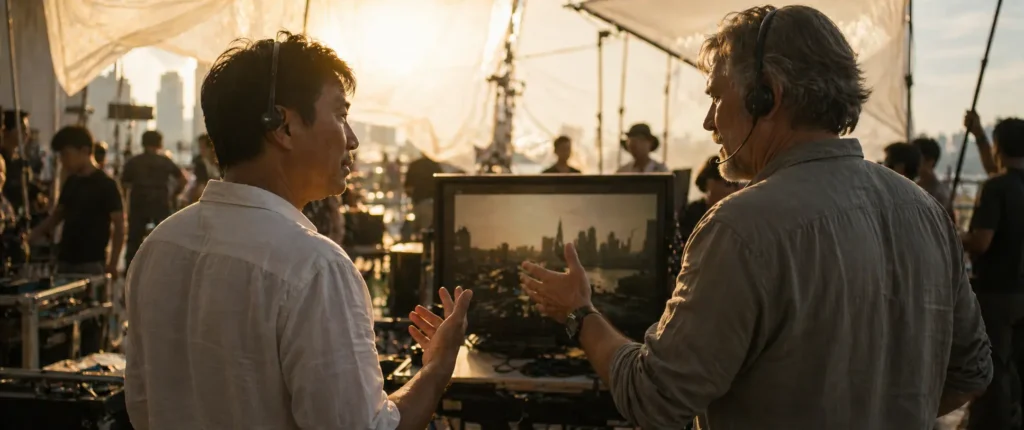
Why Thailand filming locations work for international productions
Thailand filming locations have anchored international productions for over five decades — from spy capers in the 1970s to streaming-era prestige drama today.
Moreover, the country offers an unusual combination that producers need: a wide range of looks within short driving distance, a deep bilingual crew base, and a working incentive framework that the Thailand Film Office administers.
In addition, the logistical chain — visa, equipment, customs and post — has been stress-tested by decades of foreign units passing through.
Specifically, the geography itself does most of the work. Bangkok offers dense urban texture and a working river. The central plains hold three former kingdoms and the country’s largest accessible national park.
Furthermore, the north climbs into highland valleys and Lanna-period temple architecture. Meanwhile, the northeast opens into Khmer-era temple complexes and the Mekong corridor.
Finally, the south breaks into limestone karsts, primary rainforest and undeveloped islands on two seaboards. Notably, most sites sit within a single travel day from Bangkok.
This guide collects 25 sites that international productions consistently return to, organised by region. Indeed, the under-photographed sites often lift a production above the visual register of competitor work.
How we organised this guide by region
We group locations by region: Bangkok and the river corridor, central Thailand, the north, the northeast (Isaan), and the southern Andaman, Gulf and eastern Gulf islands.
Specifically, each entry covers what the location offers visually, the permit and access route, and the practical constraints producers should account for at scout stage.
However, none of the entries below replace a recce. For example, schedule, weather window, security overlay, sound profile and vehicle access all need on-the-ground confirmation before a shoot day is committed.
We cover that in our service work — see our production service page for how that engagement runs.
Bangkok and the river corridor: five urban Thailand filming locations
Iconic riverside Thailand filming locations in Bangkok
1. Chao Phraya River and the temple skyline. The Chao Phraya is Bangkok’s spine and one of the most photographed Thailand filming locations on the river system.
Specifically, longtail boats, rice barges and cross-river ferries give a working waterway alongside the temple skyline of Wat Arun, Wat Pho and the Grand Palace approaches. Notably, the light shifts hour by hour: matte gold at sunrise, glassy haze at midday, saturated violet at blue hour.
TFO coordinates permits through the river authority and the relevant temple offices. Furthermore, producers must plan boat units, drone permissions and pier access together rather than in sequence.
2. Yaowarat (Chinatown). Yaowarat condenses neon signage, street kitchens, narrow shop-houses and dense pedestrian flow into a few square blocks.
Indeed, it is one of the few locations where atmosphere, action and food culture share the same frame. Night shoots benefit from the practical neon, but the area only fully animates after dark.
In contrast, daytime alleys (Sampeng Lane and the gold-shop strip) offer a quieter graphic look. Importantly, vehicle access tightens on weekends; therefore, producers should plan parking, generators and crew movement around tuk-tuks rather than fighting them.
Hidden corners of the city
3. Bang Krachao — Bangkok’s green peninsula. Bang Krachao is an oxbow of the Chao Phraya kept as protected farmland and forest, twenty minutes from Sukhumvit by road and ferry.
Specifically, coconut groves, raised wooden walkways, lotus ponds and a small floating market sit inside Bangkok’s southern administrative line. As a result, producers use it for jungle and rural-village beats without travelling to a different province.
However, most pathways are single-bicycle width, so larger crews break into smaller units. Notably, permits run through the Phra Pradaeng district office rather than the national-park route.
4. Sathorn Unique Tower and the city’s vertical decay. The unfinished Sathorn Unique high-rise stands as one of Bangkok’s signature graphic sites — a 49-storey concrete shell on the river, frozen mid-construction since the 1997 financial crisis.
On camera, it reads as urban decay, post-apocalyptic, dystopian sci-fi or psychological drama. However, access is private and intermittently restricted; the owner’s representatives coordinate permission directly.
In addition, safety planning, harness rigging and lighting power are non-trivial, but the building rewards productions that take it seriously.
Day-trip rail location outside Bangkok
5. Maeklong Railway Market — the train-through-the-stalls shot. At Maeklong, an active commuter line runs through a wet market eight times a day.
Specifically, vendors fold their canopies and slide their stock back as the train passes, then re-deploy in seconds. Indeed, it is one of the most identifiable rail compositions in the country and reads instantly as Southeast Asia.
Therefore, frame planning has to align with the published rail schedule. In addition, safety officers from the State Railway of Thailand sit with the unit during shoots. Generally, smaller crews are easier to choreograph here than full feature units.
Central Thailand filming locations: five sites between sea and forest
Historical-park Thailand filming locations of the central plains
6. Ayutthaya Historical Park. Ayutthaya served as Siam’s capital from the 14th to the 18th century and now functions as a UNESCO archaeological park north of Bangkok.
Specifically, the brick stupas, the Buddha-tree heads at Wat Mahathat, and the open horizon make it one of the most cinematic period sets in the country.
However, drone work follows separate regulation; ground productions must coordinate with the Fine Arts Department through TFO. Notably, daylight peaks from October to February.
7. Lopburi — Khmer towers and the macaque town. Lopburi sits two hours north of Bangkok and earns its reputation from the Khmer-era prang towers and the resident macaque population that has colonised them.
As a result, producers seeking stylised period architecture without the tourist density of Ayutthaya often work here. However, the monkey logistics are real: dressing rooms, lenses and craft service all need physical protection.
Furthermore, coordination splits between the Fine Arts Department for the ruins and the municipal authorities for road closures. Indeed, the look is unmistakable on screen.
Jungle and waterfall sites in central Thailand
8. Kanchanaburi — River Kwai, Erawan Falls and the jungle road. Three hours west of Bangkok, Kanchanaburi pairs the historical River Kwai bridge with deep limestone valleys, teak forest and the seven-tier Erawan Falls.
Indeed, productions can shoot war-period drama, period road movies and jungle adventure inside one travel day. Specifically, the Erawan and Sai Yok national park offices issue permits through TFO.
In addition, river-based work requires longtail and craft-services support; meanwhile, the upper falls require a reasonable hike with hand-carried gear.
9. Khao Yai National Park. Khao Yai is Thailand’s first and largest national park, on the Korat plateau three hours northeast of Bangkok.
Specifically, open savannah, evergreen rainforest, multi-tier waterfalls and resident gibbon, hornbill, deer and elephant populations sit inside one boundary. Therefore, for wildlife and jungle work within studio-day reach of Bangkok, it stands as the default.
However, the park enforces dawn-to-dusk gate hours and a pre-approved unit-size limit. In addition, producers run animal action through wrangler partners; importantly, wild-population shooting remains observational only.
Coastal central Thailand and the upper Gulf
10. Khao Sam Roi Yot and Phraya Nakhon Cave. On the upper Gulf coast south of Hua Hin, Khao Sam Roi Yot forms a coastal-karst national park.
Notably, its signature site holds a small royal pavilion that catches a single shaft of midday sunlight through a sinkhole — indeed, one of the most distinctive natural sets available.
However, visitors reach the cave on foot via beach and ridge trail; therefore, crews pack gear accordingly. In addition, light hits the pavilion for roughly an hour mid-morning; consequently, producers build shot lists around that window.
Northern Thailand filming locations: five sites in the highlands
Lanna-period Thailand filming locations of the north
11. Chiang Mai Old City and Lanna temples. Chiang Mai’s Old City forms a moated square of Lanna-period temples, monasteries and traditional teak architecture in the foothills of the northern range.
Specifically, Wat Phra Singh, Wat Chedi Luang and the surrounding lanes give a quieter visual register than Bangkok — saturated saffron, weathered teak, slow pedestrian rhythm.
In addition, permits run through the city office and the individual temple committees. However, November to February remains the workable window; in contrast, late February through April is burning season and air clarity falls sharply.
12. Chiang Rai — Wat Rong Khun and the Black House. Chiang Rai sits at Thailand’s northern tip and centres on two contrasting contemporary art-temple complexes: Wat Rong Khun (the white temple) and Baan Dam (the black house).
Notably, both are working artist sites, both photograph as graphic, near-monochrome compositions. However, Wat Rong Khun closes to visitors during shoots, which limits production windows.
In addition, both sites enforce strict respect protocols; therefore, talent wardrobe and direction need pre-clearance with the artist’s foundation. Indeed, the drive in from Chiang Mai is itself a road-movie asset.
Highland-route locations and remote valleys
13. Pai — mountain town, hot springs and canyon. Pai is a small town in a high valley three hours northwest of Chiang Mai.
Specifically, bamboo bridges, rice terraces, hot springs, the Pai Canyon’s clay ridgeline and a single-street centre make it a self-contained set for road-movie, indie drama and music-video work.
However, the road in totals 762 curves; therefore, vehicle planning is part of the schedule. Notably, cool-season nights drop into single-digit Celsius — producers must specify wardrobe and crew comfort accordingly.
14. Mae Hong Son loop. The Mae Hong Son loop is the 600-kilometre highland route from Chiang Mai through Pai, Mae Hong Son town, Mae Sariang and back.
Specifically, it crosses ethnic Karen, Lisu and Lahu communities, hilltop morning-mist viewpoints and unpaved spurs into untouched valleys. Therefore, for productions that need genuine highland scenery rather than dressed sets, the loop stands as the country’s strongest asset.
However, travel times are real — aim for one or two villages per shoot day at most. Notably, resident fixers mediate cultural protocols with each community.
Sukhothai and the older kingdom
15. Sukhothai Historical Park. Sukhothai was the seat of the first independent Thai kingdom from the 13th to the 14th century and predates Ayutthaya by over a hundred years.
In contrast, its UNESCO park feels more dispersed, less crowded and architecturally distinct — slimmer chedi profiles, walking-Buddha forms, lotus-pond compositions.
As a result, producers looking for period sets with fewer tourist plates than Ayutthaya often choose Sukhothai. Specifically, the park splits into three zones (central, north, west) and bicycle-mounted fixers help compress recce time.
Northeast Thailand filming locations: four under-the-radar sites in Isaan
Khmer-era Thailand filming locations in Isaan
16. Phanom Rung — Khmer temple on a volcanic ridge. Phanom Rung is an 11th-century Khmer-era sandstone temple complex on the rim of an extinct volcano in Buriram.
Notably, it predates Angkor Wat’s main temple and holds an east-west axis that aligns with the rising sun on four days a year. Indeed, for grand civilizational-scale period work, it stands as the strongest site in the northeast.
Specifically, the Fine Arts Department staffs the site; producers schedule permitted shoots outside peak tourist hours. However, the drive from Bangkok runs five to six hours one way.
17. Sam Phan Bok — the “Grand Canyon” of Thailand. Sam Phan Bok is a sandstone river bed in Ubon Ratchathani that emerges during the dry season as the Mekong drops several metres.
Specifically, three thousand wind-and-water-eroded basins (“bok”) give a near-monochrome geological set with no comparable equivalent in the country. Indeed, visitors photograph it only from December through April.
Furthermore, cross-border sightlines into Laos require coordination with the river authority. Notably, Khong Chiam serves as the access point, where local longtail operators provide on-water unit support.
Mekong corridor and rural Isaan
18. Mekong River corridor — Nong Khai to Loei. The Mekong forms Thailand’s northeastern border with Laos for hundreds of kilometres.
Specifically, the stretch from Nong Khai west through Sangkhom and Pak Chom into Loei province includes river bluffs, fishing villages, monastic communities and the seasonal Bang Fai Phaya Nak (“Naga fireball”) phenomenon.
Indeed, this corridor offers the longest unbroken sense of pre-tourist Southeast Asia. However, drone permission and cross-border framing need clearance in advance. Furthermore, provincial fixers replace national-park procedure for most municipal sites.
19. Nan Province — rural fields, traditional architecture, low traffic. Nan is a quiet eastern-foothill province near the Laos border that mass tourism often skips.
Specifically, wooden Lanna-style temples (Wat Phumin’s interior murals), terraced rice fields at Pua and Bo Kluea’s centuries-old salt wells give producers genuinely under-photographed plates.
However, the drive north from Chiang Mai takes six hours; in contrast, flights into Nan Nakhon airport simplify scheduling. Notably, local crew capacity stays limited, so heads of department travel up from Bangkok or Chiang Mai with the unit.
Southern Thailand filming locations: six sites in islands and rainforest
Andaman karst Thailand filming locations
20. Krabi and Railay. Krabi province on the Andaman holds the country’s best-known limestone-cliff-and-longtail-boat compositions.
Specifically, Railay’s two beaches, Phra Nang Cave’s interior beach, the Hong Islands’ inner lagoons and the broader Krabi mainland coastline offer some of the most internationally recognised sets.
Therefore, boat-based units, swing-tide planning and weather windows define the schedule; the wet season (May to October) compresses possible days. In addition, local fixers manage longtail captains, drone permissions and the marine national-park office in parallel.
21. Phang Nga Bay. Just north of Phuket, Phang Nga Bay’s vertical karst islands rise straight out of shallow water — including the spire often called James Bond Island.
Notably, the bay sits inside a marine national park, which constrains drone and aerial work but rewards it visually. Indeed, among coastal sets, nothing else in the country approximates the geometry.
Specifically, producers use Phuket as the unit base and shuttle to the bay each day by speedboat or longtail. As a result, the dry-season window from November to April gives the workable shoot calendar.
Rainforest interiors and southern islands
22. Khao Sok National Park — Cheow Lan Lake. Khao Sok in southern Thailand contains some of the oldest evergreen rainforest in the world along with the Cheow Lan reservoir.
Notably, 300-metre limestone karsts ring the reservoir, while floating raft houses dot its surface. Indeed, as rainforest-and-water sets go, it stands as the country’s most cinematic.
Specifically, floating accommodation lets units shoot dawn over the karsts without travel time. Furthermore, the dry months from December to April give clearer water and better helicopter visibility.
23. Trang and the southern Andaman (Koh Mook, Emerald Cave). Trang province sits below Krabi on the Andaman and offers quieter, less-shot island scenery.
Specifically, Koh Mook’s Emerald Cave is a tidal sea-cave whose interior beach you reach by swimming through an 80-metre tunnel at low tide. Indeed, this stretch stands strongest for productions wanting Andaman-look without Phi Phi traffic.
However, tide-timing windows are narrow; therefore, safety divers, action-vehicle support and underwater rigging need local coordination. Notably, Hat Yai is the nearest air hub.
Eastern Gulf islands and the royal coast
24. Koh Kood and Koh Mak. Off Trat province in the eastern Gulf, Koh Kood and Koh Mak remain among the least-developed populated islands in Thai waters.
Specifically, coconut palms reach the tideline, the reefs work as dive sites and the road network stays light. Therefore, these stand as the strongest eastern sites for a “first contact with paradise” register.
However, the trade-off is logistics: speedboats and ferries from Trat operate on a daily timetable, generators and lighting arrive by barge, and call sheets accommodate boat windows. Notably, off-monsoon months (November to April) carry the workable schedule.
25. Hua Hin and the royal coast. Hua Hin sits on the upper Gulf three hours south of Bangkok and remains the country’s original royal seaside town.
Specifically, Maruekkhathaiyawan Palace — a teak Riviera-influenced summer pavilion on stilts — gives producers a refined period look without leaving the highway corridor.
In addition, the seaside town itself, the railway station, the pineapple plantations inland and the cliffs at Khao Takiab round out the area. Notably, Hua Hin sits closer than the southern islands and stays more controllable than Bangkok.
Permits, seasons and logistics for foreign productions
How the permit chain works
Most foreign productions need to engage a Thailand Film Office-registered production service company.
Specifically, the TFO handles the central permit application for filming on government land — national parks, historical parks, royal coastlines, the river system — and coordinates with the relevant ministries on the producer’s behalf.
In addition, municipal and private-land permits run on parallel tracks. Therefore, producers should treat the permit chain as a workstream that begins at the bid stage, not after greenlight.
Seasonal windows by region
The dry season (roughly November to April) forms the dominant shoot window for outdoor work, and the southern Andaman dry window runs slightly longer than the Gulf.
Specifically, the cool-dry months from late November through February give the strongest light, the lowest humidity and the best haze profile.
However, the northern burning season (late February through April) drops air clarity sharply on wide-shot work in Chiang Mai and Chiang Rai.
Equipment imports, visas and reference links
Foreign units generally handle equipment import through ATA Carnet via the relevant chamber of commerce and the Thai customs authority — see the International Chamber of Commerce ATA Carnet system for the underlying mechanism.
In addition, foreign cast and crew apply for visas under the Non-Immigrant M (Media) category. We cover the application chain in detail in our Thailand film permit guide and the financial-incentive layer in our Thailand film incentive 2026 guide.
Furthermore, producers should confirm any current public-land or environmental restrictions with the relevant park authority directly before locking a shoot date — published rules at tfo.dot.go.th update from time to time.
How Overgrown handles location scouting and recces
Our recce process
We built our process for productions where the location call sheet has to survive contact with weather, tides, permits and traffic.
Specifically, we run an initial desk scout against the production’s brief, then a physical recce with the relevant heads of department — typically director, DoP, production designer and 1st AD — across the shortlist.
In addition, we deliver recce output as a structured document with reference plates, sun-path notes, sound profile, vehicle access, unit-base proximity, accommodation options and the permit chain mapped against the shoot calendar.
For a fuller view of how the engagement runs end to end, see our production service page.
Our internal location library
For productions returning to a location we have worked before, we re-confirm rather than re-scout.
Furthermore, our internal library covers the 25 sites above and several hundred others, including private-land options that do not appear on tourist maps.
Notably, the library reads as producer-ready: shot-frame examples, lens recommendations and known constraints sit alongside contact and access detail.
Thailand filming locations: frequently asked questions
General production questions
Do international productions need a local production service company in Thailand?
Yes, for most use cases. Specifically, registered Thai production service companies administer the TFO permit framework, and customs, work-permit, location-fee and crew-payroll workflows all run through a local entity.
However, foreign-only crews can shoot promotional or news content under narrower channels; in contrast, feature, episodic and commercial work effectively requires a local partner. For a deeper view, see our Thailand film permit guide.
What is the best season to shoot in Thailand?
November through February forms the strongest single window for nationwide outdoor work — cool, dry, low haze, predictable light. In addition, the southern Andaman dry window extends through April.
However, May to October brings monsoon season; therefore, productions can still shoot but schedule contingency rises sharply.
How long does location permit approval take?
Timelines vary by jurisdiction and site. Specifically, national-park, historical-park and royal-property permits run through the slower channels and should start as early as possible after greenlight.
In contrast, municipal and private-land permits typically move faster. Therefore, we confirm the realistic window for your specific shortlist at recce stage rather than quote a generic figure.
On-the-ground logistics questions
Can drones be used at Thailand filming locations?
Drone work follows separate regulation from ground filming. Specifically, operators must hold the relevant Thai aviation registration, and many national-park and royal-property sites enforce additional altitude or no-fly conditions.
Therefore, we coordinate drone permissions in parallel with the principal permit chain.
Are these locations open year-round?
Most are. However, national parks may close specific zones seasonally for ecological recovery, marine parks may restrict access during monsoon, and individual temple sites may close for religious observances.
Therefore, we confirm current status against your shoot dates at scheduling stage.
What does a typical recce trip cover?
For a feature or episodic production, a typical recce runs five to eight days across the shortlisted regions, with director, DoP, production designer and 1st AD on the unit.
Specifically, output includes a structured location document, a sun-path and tide schedule, a permit-chain map and a draft shoot-day pattern that the production can budget against.
Plan your Thailand filming locations recce
If you are scoping a feature, episodic, commercial or branded project against any of the sites above, our Bangkok office can scope a recce, confirm permit-chain timing for your shortlist, and quote a service budget against your shoot calendar.
Reach the line producers and location department directly at info@overgrownproductions.com. Bring the brief, the dates and the shortlist; in turn, we will come back with the practical view.