
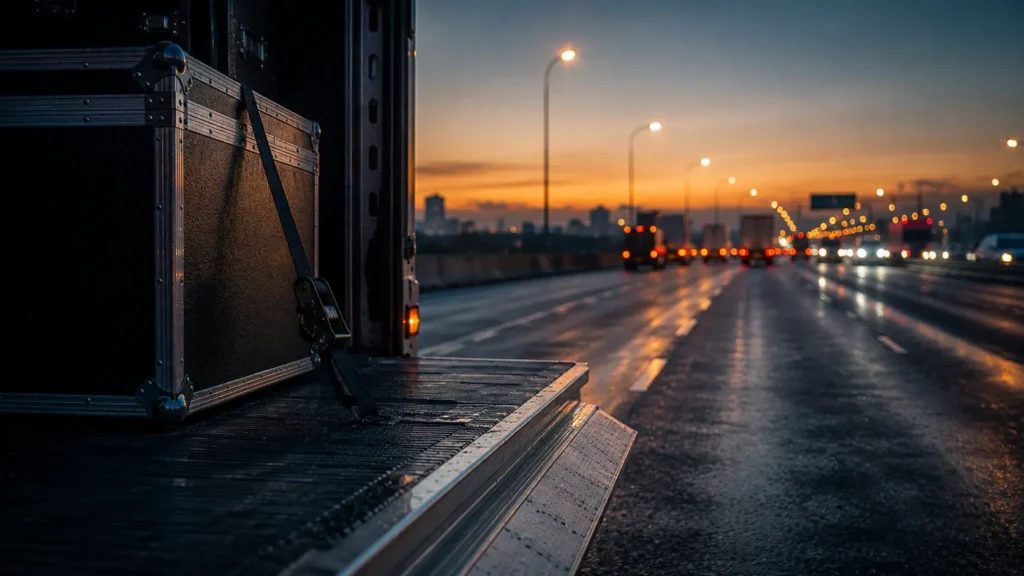
Production transport in Thailand is the quiet line item that decides whether a schedule holds. Foreign productions spent roughly THB 4 billion here in the first half of 2026 across 302 registered productions, and that volume puts real pressure on a finite pool of camera cars, low loaders, generator trucks and experienced unit drivers.
Most international producers arrive with the crew and kit questions answered and the movement questions open. How does a full package get from Bangkok to Krabi? What fits on the Koh Samui vehicle ferry? When does domestic air freight beat eleven hours of road? This guide sets out how production transport in Thailand works from the operating side, for producers building a schedule they intend to hold.
What production transport in Thailand actually covers
Production transport in Thailand is not one budget line. On a typical foreign shoot it splits into six streams, each with its own lead time and its own failure mode.
- Unit moves: the whole company relocating between bases — the single most schedule-sensitive movement on any Thai shoot.
- Daily crew transfers: hotel to location and back, usually vans and minibuses, sized to department call times rather than headcount.
- Kit trucks: camera, lighting, grip, art and wardrobe, each department typically wanting its own tail-lift vehicle.
- Picture vehicles: anything appearing on camera, plus the tow and tracking rigs that shoot them.
- Support vehicles: generator, water, honeywagon, catering, medical and production office.
- Talent and client cars: separate from crew transport, and usually the first thing a client notices.
Geography is what makes production transport in Thailand distinct. The country runs roughly 1,600 kilometres north to south, with a road-connected mainland, a long peninsula, and islands reachable only by boat or a constrained regional airport. A plan that works for Chiang Mai fails outright for Koh Tao.
Road: the backbone of production transport in Thailand
Road is the default and, for most schedules, the correct default. The national highway network is good, fuel and service coverage is dense, and a full camera, lighting and grip package can travel by road from Bangkok to the majority of shooting provinces without touching a freight terminal or a carnet officer.
Realistic one-way drive times from Bangkok, for a loaded truck rather than a car, run broadly as follows. Kanchanaburi and Khao Yai sit at roughly three hours. Hua Hin is similar. Ayutthaya and Lopburi are under two. The Isaan hubs of Khon Kaen and Korat range from four to seven. Chiang Mai and the far north are an overnight run of nine to twelve. Krabi, Phuket and the southern peninsula are eleven to fourteen and should be treated as a two-driver movement.
Two constraints shape every road plan. Bangkok restricts heavy vehicles in inner zones during daytime hours, which pushes kit trucks onto night departures and makes the first move of a shoot a 2 a.m. call. And road distance is a poor proxy for time — a provincial route through market towns runs at half the speed of a motorway leg of the same length. Build unit moves off tested drive times from a recce, not from a mapping app.
Our location scouting in Thailand recces time the vehicle route as well as photographing the site, because a location that is perfect and ninety minutes further out than assumed costs a scene.
Air freight and charter: when the cost earns itself
Domestic air moves people well and freight only sometimes. Thailand has a dense regional airport network — Chiang Mai, Chiang Rai, Phuket, Krabi, Surat Thani, Udon Thani, Khon Kaen, Ubon Ratchathani — and moving department heads and talent by air while the kit travels overnight by road is the standard hybrid that most foreign schedules land on.
Air freight earns its cost in three situations: a time-critical replacement, a remote base where the road leg would consume a full shoot day each way, or a compressed schedule where a truck cannot be in two provinces on consecutive mornings. Against that, cargo holds impose real limits. Lithium batteries, compressed gas, pyrotechnic material and certain fluids are restricted or prohibited on passenger aircraft, and camera batteries need declaring and packing to carrier specification. Confirm the rules with the operating carrier for the specific aircraft — they differ between airlines and between passenger and freighter services.
Charter is worth pricing when a remote unit would otherwise lose two travel days. It is rarely the cheap answer and frequently the correct one. Koh Samui’s airport is privately operated with limited slots and its own freight handling arrangements, so Samui air movements need planning earlier and with more contingency than any other Thai airport. Kit arriving from overseas is a separate process, covered in our guide to importing film equipment into Thailand.
Sea: moving a unit onto the islands
The islands are where production transport in Thailand stops being routine. Phuket is road-connected by bridge and behaves like a mainland province. Everything else in the Gulf and the Andaman requires water.
Vehicle ferries run to Koh Samui and Koh Phangan from the Surat Thani coast and carry trucks, but on published schedules with finite deck space and weight limits a loaded generator truck can exceed. Booking a ferry slot for a five-tonne vehicle is not the same transaction as a passenger crossing, and not something to attempt in the week of the move. Smaller islands and marine park sites are served by longtail, speedboat or chartered landing craft — and a landing craft is the only practical way to put a generator or a heavy grip package on a beach with no pier.
Sea state governs all of it. The Andaman and the Gulf have opposing weather windows, and a crossing that is a routine forty minutes in the dry season becomes a cancelled day in a swell. Every island schedule needs a weather contingency day per crossing, not per shoot. Our location guides for Koh Samui, Krabi and Phuket cover the access position for each, and marine park access carries its own permit route set out in our guide to national park filming in Thailand.
The vehicle list behind production transport in Thailand
A mid-scale foreign shoot typically books from the following. Sizes are indicative; the local market runs on Japanese and European chassis rather than the American vehicles a US-based UPM may be budgeting from.
- Crew vans: ten to fourteen seats, air-conditioned, the standard unit of crew movement.
- Minibuses and coaches: for background artists and large crew moves, particularly on period and crowd days.
- Tail-lift box trucks: three to seven tonnes, the workhorse for department kit.
- Ten-wheel trucks: for set build, large lighting packages and art department strikes.
- Low loaders and flatbeds: for picture vehicles, plant and process rigs.
- Generator trucks: sized to the lighting order, with fuel bowser where the base has no re-supply.
- Honeywagon, water and dressing units: available, though the market is thinner than in Europe or the US and needs booking early.
- Four-wheel drive: essential for jungle, hill and off-piste coastal access, and routinely under-ordered by productions working from photographs.
Specialist and heavy items book out first in the December to February window. Order production transport in Thailand at the same time you lock crew and equipment, not after.
Picture vehicles, camera cars and process trailers
Thailand supports vehicle work at international standard, but the specialist end of production transport in Thailand is genuinely finite. Arm cars, tracking vehicles, process trailers and precision drivers exist in single-digit quantities nationally. Two productions wanting the same rig in the same fortnight is a scheduling collision, not a procurement problem, and no amount of budget resolves it late.
Right-hand drive is the local standard, which matters if the script requires left-hand-drive picture cars — those are sourced, imported or converted, all with lead time. Precision driving, tow rigs and any sequence involving speed on a public road pull in road closure and police coordination, covered below. Our car commercial production page sets out the automotive workflow in detail, and the Lollipop Racing series is our own reference for sustained motorsport and vehicle-led shooting in Thailand.
Generators, fuel and restricted loads
Power travels with the unit on most Thai locations outside a studio. Mains supply at beaches, temples, jungle sites and provincial exteriors is absent or unsuitable for a lighting package, so the generator truck is a standing part of the convoy rather than an exception.
Three things follow. Fuel logistics need planning where the base is more than a short run from a filling station, particularly on islands and in national parks. Bulk fuel handling is a specialist arrangement rather than something a general transport quote covers, so raise it with the supplier at the point of order. And noise is a location constraint — a blimped generator or a longer cable run is often the difference between clearing a residential or temple location and being asked to stop.
Where a location cannot take a generator at all, the alternatives are battery-based lighting, a longer run from a negotiated mains tie-in, or moving the setup. All three are cheaper to solve at recce than at 6 a.m. on the day.
Drivers, hours and on-set vehicle safety
Unit drivers are crew, not a commodity. An experienced Thai unit driver knows which provincial routes take trucks, where a turning circle fails, and how to hold a convoy together across a two-hundred-kilometre move — in a second language. That capability is not interchangeable with a general hire driver, and rate cards reflect it.
Driver hours are a live safety question on any long-move schedule. Overnight kit runs followed by a full shooting day are a familiar pattern and a poor one. We build in relief drivers for any leg over roughly six hours, and treat driver rest as an immovable part of the schedule in the way you would treat crew turnaround.
Vehicle insurance, passenger cover and any stunt or precision driving element should be confirmed against the production policy rather than assumed to sit inside the transport supplier’s cover. Our guide to production insurance in Thailand covers how those policies are structured.
Permits, road closures and police coordination
Filming on a public road, closing a lane, running a convoy through a controlled area or working with speed all move production transport in Thailand from a logistics question to a permitting one. Road use sits with provincial and municipal authorities and, for highways, with the relevant traffic police — coordination that runs in parallel with, not inside, the main film permit.
In practice the transport plan and the permit application are the same document at an early stage. A shoot that assumes it can close a Bangkok street on two weeks’ notice has mis-planned. Our Thailand film permit guide sets out the full route through the Thailand Film Office, including the government coordinating officer requirement that applies to foreign productions. Vehicle and oversize-load requirements sit with the Department of Land Transport and should be confirmed for the specific load and route.
Costing production transport in Thailand
Production transport in Thailand is usually quoted per vehicle per day with the driver included, plus fuel, tolls and — for out-of-Bangkok work — driver accommodation and per diem. That structure is straightforward. The overruns are almost always in what sits around it.
- Deadhead legs: a vehicle returning empty to Bangkok is a chargeable day and is regularly missed in first-pass budgets.
- Standby days: vehicles held on a weather cover day still cost.
- Ferry and marine charges: priced by vehicle weight and length, not by headcount.
- Tolls and route charges: minor individually, material across a long southern schedule.
- Overnight and split-shift premiums: triggered by the same night-running that Bangkok restrictions force on you.
- Contingency crossings: the second boat when the first is cancelled.
How transport is contracted and invoiced matters beyond the transport budget itself, so agree the paperwork structure at the point the deal is set rather than in post. See our guide to the Thailand film incentive and rebate for foreign productions for how local expenditure is treated, and our breakdown of film production costs in Thailand for how transport sits against the wider budget.
How weather and season reshape production transport in Thailand
Season affects movement more than it affects shooting. The cool dry window from roughly November to February is the peak, which means the best road conditions and the worst availability — specialist vehicles and senior drivers book out months ahead.
The wet season brings three problems rather than one. Provincial and unsealed routes degrade, adding time to legs that tested cleanly at recce. Marine crossings become unreliable, and the Andaman and Gulf coasts do not share the same bad months. And localised flooding can close a route on the day, which is a contingency question for the transport plan rather than a general weather concern. Our guide to the best time to film in Thailand sets out the regional windows in detail.
How we handle production transport in Thailand
We treat production transport in Thailand as a planned department from prep, not a booking made once the schedule is locked. The transport plan is built alongside the shooting schedule, tested on the recce with real drive times, and priced with the deadhead legs and contingency crossings visible rather than discovered.
On Contra, our US feature shot across Bangkok in 2025, that meant a movement plan built around inner-city vehicle restrictions and daily unit moves between locations in a congested city. On Lollipop Racing it meant sustained vehicle and tracking work across multiple provinces. Both ran on the same principle: transport is a scheduling function first and a procurement function second.
As a Thailand Film Office-registered production service company, we contract transport locally, coordinate road and location permissions through the same channel as the film permit, and provide a bilingual English-Thai transport team, so the instruction given on set is the instruction the driver receives. Our film fixer service in Thailand covers how that fits alongside crew, permits and locations, and our full production service covers end-to-end delivery.
Frequently asked questions
How far in advance should a foreign production book transport in Thailand?
Standard crew vans and box trucks can usually be secured four to six weeks out. Specialist vehicles — low loaders, arm cars, process trailers, honeywagons and larger generator trucks — should be committed at the same time as key crew, which in the November to February peak means several months ahead. Availability, not price, is the binding constraint on production transport in Thailand in peak season.
Can film equipment trucks reach Thai islands?
It depends on the island. Phuket is road-connected by bridge and takes trucks directly. Koh Samui and Koh Phangan are served by vehicle ferries from the Surat Thani coast with published schedules, finite deck space and weight limits. Smaller islands and marine park sites need chartered landing craft or boat transfer with a hand-carry package. Confirm the specific weight and dimension limits for the vessel and the load before scheduling.
Is it faster to fly kit domestically or drive it?
For most Thai schedules, driving. Road is cheaper, avoids cargo restrictions on batteries and pressurised items, and keeps the package intact under the care of the department that owns it. Air freight is worth it where a road leg would consume a full shoot day each way, where a replacement is time-critical, or where the schedule requires the same package in two distant provinces on consecutive mornings.
More questions about Production Transport in Thailand
Do you need a permit to film on a public road in Thailand?
Yes. Filming on a public road, and any lane closure or traffic management, requires coordination with provincial or municipal authorities and, for highways, the relevant traffic police. This runs alongside the main film permit rather than inside it, and lead times are longer in central Bangkok than in the provinces. Our Thailand film permit guide sets out the full route.
Are left-hand-drive picture vehicles available in Thailand?
Thailand is a right-hand-drive market, so left-hand-drive picture cars are a special order — sourced, imported or converted, all with meaningful lead time and cost. Flag any left-hand-drive requirement at script breakdown rather than at the picture vehicle meeting.
What is the most common transport mistake on a Thai schedule?
Building unit moves off mapping estimates rather than tested drive times. A provincial route through market towns runs at roughly half the speed of a motorway leg of the same length, and a loaded truck is slower again than the car the estimate assumed. The second most common is ordering specialist vehicles late: low loaders, arm cars and process trailers are a scheduling constraint in peak season, not a procurement one.
Other questions about Production Transport in Thailand
How many contingency days should an island schedule carry?
Plan a weather contingency per crossing rather than per shoot. A schedule with three separate island movements carries more marine risk than one with a single transfer and a fixed island base, and the mitigation is usually to consolidate crossings rather than to add days at the end.
Who runs production transport in Thailand on a foreign shoot?
A local transport captain or transport coordinator working under the line producer, contracted through the Thai production service company. On foreign productions the transport team is bilingual by necessity — instructions pass between an English-speaking first assistant director and Thai-speaking drivers many times a day, and that handover is where schedules are won or lost.
Planning a Thai schedule
If you are a line producer or UPM building a Thailand schedule and want the movement plan pressure-tested before you lock dates, send us the script breakdown and the location shortlist. We will come back with tested drive times, the marine and air legs priced honestly, and a clear view of which specialist vehicles need committing now rather than later. Production transport in Thailand is straightforward when it is planned in prep and expensive when it is not. Our Bangkok team can be reached at info@overgrownproductions.com.