
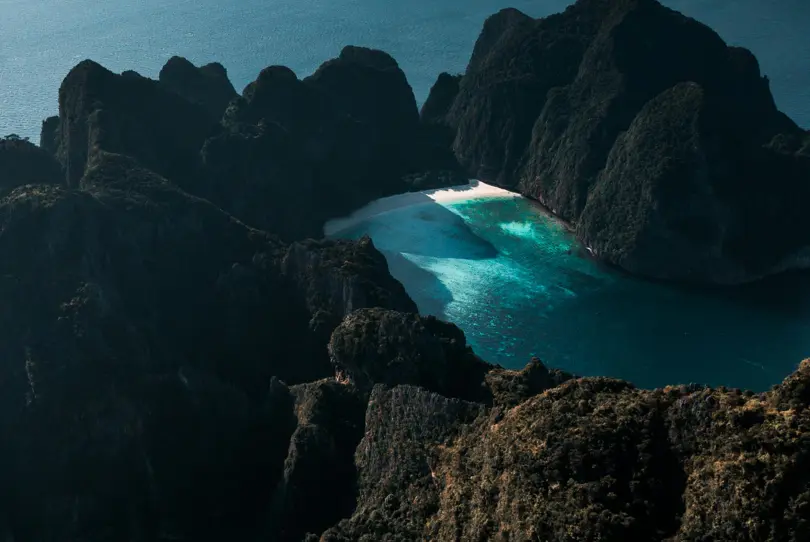
Filming in Thailand is rarely one decision. In fact it is roughly fifteen. They are taken in an order that either protects your schedule or quietly wrecks it. So this guide follows those decisions in the sequence a producer meets them. It starts with the first question we ask an incoming enquiry, and it ends with the last delivery item. It is written for the moment before you commit, when the script is locked and the country is still open.
On the numbers, the timing is favourable. Thailand’s Department of Tourism logged 302 international productions in the first half of 2026. Those carried 4.025 billion baht of declared investment. By category, feature films led on value, with 21 productions accounting for 1.989 billion baht. Advertising led on volume, at 152 productions. Meanwhile the United States remained the largest single source market, at 1.543 billion baht, followed by Hong Kong, Finland, Germany and the United Kingdom (Khaosod English, 10 July 2026).
There is also a diary reason to read this now. The Bangkok International Film Festival runs from 13 to 27 September 2026. In addition, a film market sits inside it on 22 to 24 September, drawing buyers from a range of countries. Between those dates come location visits, a studio tour, and a seminar on finding hidden Thai locations led by Hollywood location managers (Nation Thailand, 14 August 2026). Therefore, if you are weighing the country at all, that fortnight is an unusually cheap way to look at it.
What are you filming in Thailand, and at what scale?
In practice, every enquiry we answer starts here. Format and scale settle more downstream questions than location does, so we ask them first.
For example, a four-day commercial with a nine-person travelling team behaves nothing like a nine-week feature. Both are common when filming in Thailand. However, they use different permission routes, different crew structures and different equipment supply. To begin with, tell your Thai partner four things. First, give us the format, the shoot length, the travelling head count and the delivery date. After that, almost everything else can be answered in one call.
If the format is a feature, our guide to shooting a feature film in Thailand runs the same ground at feature depth. For a commercial, the commercial production route is shorter and faster.
Real place or controllable place: the first branch
Next comes the decision directors care most about. Does the story need a place that exists, or a place you can control?
A temple courtyard, a fishing village, a working market and a limestone bay all read as themselves. In contrast, a stage build reads as whatever you dress it as. Thailand supports both approaches well. Yet the two paths diverge early. A real location brings a permission chain and a weather risk. A build brings a construction lead time and a fixed budget line.
In practice, most productions end up mixed. For example, a series might shoot exteriors across two provinces, then hold interiors on a stage in Bangkok. If that is your shape, read Thai stage and soundstage capacity alongside location scouting. Where the build is heavy, set construction and art department becomes the long pole.
If the answer is coast, here is how the choice narrows
Coastal work when filming in Thailand splits along a single line: Andaman or Gulf. Because the two coasts run opposite weather patterns, the choice is partly a scheduling decision.
On the Andaman side, Phuket gives you an international airport, hotel stock and a crew base. Meanwhile Krabi gives you the limestone karst that most scripts are actually after. Further north again, Phang Nga and Trang hold quieter water. On the Gulf side, Koh Samui, Hua Hin and Pattaya trade some drama for far easier road access.
Beyond that, marine and island work adds layers. For instance, national marine parks sit under a separate authority. Boats also add a safety and insurance dimension. Our pages on underwater and marine units and national park filming cover both.
Highland and forest work behaves differently
However, move inland and the constraints change completely. Altitude, roads and daylight start to drive the plan.
Chiang Mai is the northern crew base, with a real technician bench and a functioning equipment supply. Beyond it, Mae Hong Son, Pai and Nan give you ridge lines, mist and hill villages. However, the driving hours climb steeply. To the east, Khao Yai puts forest and grassland within three hours of Bangkok, which is why it absorbs so much commercial work.
One caution about the north, though. February to April brings agricultural burning and a haze layer. As a result, it will flatten a long lens across a valley. Above all, do not plan a hero wide of a mountain range in March. Our seasonal guide maps this by region.
Key takeaway
Province choice is a schedule decision before it is a visual one. Pick the look first and you will fight the weather. Pick the window first and the look usually survives the move.
When Bangkok should be your base
For most productions filming in Thailand, Bangkok is the default answer, and for good reasons. Above all, the crew depth, the rental houses, the post facilities and the airport sit in one city.
As a result, a Bangkok base lets you run a unit that reaches Ayutthaya, Kanchanaburi and Khao Yai on day trips. Then you travel only for the sequences that genuinely need distance. In addition, the city itself carries range. It holds canal districts, old shophouse streets, towers and expressway interchanges. Our page on Bangkok production locations sets out the main environments.
Bangkok stops being the right base when your story lives in one distant province for more than about ten shooting days. At that point, the daily travel starts eating the schedule, so a local base wins.
How the season narrows your window for filming in Thailand
In general, Thailand runs three broad seasons. Even so, they do not fall at the same time everywhere.
November to February is the driest and coolest stretch across most of the country. Consequently it is also the busiest. Then March to May brings heat, and April is the hottest month by a wide margin. From roughly June to October the monsoon sits over much of the mainland. Yet the Gulf islands run an offset pattern, so they hold up later than the Andaman coast.
Rain here is usually short and heavy. Therefore a wet-season shoot is workable with a cover set and honest turnaround planning. By comparison, heat is the harder problem. Above all, build a real lunch break into a March or April call sheet. Crew performance falls off sharply after four hours in direct sun. The seasonal breakdown goes region by region, and it is the first page we send producers weighing dates for filming in Thailand.
Small unit or full crew: what changes above forty people
Meanwhile head count changes the shape of the job more than most producers expect. In short, three bands behave differently.
| Travelling and local head count | What it changes | Typical shape |
|---|---|---|
| Under 20 | Single vehicle convoy, no base camp, locations that would refuse a bigger unit | Documentary, small commercial, second unit |
| 20 to 40 | Base camp appears, catering becomes a department, road closures start to matter | Commercial, series block, small feature |
| Over 40 | Two ADs minimum, unit moves need their own plan, provincial liaison becomes a full-time role | Feature, streaming series, large campaign |
In our experience the jump from 40 to 60 is where most schedules slip. However, it is predictable. So plan the extra AD and the transport supervisor before you need them. Production transport covers the vehicle and driver side of filming in Thailand at that scale.
What travels with you and what you hire here
Similarly, this decision saves or costs more money than almost any other. In short, bring the people whose taste defines the film. Then hire the equipment.
| Usually travels | Usually hires locally |
|---|---|
| Director, DoP, production designer, lead cast | Camera bodies, lenses, lighting, grip |
| First AD on a complex feature | Second AD, third AD, set PAs |
| Specialist heads of department | Full art, costume, hair and makeup benches |
| Editor, if cutting on location | Trucks, generators, base camp, unit drivers |
Bangkok rental houses carry current large-format and anamorphic packages. Therefore a DoP arriving with a preferred lens set is usually able to match it here. Even so, confirm the specific glass early, because the popular sets book out during the November to February peak. See equipment rental and, if you are bringing kit, importing film equipment.
The permission chain, and the order it runs in
Every foreign production filming in Thailand applies through the Thailand Film Office, which sits under the Department of Tourism. In effect that approval is the spine. Around it sit the permissions each individual location requires.
Above all, the order matters. First, register the production. Then secure the site-level permissions, because a national approval does not by itself open a temple gate, a national park or a private estate. Finally, layer in the provincial and municipal contacts. Those cover anything involving roads, crowds or night work.
We do not publish a fixed approval duration, because it moves with the province, the season and the ask. What we do commit to is a named contact at every layer before a date is locked. Our Thailand film permit guide walks the process, and permit costs covers the money side.
Where filming in Thailand needs a second layer of permission
In practice, four categories reliably need more than the standard route. Moreover, each one has its own gatekeeper.
- Temples and religious sites: handled site by site, with conditions on framing, dress and behaviour. See filming in Thai temples.
- National parks and marine parks: a separate authority, with its own conditions on vehicles, drones and numbers.
- Heritage and archaeological sites: the Fine Arts Department, which matters in Ayutthaya and Sukhothai above all.
- Aerial work: drone and helicopter operations carry their own approvals. See aerial filming.
Also, each layer runs on its own clock. Consequently, the sequence in which you request them decides whether they stack or run in parallel. That is the single biggest lever a fixer has on your prep calendar.
Who leads your crew, and why the first AD matters
Crewing up for filming in Thailand starts from a deep technician bench. Camera, grip, electrical, art and costume departments here have worked to international standards for years. Many key crew are also bilingual.
Even so, the role we argue about most is the first AD, and our position is firm. Book a bilingual first AD, and book them before you lock locations. That person is the only one who will read a Thai location’s constraints and an English-speaking director’s intent in the same sentence. Even a brilliant travelling first AD without Thai will lose you time on a crowd day.
Below that line, the second AD running Thai-language instruction to background is what keeps a 120-person crowd day moving. Film crew in Thailand covers structure and rates. Similarly, casting covers cast and background.
Two languages on one call sheet
In general, most productions here run bilingual. The good ones plan for it in prep.
First, call sheets, risk assessments and safety briefings go out in both languages. Then heads of department speak English. Below that line, the working language shifts to Thai. Therefore the translation load falls on the ADs and the department seconds. For example, a lighting change explained once in English and once in Thai costs ninety seconds. The same change misunderstood costs a setup.
Finally, there is a labour dimension worth knowing about. In July 2026 the Labour Ministry said it was forming a joint working group with industry bodies. Its remit is to study whether formal working-hour standards should be introduced for film crews, after concerns about shifts running beyond sixteen hours (Nation Thailand, 5 July 2026). Parliament has enacted nothing yet. Still, the direction of travel is clear, so we already plan turnaround honestly on every production filming in Thailand with us.
The incentive question, and when to answer it
Separately, Thailand runs a cash rebate for foreign productions. The Thailand Film Office administers it under published criteria (Thailand Film Office). We do not publish rates or thresholds here. Those must be confirmed against the current criteria for your specific production.
What we can tell you is when to ask, and the answer is early. In short, ask before the budget hardens. In July 2026 the Deputy Prime Minister announced a review of the scheme after meeting Motion Picture Association executives. He said the direction was to weight support toward Thai employment and domestic supply chain value. However, the announcement changed no rates and set no timetable.
Because eligibility depends on how your spend is structured, the incentive shapes the budget. It does not simply refund part of it afterwards. Our incentive services page and the foreign producer’s rebate guide cover the application route. In addition, production accounting covers the audit trail it requires.
Key takeaway
Ask about the incentive during budgeting, never during prep. By prep, the spend structure that determines eligibility is already fixed. At that point the conversation becomes a reconciliation exercise instead of a planning one.
What moves the budget once you are filming in Thailand
In our experience four lines carry most of the variance. Only one of them is the crew rate.
Travel and accommodation for the arriving team moves first, because it scales with head count and shoot length together. Then unit moves come second. Every province change costs a half day at minimum, and two moves in one week will cost you a full one. Third is build, which is inexpensive here by international comparison. Its lead time, though, will not compress, and that is true anywhere in the country. Fourth is contingency, which producers cut first and regret most.
Crew and equipment are genuinely competitive here. Yet they are also the lines least likely to surprise you. Production costs in Thailand sets out the ranges. Similarly, the production timeline shows where the time goes.
Service company or fixer: choosing your partner
The words get used loosely. So here is the distinction we work to.
To begin with, a fixer solves problems in country. They open doors, find locations, handle a permit and put a small crew together. That is exactly right for a documentary, a news assignment or a compact commercial. In contrast, a full service company carries the whole production entity. It contracts crew, holds insurance, runs the accounting, files the incentive application and takes responsibility for delivery.
Choose on liability before you choose on price. Most producers filming in Thailand for the first time do the reverse, and then discover the gap. If your production needs a Thai entity to sign contracts, hold insurance and stand behind an incentive claim, a fixer arrangement will not cover it. Read the fixer guide and line producer services together. Also see production insurance for the cover side.
Deciding post and delivery before the shoot
In truth, delivery specification is a production decision disguised as a post one. Decide it before the first day.
Bangkok carries picture editorial, sound, colour and VFX finishing. Therefore a production can complete here if it wants to. Alternatively, many shoot here and cut at home. That works cleanly, as long as you agree the data workflow, the codec and the backup regime in prep. Above all, agree who holds the masters and where the archive lives.
So where a platform specification applies, work backwards from it. Post-production in Thailand covers capability. Meanwhile virtual production covers LED volume work, for anyone considering in-camera VFX.
What we advise against when filming in Thailand
Three things. We say them to nearly every production filming in Thailand for the first time.
First, do not lock a shoot date before the permission chain has a named contact at every layer. A date without contacts is a wish. Second, do not split a small unit across two distant provinces inside one week. The travel will consume the saving you thought you were making. Third, do not approve a location from stills alone.
Above all, that last one has a specific failure mechanism we see repeatedly. A director approves a location on beautiful photographs. Then it dies on the technical recce, because the access road cannot take a ten-tonne truck and a generator. The scout who shot those stills had arrived in a pickup. So our fix is procedural. Every location that will carry a full unit gets a technical recce with the transport captain present. No location goes on a schedule without one.
How Overgrown Productions handles filming in Thailand
We are a Bangkok-based, full-service international production partner. Moreover, we are registered with the Thailand Film Office as a production service company. Over fifteen years we have delivered more than 400 productions, for clients including Netflix, Vice, Al Jazeera, Reuters, the United Nations, Universal and Warner Music.
In practice, recent work runs across formats. For example, we produced the US chess thriller Contra in Bangkok. We also delivered the global motorsport series Lollipop Racing across multiple territories. In both cases our team held the permits, the crew contracts, the transport and the delivery.
Overall, our working method is the one this guide describes. We ask the four questions first. Then we build the schedule before the location list. After that, we run a technical recce on every full-unit location. We put a named contact against every permission. Finally, we handle permits through the Thailand Film Office, source bilingual crew, arrange visas and work permits, and manage set safety to international standards. Less-shot provinces with real production value include our Chiang Rai, Loei and Mae Hong Son guides.
Questions about cost, season and scale when filming in Thailand
How much does it cost to shoot in Thailand compared with Europe or Australia?
Below-the-line costs here are materially lower, and crew and equipment are the clearest savings. However, the gap narrows once you add travel and accommodation for a large arriving team. Our production costs page gives working ranges by department.
When is the best time of year to shoot?
November to February is driest and coolest across most of the country, and it is also the busiest. March to May is hot, with April the extreme. From June to October the monsoon sits over the mainland. However, the Gulf islands run an offset pattern.
How far ahead should we start planning?
For a commercial, six to eight weeks is comfortable enough. For a feature or a series block, start twelve weeks out at minimum. Start earlier still if you are applying for the incentive or building sets.
Can a small documentary crew work here without a full service company?
Yes. In general, a fixer arrangement covers a compact crew well. However, you will want a service company once you need a Thai entity to contract crew, hold insurance or file an incentive application.
More questions about permits, crew and delivery
Do we need a permit to film in Thailand?
Foreign productions register with the Thailand Film Office under the Department of Tourism. In addition, individual locations carry their own permissions. Temples, national parks and heritage sites each sit with a different authority. Our permit guide sets out the route.
Is the local crew good enough for a streaming-grade production?
Yes. In fact Thai camera, grip, electrical, art and costume departments have delivered platform-commissioned work for years, and many key crew are bilingual. Moreover, we staff to international department structures. See film crew in Thailand.
What visas do arriving crew need?
Foreign crew working here need the correct visa category, plus a work permit we arrange in advance. We process these for productions we service. Our crew visa page covers the documentation.
Can we complete post-production in Thailand?
Yes. In short, Bangkok carries picture editorial, sound, colour and VFX finishing to international delivery specifications. Many productions still cut at home, which works cleanly once you agree the data workflow in prep. See post-production in Thailand.
Talk to our Bangkok team before you lock the schedule
If you are a line producer, UPM or executive producer weighing Thailand for a 2026 or 2027 production, send us four things. Give us the format, the shoot length, the travelling head count and the delivery date. Then we will come back with a route through the decisions above. That includes the permission layers your locations will trigger, and the schedule shape we would recommend for filming in Thailand on your dates. Write to info@overgrownproductions.com, or use the contact page. If you are in Bangkok during the festival fortnight in September, we are happy to meet. Comparing regions before you commit? Start with our guide to Thailand filming locations.