
Why filming in Mae Hong Son rewards the journey
Filming in Mae Hong Son puts a production in the most remote and cinematic corner of northern Thailand — a mountain province on the Myanmar border where valleys fill with a sea of fog at dawn, pine-fringed lakes stand in for temperate Europe, and Shan and Karen culture gives a look that no other part of the country offers. It is a location for productions that want scale, altitude and atmosphere rather than convenience.
The trade-off is access. Mae Hong Son sits four to eight hours by road from Chiang Mai along a legendary switchback loop, and its small airport is weather-dependent. That distance is exactly why the province stays uncrowded and unspoilt on camera, and why it needs a service company that plans the logistics tail properly. This guide covers what is here, how to reach it, how permits work, and when to shoot.
The Mae Hong Son Loop: one road, a dozen looks
The province is defined by the Mae Hong Son Loop, the roughly 600-kilometre mountain circuit that runs from Chiang Mai through Pai, Pang Mapha, Mae Hong Son town, Khun Yuam and Mae Sariang before returning. It is famous for its curves — often cited at around 1,864 of them — and for the way the scenery changes hour to hour, from terraced rice valleys to cloud forest to open ridgelines.
For a location manager, filming in Mae Hong Son turns the loop into a moving backlot. A single travel day yields hairpin mountain roads for automotive and motorcycle work, misty forest for tone pieces, riverside villages, and long empty stretches with no power lines in frame. Our northern base near Chiang Mai makes the province a natural extension of a shoot there; the neighbouring town of Pai on the same route has its own draw, covered in our guide to filming in Pai.
Sea of fog: the province’s signature image
Mae Hong Son’s defining shot is the sea of clouds — a valley filled edge to edge with mist at first light, mountain peaks breaking through like islands. Pang Ung, a pine-ringed reservoir nicknamed the “Switzerland of Thailand,” is the postcard version, with bamboo rafts on still water and fog burning off through the trees. The viewpoints at Ban Jabo and Doi Mae U-Kho deliver the same phenomenon on a wider scale.
These are dawn locations with a short usable window, so shot lists are built backwards from the light. The fog is reliable in the cool months and effectively absent later in the year, which makes seasonality a creative decision here as much as a logistical one.
Ban Rak Thai and the Yunnanese highlands
Near the Myanmar border, Ban Rak Thai (formerly Mae Aw) is a Yunnanese Chinese tea-growing village at around 1,700 metres, with mud-walled houses around a small lake and tea terraces climbing the surrounding slopes. It reads on camera as a mountain settlement anywhere along the old China–Southeast Asia trade routes, and offers a cultural texture that is genuinely uncommon in Thai locations.
The altitude keeps the air cool and the mornings misty, and the border setting means productions should expect additional coordination near sensitive zones. We treat any border-adjacent location as a permissions question to be resolved well before the recce.
Shan temples, Su Tong Pae and the town itself
Mae Hong Son town is a compact Shan (Tai Yai) settlement built around Nong Jong Kham lake, where the Burmese-style temples Wat Chong Kham and Wat Chong Klang reflect in the water — a ready-made establishing image, especially when lit at dusk. The architecture, dress and festivals here belong to a cross-border culture that looks distinct from central and southern Thailand.
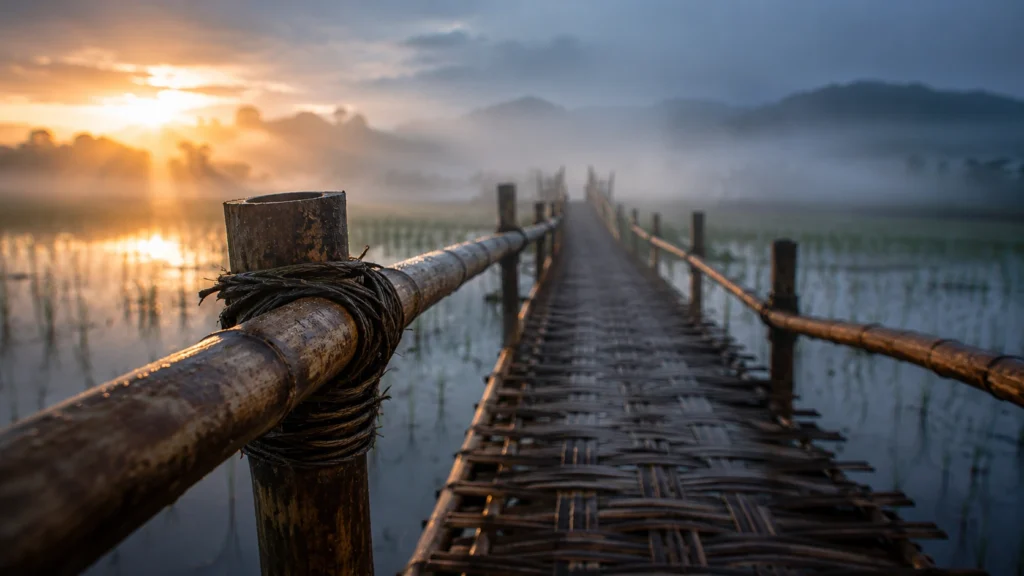
Just outside town, the Su Tong Pae bamboo bridge stretches roughly 500 metres across rice paddies to a hillside temple, and is often filmed at dawn with monks crossing on alms rounds. It is one of the most photographed structures in the north and a strong single-location set-piece for anything needing a serene, faith-centred image.
Caves, rivers and national parks
At Pang Mapha, Tham Lot (Nam Lod) is among Thailand’s longest and most dramatic cave systems: a river runs through cathedral-scale chambers reached by traditional bamboo raft, with prehistoric wall art, ancient coffin sites, and evening flights of swifts. The province also holds Namtok Mae Surin National Park, the Salawin protected area along the Myanmar frontier, and hillsides that turn gold with Mexican sunflower (Bua Tong) in late autumn.
Many of these sit inside protected areas, which means a separate layer of authority governs access, movement and equipment. National-park filming has its own process, which we set out in our guide to national-park filming in Thailand.
Filming with hill-tribe communities, respectfully
Mae Hong Son is home to Shan, Karen, Lisu, Lahu and other communities, and their villages and daily life are part of what draws productions here. We approach these locations as collaborations, not backdrops: informed consent, fair engagement, a bilingual liaison, and a clear agreement about what is filmed and how it is used.
Some heavily touristed village setups raise ethical questions that a credible international production will want to avoid. We advise clients candidly on which arrangements are appropriate and help build relationships with communities that genuinely wish to take part.
Permits for filming in Mae Hong Son
Every foreign shoot in the province runs on a national filming permit coordinated through the Thailand Film Office (TFO), the government body that reviews scripts, issues permits and oversees foreign productions. On top of that, Mae Hong Son adds provincial coordination and, depending on the location, further approvals: the Department of National Parks for protected areas, the Fine Arts Department for temples and heritage sites, and private owners for villages, tea estates and resorts.
Border proximity is the province’s distinctive complication. Locations near the Myanmar frontier can require additional security coordination, and lead times run longer than for Bangkok or the islands. Our full breakdown of the process is in the Thailand film permit guide; as a TFO-registered service company we file and manage these approvals on a production’s behalf.
Crew, equipment and the Bangkok-out-of model
There is no large standing crew or rental base in Mae Hong Son itself. Productions filming in Mae Hong Son work on a travelling model: a bilingual English–Thai core crew and camera, lighting and grip packages move up from Bangkok or our northern base near Chiang Mai, supported by local fixers, drivers and production assistants who know the loop and the communities.
Equipment brought into the country moves under an ATA Carnet for temporary import, and generators, comms and vehicle support matter more here than in the city because power and services thin out on the mountain. We plan convoys, contingency days and accommodation clustering around the specific stretch of the loop a schedule needs, drawing on the wider approach in our guide to location scouting in Thailand.
Seasons and the burning-season window
Timing is the single most important decision for filming in Mae Hong Son. The cool, dry season from November to February is the prime window for filming in Mae Hong Son: clear skies, comfortable mountain temperatures and the reliable dawn fog that defines the province. This is when the sea-of-cloud viewpoints and the sunflower hillsides are at their best.
The critical caution is the northern burning season. From late February through April, agricultural and forest fires blanket the upper north in haze, and Mae Hong Son is among the worst-affected provinces — visibility collapses, mountains disappear, and the small airport is prone to smoke-related delays. We steer photography away from this window. The green season from June to October brings lush landscapes but heavy rain and occasional landslides on the loop, so it needs weather contingency built into the schedule. Our broader guidance is in the best time to film in Thailand.
The cash rebate and Thailand’s secondary provinces
Foreign productions that qualify may claim Thailand’s cash rebate on local spend, administered by the TFO under published criteria that the cabinet updates from time to time. Provinces such as Mae Hong Son sit at the centre of the government’s stated push to spread production beyond Bangkok into secondary regions, and the incentive framework has been used to encourage exactly that kind of location work. We keep the mechanics general here and confirm current terms against the official criteria for each project; the detail lives in our Thailand film incentive 2026 guide.
How we handle filming in Mae Hong Son
Overgrown Productions is a Bangkok-based, full-service production company with more than fifteen years and 400-plus productions behind us, working to international standards with a bilingual English–Thai crew. We have delivered for clients including Netflix, Vice, Al Jazeera, Reuters, the United Nations, Universal and Warner Music, and our recent credits include the US feature Contra and the global motorsport series Lollipop Racing.
For a remote province like this, that end-to-end capability is the point: permits, border coordination, a travelling bilingual crew, equipment logistics up the loop, community liaison and a schedule that respects the fog and dodges the haze. We scout, plan and run the shoot as one structured workflow so the production can focus on the frame, not the mountain road.
Frequently asked questions about filming in Mae Hong Son
How do you reach Mae Hong Son for a shoot?
Most productions drive in from Chiang Mai along the Mae Hong Son Loop — roughly three to four hours to Pai and six to eight hours onward to Mae Hong Son town, depending on the route and stops. A small airport also serves the province, but it is weather-dependent and prone to delays during the haze months, so we plan road access as the reliable option.
When is the best time for filming in Mae Hong Son?
November to February, the cool dry season, is the prime window for clear skies and the signature dawn sea of fog. Avoid late February to April, when the northern burning season fills the province with haze. The June-to-October green season is lush but wet, with rain and occasional landslides on the loop.
What locations is Mae Hong Son known for?
The sea-of-fog viewpoints at Pang Ung and Ban Jabo, the Yunnanese tea village of Ban Rak Thai, the Su Tong Pae bamboo bridge, the Shan temples on Nong Jong Kham lake in Mae Hong Son town, and Tham Lot cave at Pang Mapha. The province is also known for its winding mountain roads and hill-tribe communities.
Do you need special permits to film near the Myanmar border?
Border-adjacent locations can require additional security coordination on top of the standard TFO filming permit and any national-park or heritage approvals. Lead times run longer than elsewhere in Thailand. We resolve these permissions before the recce and confirm current requirements for each specific site.
More questions about filming in Mae Hong Son, Thailand
Is there a film crew and equipment base in Mae Hong Son?
No. There is no large standing crew or rental house in the province. Productions work on a travelling model, moving a bilingual core crew and camera, lighting and grip packages up from Bangkok or a northern base near Chiang Mai, supported by local fixers and drivers who know the loop.
Can you film inside the national parks and caves?
Yes, with the appropriate approvals. Protected areas such as Tham Lot, Namtok Mae Surin and the Salawin zone are governed by the Department of National Parks, which sets conditions on access, movement and equipment. We handle those applications alongside the national permit.
How does the cash rebate apply to a Mae Hong Son shoot?
Qualifying foreign productions may claim Thailand’s cash rebate on eligible local spend, administered by the TFO under published criteria, and secondary provinces like Mae Hong Son align with the government’s push to spread production regionally. We confirm current terms and thresholds against the official criteria for each project rather than quoting figures that change.
Can filming in Mae Hong Son be combined with Chiang Mai or Pai?
Yes, and it usually is. Mae Hong Son sits on the same loop as Pai and is a natural extension of a Chiang Mai schedule, so many productions combine the three to build variety into a single northern block. We plan the routing, convoys and accommodation as one workflow.
Plan your Mae Hong Son shoot with a Bangkok team
If you are a line producer, location manager or director weighing filming in Mae Hong Son, our Bangkok office can pressure-test the location against your schedule, budget and story, and handle the permits, border coordination, travelling crew and logistics that a remote mountain province demands. Email us at info@overgrownproductions.com to start planning your northern shoot. For the wider picture, see our guide to Thailand filming locations.