
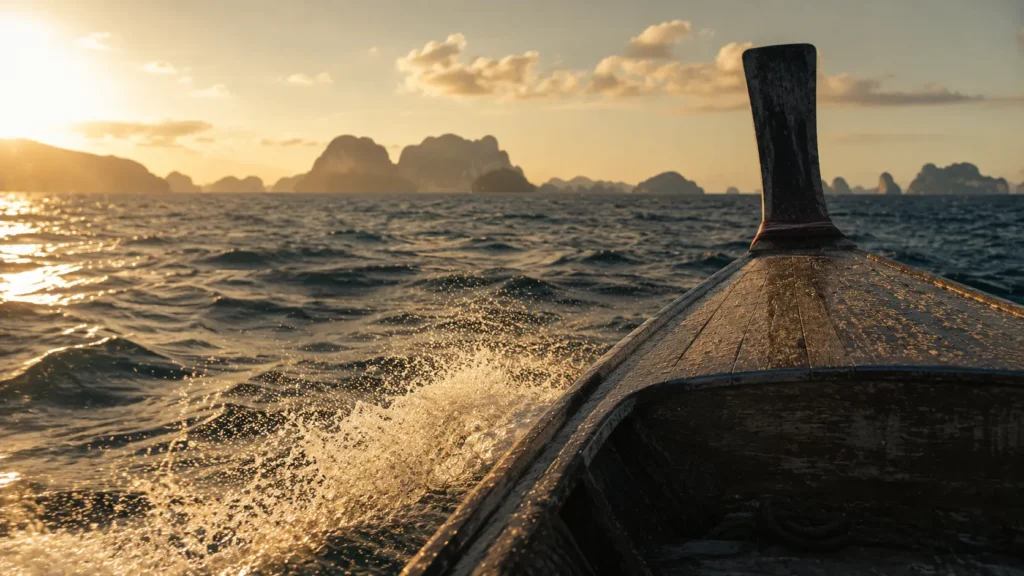
Why filming in Satun gives you Thailand’s least-worked coastline
Filming in Satun puts a unit on the last stretch of Thai Andaman coast that has not been shaped by two decades of location traffic. The province sits at the southwestern corner of the country, below Trang and against the Malaysian border, and it holds the Tarutao archipelago — 51 islands in the Strait of Malacca, gazetted as Thailand’s first marine national park. The scenery reads as Andaman: limestone towers, translucent shallows, jungle running to the tideline. What it does not carry is the visual fingerprint of the shoots that came before it.
That matters commercially. Thailand recorded 302 foreign productions worth roughly THB 4.03 billion in the first half of 2026 alone, with feature films accounting for the largest single share of that spend (Nation Thailand, July 2026). Volume at that level puts pressure on the well-known coastlines. Phuket, Krabi and Phang Nga carry heavy tourist and production traffic, and their headline geography has been photographed thousands of times. Satun offers the same geological family with a fraction of the exposure.
The Tourism Authority of Thailand has been actively pushing screen work toward provinces outside the established circuit, marketing shoot locations as travel destinations under its Amazing Locations programme. Satun is exactly the sort of province that policy is aimed at. For a producer, the practical read is simpler: the frames are unfamiliar, the crowd control is easier, and the trade-off is infrastructure.
What filming in Satun actually looks like on camera
The province gives you four visually distinct environments inside a compact working radius. Understanding which one a script needs determines everything downstream — basing, marine budget, and whether the schedule is buildable at all.
- Open-ocean island archipelago. Tarutao, Adang, Rawi and Lipe sit well offshore in genuinely clear water. This is blue-water territory, not the sheltered bay look of Phang Nga. Horizons are empty. Islands read as isolated because they are.
- Limestone and karst coast. The same Permian and Ordovician limestone that defines the Andaman coast surfaces here as sea stacks, cliffs and cave systems, including the long navigable river caves inland.
- Mainland shore and mangrove. The Pak Bara and Langu coastline gives working fishing communities, estuary channels, mangrove and long unbuilt beaches — useful for period, documentary and anything that cannot show resort architecture.
- Rubber and interior farmland. Inland Satun is plantation country running up to the Malaysian border ranges, with a strong Thai-Malay Muslim cultural character that distinguishes it from central and northern Thailand on camera.
The single most useful thing to know about filming in Satun is that these four environments do not share a base. An island schedule and a mainland schedule are two different logistical operations, and mixing them without planning the transfer time will cost days.
Marine units: what filming in Satun demands offshore
Tarutao National Park is the anchor location and the hardest one to schedule. The park covers 51 islands across two groups — the Tarutao group closer to the mainland, and the Adang-Rawi group roughly 40km further west. Ko Tarutao itself is large, forested and largely undeveloped, with cliff coastline, mangrove river mouths and long empty beaches. Ko Adang rises steeply out of clear water and gives elevation for wides.
Marine work here behaves differently from Phang Nga Bay. Crossings are longer, the water is more exposed, and there is no protected inner bay to retreat into when the sea gets up. Every marine day needs a qualified marine coordinator, a briefed skipper fleet, and a stated abort condition agreed before the boats leave. Our underwater and marine filming guide covers the surface-support structure in detail; the Satun-specific point is that the transit legs are long enough that a lost morning is usually a lost day, not a lost hour.
Camera boats, safety boats and a separate kit tender should be budgeted as distinct vessels. Trying to run picture, safety and equipment off a shared longtail is where marine schedules in this region break, and it is the most common costing error we see on first drafts for filming in Satun.
Koh Lipe, Koh Adang and the island basing decision
Koh Lipe is the only island in the group with commercial accommodation, power, mobile coverage and food supply at a level that can hold a unit. It is small, walkable, and busy in high season. Basing on Lipe removes the daily mainland crossing and puts the Adang-Rawi locations within a short boat leg — which is the strongest argument for it.
The costs of that decision are real. Everything arrives by boat. Generators, grip, large lighting packages and vehicles either come across on a chartered supply run or do not come at all. Waste has to leave the same way. There is no equipment resupply, no repair, and no local crew depth. Anything that breaks is either fixed by the crew or replaced from Bangkok, which is a full day minimum.
The alternative is basing at Pak Bara on the mainland and running out daily. That keeps vehicles, generators and a supply chain on land, but imposes a crossing at both ends of every shoot day. For most schedules the honest calculation is: island-heavy scripts base on Lipe and accept the supply constraint; mixed scripts base on the mainland and treat the islands as chartered day trips.
The Satun UNESCO Global Geopark and the mainland interior
Satun holds Thailand’s first UNESCO Global Geopark, designated for a Palaeozoic fossil record running back more than 500 million years across a landscape of limestone ranges, caves and coastal cliffs (UNESCO, International Geoscience and Geoparks Programme). For documentary and factual work this is a subject in its own right. For drama it is a set of caves, river passages and rock formations that have essentially no screen history.
The long water caves are the standout. Navigating them by boat gives an interior that cannot be built cheaply and cannot be found in the same form elsewhere on the Andaman coast. They are also technically demanding: low headroom in places, no natural light, tidal access windows, and no possibility of running mains power. Treat them as a specialist unit day with a compact package, not as a location the main unit drops into.
Geopark status also brings its own stewardship expectations. Access is not simply a matter of turning up, and any physical intervention — set dressing, rigging, anchoring — needs to be raised in advance rather than resolved on the day.
Permits for filming in Satun: two parallel tracks
Any foreign production working in Thailand runs through the Thailand Film Office under the Department of Tourism. That process, and the coordinating officer who accompanies a foreign shoot, applies to Satun exactly as it does to Bangkok. Our Thailand film permit page sets out the route.
What is specific to filming in Satun is how much of the province sits inside protected areas. Tarutao National Park, the marine zones around Adang-Rawi, the Geopark sites and the mainland forest areas each carry a permission layer administered by the Department of National Parks, Wildlife and Plant Conservation that runs in parallel with, not inside, the national film permit. Our guide to filming in Thai national parks covers how the two tracks interact.
The practical consequences for a schedule: park permissions are location-specific and unit-specific, drone work over protected areas is treated separately from ground work, and marine parks carry seasonal closures that no permit overrides. Build the park layer into the prep calendar as its own workstream with its own owner. Productions that discover it late lose locations, not just time.
Satun’s border position adds one more consideration. Parts of the province and its waters sit close to the Malaysian frontier, and any unit working near a border or in border waters should have that flagged and cleared in advance rather than assumed.
Basing options compared
| Base | Best for | Main constraint |
|---|---|---|
| Hat Yai (Songkhla) | Crew accommodation depth, airport access, resupply, banking and medical | Roughly two hours’ drive to the Satun coast — not a daily shooting base |
| Satun town | Mainland interior, Geopark caves, plantation and border-country locations | Limited hotel stock at unit scale; no production infrastructure |
| Pak Bara | Daily island runs with vehicles, generators and kit held on land | A crossing at both ends of every island day |
| Koh Lipe | Island-heavy schedules; short legs to Adang, Rawi and the surrounding reefs | Everything arrives by boat; no resupply, no repair, no local crew |
Getting a unit and its kit to Satun
Satun has no commercial airport, which shapes the front end of every schedule. Crew and equipment for filming in Satun arrive through Hat Yai International Airport, roughly two hours away by road, and Hat Yai is where the province’s practical support sits — hotels at volume, hospitals, banks and vehicle hire. For international arrivals the realistic chain is Bangkok, then a domestic leg to Hat Yai, then road.
Heavy kit moves by road from Bangkok. That is a long drive, and it needs to be planned as a scheduled item with buffer rather than an assumption. We cover the vehicle classes, drive-time ranges and the air-versus-road decision in our production transport guide. Equipment arriving from overseas under an ATA Carnet clears at the port of entry, not in the province, so carnet planning and the Bangkok leg are the same conversation — see our notes on importing film equipment into Thailand.
Once kit is on the coast, the last leg to the islands is a boat charter. Charter capacity is the constraint that surprises most incoming producers: the local fleet is built for passengers and dive trips, not for camera departments with flight cases, and it needs to be contracted early with the load specified.
Season and sea state: when filming in Satun is buildable
The Satun coast follows the Andaman pattern. The reliable window runs roughly from November to April; the southwest monsoon dominates the middle of the year and brings sustained swell rather than simply rain. Our guide to the best time to film in Thailand sets out the wider national picture.
The distinction that matters offshore is between weather and sea state. Rain is a lighting and continuity problem that a competent unit works around. Swell is a hard stop — it stops boats leaving, it stops safe transfer of crew and kit between vessels, and it makes camera platforms unusable regardless of how bright the sky is. On an exposed archipelago like Adang-Rawi, sea state decides more shoot days than rainfall does.
Marine national park areas in this region also close seasonally during the monsoon. That is not a permit that can be negotiated; it is a closure. Any script that needs the outer islands is a high-season script, and the schedule should say so in the first budget draft rather than the last.
Crew and kit: filming in Satun runs out of Bangkok
Satun has no production infrastructure. Anyone costing filming in Satun should start from that: there is no rental house, no grip supply, no crew pool, no stage and no post facility in the province. Every location page we write for the smaller provinces says a version of this, and Satun is the strongest case of it on the Andaman coast.
The working model is a Bangkok-based unit travelling in. Heads of department, camera, grip, electric, sound and art all come from Bangkok, with our Thai crew base and equipment packages moving as a single travelling unit. Locally you can reliably source boats and skippers, drivers, security, general labour and catering support — and the local knowledge of tides, channels and landing points is genuinely valuable. What you cannot source locally is anything technical.
That has a budget consequence worth stating plainly: per-head travel and accommodation on a Satun schedule is higher than on a Bangkok or Phuket schedule, and the fix is a tighter crew list, not a cheaper one. Foreign crew coming in still need the correct visa and work authorisation regardless of how remote the location is — our film crew visa guide covers the route.
Aerial and specialist units
Aerials are the strongest single argument for filming in Satun. The Adang-Rawi group from altitude, the Tarutao cliff coast, the limestone ranges running inland — these are frames that have not been used. Drone and aerial work over national park and marine park areas requires its own permission track separate from the ground permit, and the flight planning has to account for the fact that the launch point is often a boat. Our aerial filming guide covers how we structure that.
Underwater is the other specialist case. The Adang-Rawi reefs sit in the clearest water on the Thai Andaman coast, and for anything that needs genuine visibility rather than a graded approximation, this is where to shoot it. Both aerial and underwater are best handled as dedicated second unit days with their own call sheet and their own weather abort, rather than as add-ons to a main-unit day.
What moves the budget when filming in Satun
Four line items account for most of the variance between a controlled Satun budget and one that runs away.
- Marine charter. Multiple vessels, standby days, fuel over long transits, and the charter days you pay for when the sea state cancels the shoot. Build weather contingency into the charter contract, not just the schedule.
- Transfer time. Hat Yai to the coast, coast to island, island to location. Every leg is paid crew time. Schedules that assume a single transfer per day and then discover three are the ones that overrun.
- High-season accommodation. The shooting window is also the tourist window, and Koh Lipe room stock is finite. Book early or base on the mainland.
- Kit redundancy. With no local rental house, the answer to a failed body or a flooded housing is the backup you brought. That redundancy is a real line item and cutting it is a false economy.
Our Thailand production cost guide sets out the wider structure, and the national cash rebate for qualifying foreign productions is administered by the Thailand Film Office under published criteria — see our incentive guide and the Thailand Film Office incentive pages.
Where Satun sits against the rest of the Andaman coast
Satun completes the Thai Andaman chain. Read north to south: Phang Nga gives the karst bay, Phuket gives the infrastructure, Krabi gives the accessible cliff coast, Trang gives the quiet mainland and near islands, and Satun gives the open-ocean archipelago and the border interior. Producers scouting the region should read them as one coastline with different trade-offs rather than as competing options.
If a script needs proximity to services, it belongs in Phuket or Krabi. If it needs the signature bay geography, Phang Nga. If it needs quiet mainland with island access, Trang. If it needs genuine isolation and water no one has shot — that is the case for filming in Satun, and it is the only province on the coast that still delivers it.
The wider picture is in our Thailand filming locations guide and, for producers still choosing a country, our Southeast Asia comparison.
How Overgrown Productions handles filming in Satun
We are a Bangkok-based, full-service production service company registered with the Thailand Film Office, with fifteen years and more than 400 productions behind us. Our client work includes Netflix, Vice, Al Jazeera, the United Nations, Reuters, Universal and Warner Music, and we have delivered international feature work in Thailand — the US thriller Contra shot with us in Bangkok — alongside the global motorsport series Lollipop Racing.
For a remote-province schedule our approach is structural rather than improvised. We scout with a marine coordinator present from the first recce, because on this coast the question is never only whether a location looks right but whether a unit can be landed on it safely and repeatedly. We run the film permit and the protected-area permissions as two tracked workstreams with named owners. We build the travelling unit in Bangkok and cost the transfer legs explicitly rather than burying them. And we contract the boat fleet with the load and the abort conditions written in.
Bilingual English-Thai heads of department matter more here than in Bangkok, because the working relationships that make a Satun day possible — skippers, park officers, village heads, local fixers — are conducted in Thai and often in the local Thai-Malay register. Our fixer and location scouting teams handle that layer directly.
Frequently asked questions about filming in Satun
Is filming in Satun realistic for a feature schedule, or only for second unit?
Both work, but they are different builds. A full feature block is realistic if the schedule is written around the marine and transfer constraints and the unit bases sensibly. Many productions use Satun as a targeted block — the isolation and archipelago material — while carrying the dialogue and interior work elsewhere on the coast where infrastructure is deeper.
What is the best time of year to shoot in Satun?
Roughly November to April. The southwest monsoon dominates the middle of the year and brings sustained swell that closes the outer islands to safe marine work. Marine national park areas also observe seasonal closures during that period, which no permit overrides.
Do we need a separate permission to film inside Tarutao National Park?
Yes. The national film permit administered by the Thailand Film Office and protected-area permission administered by the Department of National Parks are two parallel tracks. Park permission is location-specific and unit-specific, and drone work is assessed separately from ground work. Both need to start in prep, not on arrival.
Can we hire crew and equipment locally in Satun?
No technical crew or equipment. Boats, skippers, drivers, security, general labour and catering support are available locally and the local marine knowledge is valuable. Camera, grip, electric, sound and art all travel in from Bangkok, and so does the kit.
More questions about filming in Satun, Thailand
How does a unit reach Satun?
Through Hat Yai International Airport, roughly two hours away by road — there is no commercial airport in Satun province. Heavy equipment travels by road from Bangkok. The final leg to the islands is a contracted boat charter, which should be booked early with the load specified.
Should we base on Koh Lipe or on the mainland?
Island-heavy schedules generally base on Koh Lipe and accept that everything arrives by boat with no resupply or repair available. Mixed schedules base at Pak Bara or in Satun town, keep vehicles and generators on land, and treat the islands as chartered day trips. Hat Yai works for prep and wrap but is too far for a daily shooting base.
What makes Satun visually different from Krabi or Phang Nga?
Open water and empty horizons. Phang Nga and Krabi are sheltered-bay geography with heavy tourist and production traffic; the Adang-Rawi group sits well offshore in clear blue water with genuine isolation in frame. The province also has the Satun UNESCO Global Geopark’s cave and limestone landscape, which has almost no screen history.
Does a Satun shoot qualify for the Thailand production incentive?
Qualification depends on the production, not the province. The cash rebate for qualifying foreign productions is administered nationally by the Thailand Film Office under its published criteria, and a Satun-based schedule is assessed on the same basis as one shot anywhere else in the country.
Planning a shoot in Satun
If you are a line producer, UPM or location manager weighing filming in Satun against the better-known Andaman provinces, the decision usually comes down to how much isolation the script actually needs and how much infrastructure you are prepared to travel with. That is a conversation worth having early, while the schedule is still movable. Send us the script pages, the shoot window and the unit size, and our Bangkok team will come back with a location assessment, a permit and park-permission plan, and a realistic marine and transfer structure. Reach us at info@overgrownproductions.com. Comparing regions before you commit? Start with our guide to filming locations across Thailand.