
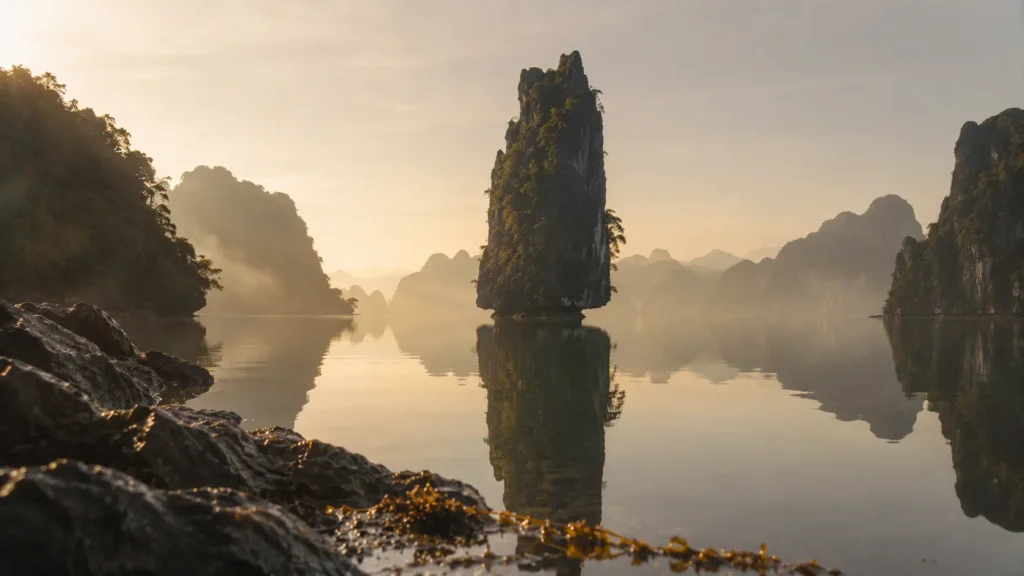
Filming in Phang Nga puts a production inside the most recognisable seascape in Southeast Asia. Vertical limestone karsts rising straight out of flat green water, mangrove channels narrow enough to touch both banks, and a mainland coast of long empty beaches backed by rainforest — all within a two-hour drive of an international airport. Foreign productions spent roughly THB 4 billion in Thailand across 302 registered productions in the first half of 2026, and the Andaman provinces took a meaningful share of it.
The province is also the least understood of Thailand’s southern shooting bases. Producers arrive with Phuket in the budget and Phang Nga in the shot list, then discover that the two work very differently. This guide sets out what filming in Phang Nga actually involves — access, permissions, basing, crew, weather and the costs that move — for producers building a schedule they intend to hold.
What filming in Phang Nga gives a production
Phang Nga province wraps around the top of the Andaman coast, north of Phuket and west of Surat Thani. Within roughly ninety minutes of each other it holds four distinct visual environments: the karst bay, an open mainland coastline, offshore island groups with genuinely clear water, and a rainforest-and-lake interior. Very few locations anywhere let a unit move between that range of looks without a company move by air.
For a feature or a high-end series, that density is the argument. A single Phang Nga base can cover a tropical-island act, a boat sequence, a jungle act and a coastal-village act inside one shooting block. For commercials and branded content, it is often the only place in Thailand where an aerial establishing shot reads as unmistakably Southeast Asian without a single sign or building in frame.
The trade-off is logistical. Much of what makes filming in Phang Nga worth doing sits on water, inside a protected area, or both — and both of those add lead time.
Phang Nga Bay: the limestone seascape
Phang Nga Bay is the shot most productions come for. The bay sits inside Ao Phang Nga National Park and contains dozens of karst islands, sea caves, hongs — collapsed cave systems that open into hidden interior lagoons — and mangrove channels running back to the mainland shore.
Practically, this is a marine unit. Camera, grip and lighting move by longtail or by chartered speedboat, crew work off boats or off small beaches that appear and disappear with the tide, and every schedule is written against a tide table rather than a call sheet. Hongs are only enterable within a tidal window; some are only enterable by kayak. A production that plans a hong interior without a marine coordinator reading the tides will lose the day.
The bay is also busy. Tour traffic to the well-known islands runs heavily through the middle of the day, which pushes serious camera work to early morning and late afternoon. Productions that need clean plates on the signature islands should plan for first light and accept that a mid-morning slot will have longtails in frame.
Khao Lak and the mainland coast
Khao Lak, on the province’s western shore, is the practical base for most productions filming in Phang Nga province. It runs roughly thirty kilometres of beach backed by low forested hills, with resort stock that ranges from mid-tier to genuinely five-star, and it is quiet enough that a unit base can sit on a beach without closing a tourist economy to do it.
Visually the mainland coast gives long empty sand, casuarina and palm treelines, river mouths, and headlands that read as remote island even though they are road-accessible. For any sequence where the schedule cannot absorb a daily boat call, the mainland coast is where a Phang Nga schedule should live.
North of Khao Lak the coast becomes progressively less developed toward Takua Pa. That stretch is where productions find beaches with no visible built environment at all — the single most requested and least available thing in Thai coastal filming. Our guide to filming on a beach in Thailand covers the access and permission layer in more detail.
Similan and Surin: the offshore marine parks
The Similan and Surin island groups sit well offshore in the Andaman Sea and hold the clearest water in Thai territory — the reason they carry most of the country’s high-end underwater and marine work. Granite boulder formations, white sand and visibility that supports genuine sub-surface camera work put them in a different category from anything shootable from the mainland.
They are also the hardest sites in the province to schedule. Both groups close to visitors during the southwest monsoon and reopen in the second half of October. Access is by a long boat run from Thap Lamu or Khura Buri, which means a marine day with meaningful transit at both ends. And both are national parks, so filming permission runs through the protected-area route on top of the standard national process — the mechanics are set out in our guide to national park filming in Thailand.
For any production planning sub-surface work here, the crew, safety and kit requirements are covered in our underwater filming in Thailand guide. This is not a place to improvise a marine unit.
Khao Sok and the rainforest interior
Inland, Phang Nga rises into old-growth rainforest that continues east into the Khao Sok system and its reservoir — sheer karst cliffs standing directly out of still fresh water, with floating raft accommodation at the base of them. It is the single most cinematic freshwater environment in southern Thailand and it looks nothing like the coast forty minutes away.
The interior also gives waterfalls, limestone caves, rubber and palm plantation, and river sections that support boat work without sea state. For productions that need jungle without committing to a northern base, the Phang Nga interior is the shortest route to it.
Access is the constraint. Reservoir locations need boat transfer with limited deck space, generator and lighting packages have to be sized to what a longtail will carry, and there is no meaningful support infrastructure past the pier. Plan a rainforest day the way you would plan a marine day.
Takua Pa and the built environment
Phang Nga is not only landscape. Takua Pa old town holds a well-preserved run of Sino-Portuguese shophouses — the same architectural language as Phuket Town and Penang, with a fraction of the foot traffic and far simpler street control. For period, commercial or drama work needing a Southeast Asian trading-town look, it is a genuinely underused asset.
The province also holds working fishing villages, Muslim coastal communities, rubber smallholdings and stilt settlements over tidal flats. These are lived-in locations, not sets, and they require a community liaison approach rather than a permit-and-shoot approach. Budget the relationship time; it is what makes the difference between access and a closed door.
Permits and the protected-area layer
Every foreign production shooting in Thailand works through the Thailand Film Office (TFO) under the Department of Tourism, and the general process is set out in our Thailand film permit guide and the accompanying breakdown of Thailand film permit costs.
What makes filming in Phang Nga different is that a large share of the province’s best locations sit inside protected areas — Ao Phang Nga National Park, the offshore marine parks and the inland forest reserves. Protected-area filming requires permission from the park authority in addition to the national process, and the two run in parallel rather than in sequence. Productions that treat the park layer as an afterthought discover it late, and late is where Phang Nga schedules break.
Marine work adds a third layer to filming in Phang Nga. Boat charters, dive support and any activity involving anchoring, drones over water or crew in the water all have their own requirements. Bring a local production service company into the conversation at the location-scout stage, not after the schedule is locked.
Basing a unit: Phuket, Khao Lak or Krabi
Most productions filming in Phang Nga base in one of three places, and the choice sets the shape of the whole schedule.
Phuket gives the deepest infrastructure — international airport, hotel stock at every tier, hospitals, equipment sub-rental and the largest pool of local crew on the Andaman coast. It costs an hour or more of unit move to reach the northern Phang Nga locations. See our filming in Phuket guide for what the island supports.
Khao Lak puts the unit inside the province, cuts the daily move to the mainland coast and the Thap Lamu marine departures, and keeps costs lower than Phuket. It has less depth in equipment and specialist crew, so anything not brought from Bangkok or Phuket has to be committed early.
Krabi works when the schedule is weighted toward the eastern bay and the Krabi karsts rather than the western coast. Our filming in Krabi guide covers that side.
A common and sensible pattern is a Phuket prep base with a Khao Lak shooting base — full support during prep, minimal moves during production.
Getting crew, kit and units in
Phang Nga has no commercial airport. Everything arrives through Phuket International, roughly ninety minutes to two hours from Khao Lak by road depending on traffic through the Phuket bridge, or overland from Bangkok on a long haul that suits heavy trucks rather than crew.
Camera, lighting and grip packages generally come from Bangkok with the crew that operates them, moving by road; our guide to production transport in Thailand covers how those legs price and how long they realistically take. Foreign productions bringing their own kit should read our importing film equipment into Thailand guide before booking freight — the carnet decision is easier to make early.
Once in the province, the last leg is usually the hard one. Marine locations need boats sized to the package, tender support and a plan for getting a heavy camera cart onto a beach with no vehicle access. Local film equipment rental in Thailand can cover consumables and expendables, but specialist kit comes from Bangkok.
Crew and local capability
Phang Nga does not have a resident film crew base. It has an excellent marine services sector — boat captains, dive operators, safety divers and boat crew who work daily in these waters — and that is the local capability that matters most.
Camera, grip, electric, art department and assistant directors come from Bangkok or Phuket. Our film crew in Thailand guide sets out how those departments are structured on foreign productions, and the film crew visa and work permit guide covers what incoming foreign crew need in place before they land.
The one role to budget explicitly when filming in Phang Nga is a marine coordinator who knows these specific waters — tides, hong windows, park boundaries, safe anchorages and which captains will actually hold a mark on a moving boat. That person saves more money than they cost. So does a bilingual first assistant director; instructions pass between an English-speaking department head and Thai-speaking boat crew dozens of times a day.
Weather, sea state and the shooting calendar
The Andaman coast runs on a clear seasonal split, and filming in Phang Nga province is more weather-dependent than almost anywhere else in Thailand because so much of it is on water.
The southwest monsoon brings sustained onshore wind, swell and heavy rain to the west coast through the middle of the year. Sea state, not rainfall, is what stops a marine day — a shoot can work through a squall but cannot work through a swell that will not let a camera boat hold position. The offshore marine parks close entirely for this period.
The dry season delivers flat water, long clear light and reliable boat access, and it is also the peak tourist and peak production window. Crew, boats, hotels and specialist kit all need committing months out. Our guide to the best time to film in Thailand sets the national picture; on the Andaman coast, weight it more heavily toward the dry months than you would for a Bangkok or Isaan schedule.
Shoulder periods can work well for mainland coast and interior locations even when offshore work is off the table. Build the schedule so land days can absorb a lost marine day rather than stacking all the water work at the end.
What filming in Phang Nga costs, and what moves it
Below-the-line rates in Thailand remain the reason productions come, and the general picture is set out in our film production costs in Thailand guide. Phang Nga sits close to the national baseline on crew and slightly above it on logistics.
Four items move a Phang Nga budget more than anything else. Marine charter is the largest — camera boats, tender boats, safety and dive support, and standby time that accrues whether or not you turn over. Accommodation is the second, because dry-season rates on the Andaman coast run at genuine international resort pricing and crew volume is not a discount lever the way it is inland. Transfer time is third — every day that starts with a boat run costs shooting hours. Contingency is fourth, and on this coast it is not optional: build weather days into the schedule rather than the overage.
Foreign productions structuring a Thai spend should read our guide to the Thailand film incentive and cash rebate for foreign productions alongside the budget work, and carry proper production insurance in Thailand — marine and aerial work make that non-negotiable.
Common mistakes on Phang Nga schedules
The recurring errors are consistent enough to list. Treating Phang Nga as an extension of Phuket and budgeting a company move as a unit move. Scheduling hong and cave interiors without tide-checking the specific day. Assuming the offshore marine parks are available year-round. Starting the protected-area permission process after the schedule is locked. Sending a scout who photographs a location at slack water and books it for a spring tide. And underestimating how much of a marine day disappears into transit.
None of these are unique to filming in Phang Nga. They are prep problems that the province exposes faster than a road-accessible location would. Get a marine coordinator and a local production service company into prep and most of them stop existing.
How we handle filming in Phang Nga
Overgrown Productions is a Bangkok-based, full-service production company and a Thailand Film Office-registered production service company. Across fifteen years and more than four hundred productions we have delivered for clients including Netflix, Vice, Al Jazeera, Reuters, the United Nations, Universal and Warner Music, and our recent feature work includes the US chess thriller Contra, shot in Bangkok in 2025, and the global motorsport series Lollipop Racing.
For Andaman work we run a Bangkok core crew with local marine capability contracted in the province — the model that keeps international standards on the camera side without importing people who do not know these waters. We handle permits through the TFO, the protected-area applications, boat and marine safety contracting, location scouting, equipment, bilingual crew, and visa and work permit processing for incoming foreign crew. If you would rather start with a fixer engagement than a full service package, our film fixer in Thailand page explains how that works.
Producers weighing Phang Nga against other Thai options will find the wider picture in our Thailand filming locations guide and the annual Thailand film production market report.
Frequently asked questions about filming in Phang Nga
Do I need a separate permit to film inside Phang Nga Bay?
Yes. Ao Phang Nga is a national park, so filming there requires permission from the park authority in addition to the standard Thailand Film Office process that applies to every foreign production. The two applications run in parallel, and the park layer is the one productions most often discover late. Start it at the location-scout stage.
What is the nearest airport to Phang Nga?
Phuket International Airport. Phang Nga province has no commercial airport of its own. From Phuket the drive to Khao Lak is roughly ninety minutes to two hours depending on traffic across the Phuket bridge, and longer if a full unit is moving. Crew and light kit fly into Phuket; heavy packages generally come overland from Bangkok.
When are the Similan and Surin islands available to film?
Both marine national parks close to visitors during the southwest monsoon and reopen in the second half of October, running through to the following monsoon. Any schedule that depends on offshore island work has to sit inside that window, and permission still runs through the protected-area route. Do not plan Similan or Surin coverage into a mid-year block.
More questions about filming in Phang Nga, Thailand
Can a full camera and lighting package reach the Phang Nga marine locations?
Within limits. Packages move by longtail or chartered boat, so weight, footprint and the number of trips are the real constraints rather than the kit list. Larger lighting and generator packages need a landing craft or a dedicated equipment boat. The practical answer is to scout the specific access, then size the package to it — not the other way round.
Should I base a Phang Nga shoot in Phuket or Khao Lak?
Phuket if the schedule needs deep infrastructure, sub-rental and hospital access, and can absorb a daily unit move. Khao Lak if the schedule is weighted toward the mainland coast and the Thap Lamu marine departures, where being inside the province saves shooting hours every day. A Phuket prep base with a Khao Lak shooting base is a common and effective compromise.
Is there a local film crew in Phang Nga?
Not a full one. Phang Nga has a strong marine services sector — boat captains, dive operators, safety divers — and that local capability is genuinely valuable. Camera, grip, electric, art department and assistant directors come from Bangkok or Phuket. Budget for a Bangkok core crew with local marine support contracted in the province.
Other questions about filming in Phang Nga, Thailand
How many weather contingency days should a Phang Nga schedule carry?
More than an inland Thai schedule. Sea state, rather than rainfall, is what cancels a marine day, and a swell that stops a camera boat holding position can sit in for several days. Structure the schedule so land and interior days can absorb a lost marine day, and avoid stacking all the water work at the end of the block.
Can drones be flown over Phang Nga Bay?
Aerial work over the bay is possible and is one of the strongest reasons to shoot there, but it sits inside the protected-area permission and the national aerial framework rather than outside them. Clear it as part of the permit package rather than as a same-day decision on location. Our aerial filming in Thailand guide covers how those approvals are structured, and on any production filming in Phang Nga the aerial plan should be locked with the permit package.
Planning a Phang Nga schedule
If you are a line producer, UPM or location manager weighing filming in Phang Nga against other Andaman options and want the plan pressure-tested before you lock dates, send us the script breakdown and the location shortlist. We will come back with realistic access and transfer times, the marine legs priced honestly, the protected-area permissions mapped out, and a clear view of which boats and specialist kit need committing now rather than later. Filming in Phang Nga is straightforward when the water and the permissions are planned in prep, and expensive when they are not. Our Bangkok team can be reached at info@overgrownproductions.com.
External references: Thailand Film Office, Department of National Parks, Wildlife and Plant Conservation. For the wider picture, see our guide to filming locations in Thailand.