
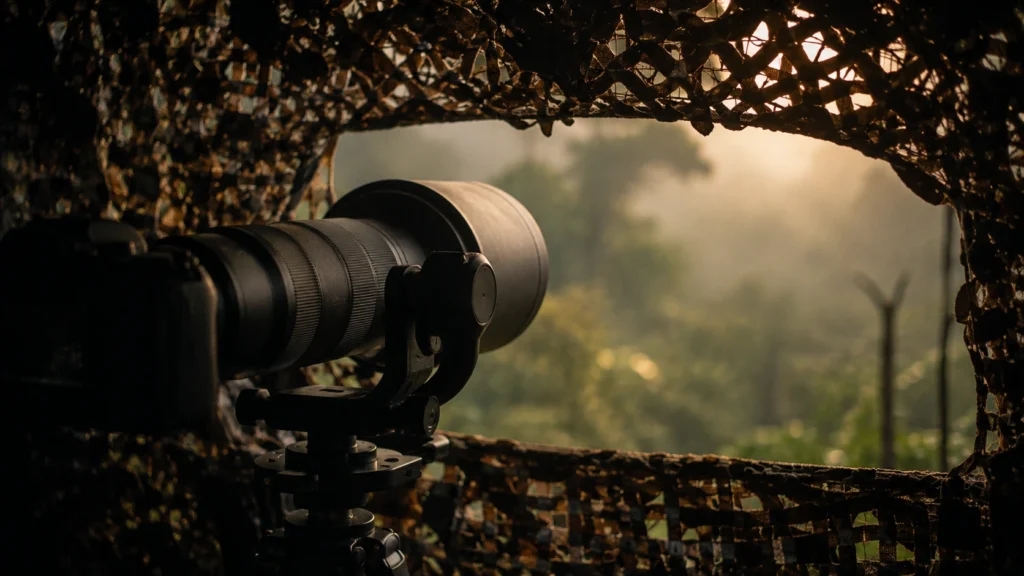
Wildlife filming in Thailand asks a production to solve two problems at once: reaching the animal, and holding the permission to be there when it appears. Thailand carries an unusual density of habitat inside a country a foreign unit can cross in a day — tropical rainforest, limestone karst, mangrove, monsoon-flooded lake, dry evergreen forest, coral reef and one of the region’s larger protected-area networks. Foreign productions registered 302 shoots in the first half of 2026, spending roughly 4.03 billion baht (about USD 120 million), already more than half the full-year 2025 record. Natural history units are a small slice of that number, and a slice that rewards preparation more than budget.
This is a field guide to wildlife filming in Thailand for producers, series producers and commissioning teams planning a natural history, conservation or wildlife-led documentary shoot. It covers where the habitat is, how the approvals actually stack, what the seasons do to a schedule, and what a wildlife unit needs on the ground.
Why producers consider wildlife filming in Thailand
Thailand’s value to a natural history production is range compressed into short travel legs. A unit can shoot lowland rainforest canopy in the south, karst-and-lake systems in the west, dry evergreen forest and grassland in the northeast, montane cloud forest in the far north, and reef and pelagic work off two separate coastlines — the Gulf of Thailand and the Andaman Sea — with different weather windows.
The second reason is infrastructure. Wildlife work is slow and equipment-heavy, and Thailand supports it with international airports close to habitat, reliable road access to most park gates, functioning cold chain and power, medical evacuation, and a professional freelance crew base. That combination is rare in the region: many habitats elsewhere in Southeast Asia demand two travel days before a camera is set.
Third, foreign productions here work inside a formal system. Shoots are registered with the Thailand Film Office through a registered production service company, which means a natural history unit is not improvising its legal standing in a protected area. That matters when a broadcaster’s compliance team asks how access was obtained.
Habitats and regions worth scouting
Broadly, four habitat groups carry most of the wildlife filming in Thailand that international units come for.
- Southern rainforest and karst lake systems. Deep evergreen rainforest with limestone towers, flooded valleys and long boat approaches. Strong for canopy species, primates, hornbills, bats, reptiles and dawn-mist wide shots.
- Western forest complex. A large contiguous block of protected forest along the Myanmar border, and the country’s most significant landscape for large mammals and apex predators. Access is restricted and research-led, and lead times are long.
- Northeastern dry evergreen forest and grassland. Accessible from Bangkok, with well-established visitor infrastructure, waterfalls, salt licks and open viewing that suits presenter-led and observational work. See our guide to filming in Khao Yai.
- Coastal, mangrove and marine. Reef systems, mangrove channels, seabird islands and estuarine habitat across both coasts, with separate marine national park approvals.
Species-led scouting is different from location scouting for drama. A wildlife recce is a behaviour recce: it establishes where an animal reliably is, at what hour, in what season, and whether a camera can be there without displacing it. We treat that as a distinct workflow from standard location scouting in Thailand, usually run with park staff or field researchers rather than location managers alone.
Permits: the two layers behind wildlife filming in Thailand
Producers routinely underestimate this. A Thai film permit and a protected-area permit are two separate approvals, granted by two different authorities, on two different clocks.
The first layer is the national film permit, coordinated through the Thailand Film Office for foreign productions and applied for by a registered production service company. This is the approval that makes the production lawful to shoot in Thailand, and it is the layer that also carries the government coordinating officer attached to foreign shoots. Our Thailand film permit guide sets out that process.
The second layer is site permission. Filming inside a national park, wildlife sanctuary or non-hunting area requires permission from the Department of National Parks, Wildlife and Plant Conservation, under the National Park Act and the department’s filming regulations. It carries its own application, its own conditions written onto the permit itself, its own daily fees and its own officials. Applications for continuous multi-day filming are handled differently from short shoots, and wildlife sanctuaries are governed more tightly than national parks. Our DNP permit guide covers the mechanics in detail.
For a natural history production the practical consequence is scheduling. Site approvals are not same-week items, and a park permit written for one zone does not travel to the next valley. Build the permit map before the shooting schedule, not after.
Animals in habitat versus animals brought to set
These are two entirely different regulatory paths and producers should not conflate them.
Filming wild animals in habitat is an access-and-conduct question: where the unit may go, how long it may stay, how close it may approach, whether artificial light or playback is permitted, and what it may leave behind. Conditions are specified on the permit and enforced by park staff.
Bringing animals into a location — a picture animal for a drama scene, a handled species for a piece to camera — triggers a separate documentation set, including veterinary health certification issued by the relevant livestock authority within a defined recency window, together with identification of every animal entering the site. Broadcasters increasingly attach their own animal-welfare compliance standards on top, and those are usually stricter than the local minimum. Confirm the broadcaster standard before you confirm the shoot.
Seasons and light: timing wildlife filming in Thailand
Season selection drives more of the success of wildlife filming in Thailand than any other single decision a producer makes. The country runs three broad periods, and the two coasts do not share a calendar.
- Cool dry season. Roughly November to February. Stable conditions, clean light, easier road and trail access, concentrated wildlife near water. The default window for most units, and the busiest for permits and accommodation.
- Hot season. Roughly March to May. Water sources shrink and animals concentrate around them, which is productive for hide work, but heat is severe for crew and for camera batteries, and northern haze can persist into April.
- Green and monsoon season. Roughly June to October, with the Andaman and Gulf coasts peaking at different times. Saturated forest, active amphibians and insects, dramatic skies — and real risk to trail access, boat movement and continuity.
Behavioural events — nesting, fruiting, migration, breeding aggregations — sit inside narrow windows that rarely align with the most comfortable weather. We plan against the behaviour first and the weather second. Our guide to the best time to film in Thailand sets out the broader production calendar.
Field craft for wildlife filming in Thailand: hides, remote rigs and camera traps
Wildlife filming in Thailand is mostly a waiting discipline, and the unit’s job is to make waiting survivable and repeatable.
Hides and blinds need to be agreed in advance with park authorities, since anything semi-permanent is a structure and structures need permission. Placement, materials, removal and duration should all be written into the permit request rather than negotiated on the day.
Remote and unattended systems — camera traps, motion-triggered rigs, long-duration nest cameras — raise the same question in a sharper form: equipment left unattended in a protected area needs explicit consent, a named responsible person and an agreed retrieval date. Humidity is the practical enemy. Silica management, sealed housings and a disciplined battery and card rotation matter more than sensor choice.
Long-lens work in dense tropical forest is a light problem before it is a lens problem. Practical planning tends to mean fast long glass, high-sensitivity bodies, sturdy support and an acceptance that the usable window at ground level in closed canopy is short at both ends of the day. Low-light and after-dark work carries its own permit conditions — see our guide to night filming in Thailand.
Marine, mangrove and aerial units
Marine wildlife work adds a vessel, a dive supervisor and a weather dependency that no schedule controls. Reef and open-water sequences need a marine park permit alongside the film permit, plus qualified safety cover and a realistic surface-interval plan. Our underwater filming page covers the dive and equipment side.
Aerial coverage over protected areas is tightly controlled. Drone operation in national parks and wildlife sanctuaries is not covered by a general film permit and requires specific authorisation, with additional conditions where wildlife disturbance is a factor — nesting colonies and large mammal groups in particular. Assume aerials over habitat are a separate approval with its own lead time, and plan alternatives. Our aerial filming in Thailand guide sets out the framework.
Crew: what a wildlife unit in Thailand needs
A natural history unit is small, technical and endurance-led. The roles that consistently determine success are a bilingual field fixer who can hold a working relationship with park officers, a local field guide or researcher with genuine species knowledge, a camera assistant comfortable with humidity and remote power, and a producer who can renegotiate a day without losing the permit.
Thailand’s freelance base is deep in drama and commercial disciplines and thinner in specialist natural history camera work, so most units arrive with their own principal operator and build the support team locally. That is a workable and common structure. Our Thailand film crew page covers the wider crew market, and our documentary fixer page covers factual field support specifically.
Foreign crew still require the correct immigration and work authorisation regardless of unit size. A three-person natural history team is subject to the same rules as a feature unit, and the fact that the shoot is observational does not change the requirement.
Welfare, access and the ethics record
Wildlife filming in Thailand is now audited on access as closely as it is on content. A production should be able to evidence how permission was obtained, which authority granted it, what disturbance limits applied, and who supervised compliance in the field.
Two positions we hold as standard: no filming that presents captive or handled animals as wild, and no arrangement that induces behaviour through baiting, playback or provisioning unless it is explicitly permitted, scientifically supervised and disclosed. Both are increasingly formal requirements in commissioning paperwork, and both are far cheaper to design in than to defend afterwards.
Conservation-sensitive material carries a further consideration. Precise location data for rare or persecuted species can put the animal at risk. Metadata handling and how a location is described on screen deserve a decision at the planning stage.
How Overgrown supports wildlife filming in Thailand
We are a Thailand Film Office-registered production service company based in Bangkok, with fifteen years and more than 400 productions behind us, including work for Netflix, Vice, Al Jazeera, Reuters, the United Nations, Universal and Warner Music. We run the full stack for incoming units: film permit applications through the TFO, protected-area applications and conditions, visas and work permits, equipment import under carnet, bilingual field crew, vehicles, vessels and remote logistics.
On the ground that means we handle the approval architecture and the relationships that keep it intact, so the field team spends its hours on behaviour rather than paperwork. Our production credits include the US feature Contra, shot in Bangkok, and the global motorsport series Lollipop Racing, and the same structured workflows apply to a two-person natural history crew in a wildlife sanctuary.
Where a project qualifies, we also manage cash-rebate applications on a production’s behalf as a registered service company. Our Thailand film incentive guide sets out how the scheme is administered and what documentation it demands.
Wildlife filming in Thailand: frequently asked questions
Do I need a separate permit to film wildlife inside a Thai national park?
Yes. The national film permit coordinated through the Thailand Film Office does not by itself authorise filming inside a national park, wildlife sanctuary or non-hunting area. Site permission from the Department of National Parks, Wildlife and Plant Conservation is a second application with its own conditions, fees and timeline. Both are required.
How far in advance should a natural history shoot be planned?
Longer than a drama shoot. Protected-area approvals, restricted-access landscapes, research partnerships and behavioural windows all run on lead times measured in months rather than weeks. We advise starting the permit and access conversation as soon as the target species and season are fixed, and treating the shooting schedule as the last thing to lock.
Can we leave camera traps or unattended rigs in a protected area?
Only with explicit permission. Unattended equipment in a protected area requires prior consent, a named responsible person, agreed placement and a defined retrieval date. Conditions are written onto the permit. Equipment left without that consent risks confiscation and jeopardises the wider permit.
What is the best season for wildlife filming in Thailand?
The cool dry season, roughly November to February, offers the most stable conditions and easiest access. But behaviour drives the answer: nesting, fruiting, migration and breeding events sit in fixed windows that may fall in the hot or green season. Plan around the behaviour, then mitigate the weather.
More questions about Wildlife Filming in Thailand
Are drones allowed over national parks for wildlife work?
Not under a general film permit. Drone operation over national parks and wildlife sanctuaries requires specific authorisation, and additional restrictions apply where disturbance to nesting or large mammal groups is a factor. Treat aerials over habitat as a separate approval with its own lead time.
What happens if we want to bring animals to a location rather than film them wild?
That is a different regulatory path. Bringing animals into a filming location requires veterinary health certification from the relevant authority within a defined recency period, identification of each animal, and site permission covering their presence. Most broadcasters also apply their own animal-welfare standards, which are typically stricter than the local minimum.
Do small documentary crews still need visas and work permits?
Yes. Immigration and work authorisation requirements apply regardless of unit size or genre. A two- or three-person natural history team is subject to the same rules as a feature unit. We process the Non-Immigrant M Visa and work permit route as the sponsoring service company.
Can a wildlife documentary qualify for the Thai cash rebate?
Documentary content can fall within the scheme, subject to the qualifying criteria and minimum local spend that the Thailand Film Office administers and updates from time to time. Eligibility depends on structure, spend and documentation, so it should be assessed before contracting rather than after. We can review a budget against the current criteria.
Planning a shoot?
If you are a series producer, commissioning editor or production manager scoping a natural history, conservation or wildlife-led factual shoot in Thailand, we can map the permit stack, habitat options and seasonal windows against your species list before you commit to a schedule. Send the treatment, target species and intended window to our Bangkok team at info@overgrownproductions.com and we will come back with a route to access, a realistic lead time and a budget structure.