
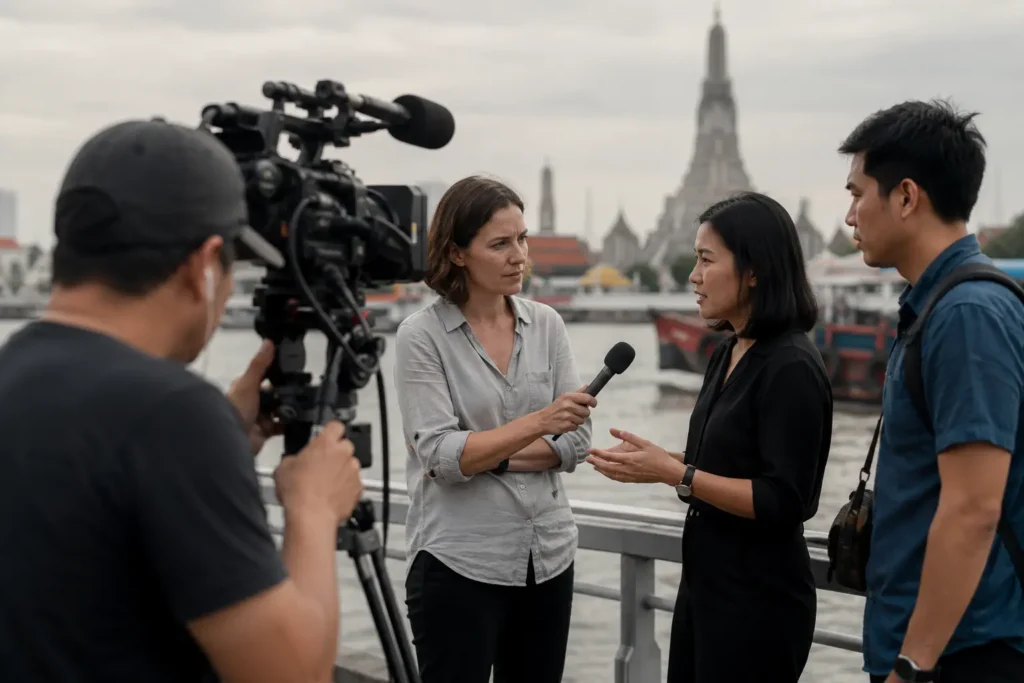
A documentary fixer in Thailand is not a film fixer with a different label. The work is different. The clients are different. The risk profile is different. International broadcasters commissioning observational, current-affairs, investigative, or environmental documentaries out of Thailand need a counterparty in Bangkok who understands how a foreign-correspondent crew operates, what a network compliance team requires, how to move through permits and press accreditation without slowing the story, and how to keep crew and sources safe when subjects are sensitive. This guide sets out what international broadcasters and documentary producers should expect when sourcing a documentary fixer Thailand engagement, and how the right fixer protects the story, the crew, and the network behind it.
Overgrown is a Bangkok-based, TFO-registered production service company with fifteen years of documentary credits for international broadcasters including Vice, the United Nations, Lion TV, and Reuters. The work that follows is grounded in what those teams actually need on the ground.
What a documentary fixer in Thailand actually does
A documentary fixer in Thailand is the in-country production lead who makes a foreign documentary or news shoot possible. The role bridges three things: access (to people, places, and information that a visiting crew cannot reach alone), logistics (permits, transport, accommodation, crew, kit), and judgement (knowing when a subject is safe to film, when a permit is genuinely needed, when an interview should be moved, when a location is wrong for the story).
Where a film fixer for a fiction shoot is primarily an extension of the line producer, a documentary fixer is closer to a field producer. They research the story alongside the broadcaster’s team, build the contact list, arrange the interviews, scout the locations, manage permits and accreditation, hire and run the crew, and stand on set as the interface between the foreign correspondent or director and the Thai context. On a sensitive subject they also assess risk — for the crew, for sources, and for the production company that has to keep operating in Thailand after the story airs.
Why English-speaking matters when choosing a documentary fixer Thailand
This is the single most underestimated variable in vendor selection. Thailand has many capable production crews. Far fewer operate in fluent, technical, broadcaster-grade English across the full team — fixer, producer, cinematographer, sound recordist, drivers, and crew leads. A documentary shoot is conducted in real time: the correspondent asks the fixer a follow-up question between takes, the sound recordist needs a cue called in English, the director gives notes through translation that have to land cleanly.
For a broadcaster, English-speaking crew across the board is what separates a documentary fixer Thailand engagement that runs cleanly from one that stalls on every interview. It is also what allows the broadcaster’s compliance, legal, and editorial teams to communicate directly with the Thai-side production lead during the shoot, not through a relay. International broadcasters — Vice, Reuters, the United Nations, Lion TV, and the BBC-aligned independent doc world — work in English, and the fixer needs to be able to operate inside that conversation, not adjacent to it.
The second dimension is interview translation. A documentary fixer who can sit in a Thai-language interview, follow the substance, and quietly cue the correspondent on a follow-up — and who can later supervise a clean transcript and translation for the edit — turns hours of edit-room confusion into clean cuts. That capability is part of the role, not an extra service.
The day-to-day work of a documentary fixer in Thailand
On a typical international documentary or news shoot, the documentary fixer Thailand workflow runs across pre-production, shoot days, and a short wrap phase. Pre-production usually begins three to eight weeks before crew arrival depending on the complexity of the story. The fixer reads the brief, researches the contributors, makes the approach calls, secures the interview commitments, scouts the locations, books transport and accommodation, hires the technical crew, and prepares the permit and press accreditation paperwork.
On shoot days the fixer is on set from call to wrap, running the schedule, managing interview prep, coordinating with security where relevant, troubleshooting access issues that arise on the day, and acting as the cultural and contextual translator between the director and the Thai context. The work is rarely visible in the final cut but it determines whether the cut exists.
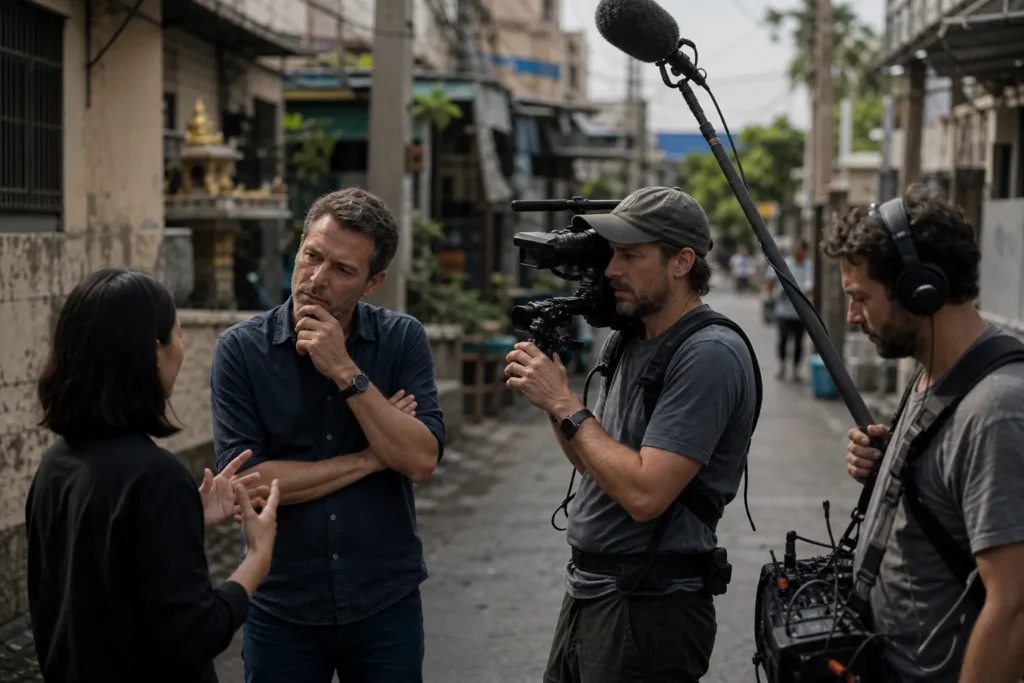
The wrap phase covers materials hand-off, transcript and translation supervision, additional B-roll requests that come back from the edit, follow-up interviews if the story develops, and the documentation a broadcaster’s compliance team needs to clear the cut. A documentary fixer who delivers a clean wrap is the one the broadcaster calls again on the next assignment.
Sensitive subjects, source protection, and journalist safety on documentary fixer Thailand assignments
Investigative and current-affairs documentary work in Thailand frequently involves subjects where source protection is not optional. Trafficking, organised crime, political reporting, environmental abuse, labour exploitation, and corruption stories all carry risk for the people who agree to be on camera, the people who speak off the record, and the foreign crew who turn up to film. A documentary fixer Thailand engagement on subjects like this is part field producer, part risk manager.
The practical work covers a few things. Identifying contributors who can be filmed safely versus those who should remain off-camera. Locations where filming will not expose a source. Travel plans that keep the crew and the contributors apart in public. Data handling on shoot — encrypted drives, secure transcripts, not naming sources in filenames or call sheets. Post-shoot follow-up with contributors who may face consequences after a story airs. None of this is bolt-on. It is built into how the shoot is planned.
The other side of the same coin is journalist safety. International broadcasters often arrive in Thailand from regions where their crew has higher exposure to threats, and the fixer’s job includes briefing the crew on local risk factors, managing the relationship with local authorities where helpful, and pulling the shoot when a situation changes. A fixer who refuses to make the cautious call when it is the right one is the wrong fixer.
News, current affairs, and rapid-response deployment for documentary fixer Thailand work
Not all documentary work has a long pre-production runway. News bureaus deploying for a breaking story — a political development, a disaster, a court ruling, an arrival — often need crew on the ground within twenty-four to forty-eight hours. A documentary fixer Thailand operation that can support both modes is the one international broadcasters keep in their contact book.
Rapid-response deployment looks different to the long-form workflow. The fixer is making calls during the flight in, locking accreditation overnight, sourcing a small crew (cinematographer, sound, driver) for a same-day or next-day deployment, and adapting the shoot plan as the story moves. The kit travels light: small-form camera, run-and-gun lens kit, lavalier and shotgun audio, mobile broadcast-spec transmission, backup batteries. Edit and transmission happen in hotel rooms or local facilities. The fixer’s value in this mode is decisive in-country judgement, not elaborate logistics.
The same team that runs a multi-week observational documentary should be able to drop into a forty-eight-hour news brief. Continuity matters. A broadcaster’s bureau chief calling a fixer they have used before, on a story breaking now, gets a faster and more reliable result than starting a vendor search at deadline.
Permits, press accreditation, and TFO access for documentary teams
Documentary and news work in Thailand sits across two regulatory frames. Most documentary film work — observational, environmental, current affairs filmed for broadcast or streaming distribution — runs through the Thailand Film Office (TFO) under the Department of Tourism, which administers film permits and foreign crew acknowledgement for international productions. The TFO process is administered under published criteria, updated from time to time, and a registered service company is the required counterparty for foreign productions filing through TFO. For the wider permit picture, see our Thailand Film Permit Guide and the Thailand Film Office.
Journalistic and news work — foreign correspondent coverage, current affairs, hard news — often runs through a separate press accreditation track administered by the Ministry of Foreign Affairs and the relevant Thai authorities, which issues press credentials to foreign journalists and supports access to government events and certain interviews. Many international documentary shoots operate across both tracks at once: TFO acknowledgement for the production, press accreditation for the correspondent, and a fixer who can move between the two without delaying the schedule. Authoritative regulatory information is available from the Ministry of Foreign Affairs of Thailand.
Knowing which track applies — and when both apply — is part of the documentary fixer’s judgement. Producers who arrive without that distinction worked out can find themselves caught between two regulatory frames at the worst possible moment.
Equipment and crew kit for broadcast and streaming documentary specs
International broadcasters have technical specifications. A documentary delivered to Vice, the United Nations, Lion TV, Reuters, or a streaming platform commission has to meet specific resolution, frame-rate, codec, audio, colour-space, and delivery standards. A documentary fixer in Thailand needs to understand the spec before the first shoot day and source crew and kit that can deliver against it.
For broadcast and streaming documentary work the typical kit pool covers small-form cinema cameras (Sony FX6 / FX9, Canon C70 / C300 / C500 II) for observational and current-affairs shoots, larger cinema bodies (Sony Venice, ARRI Alexa Mini LF) for premium long-form, run-and-gun audio (lavalier, shotgun, wireless), reliable mobile broadcast transmission for news work, and aerial coverage where the story calls for it. Files are captured to broadcast-acceptable codecs (ProRes 422 HQ, XAVC) and managed with a clear DIT workflow so the rushes arrive at the edit in the format the post house expects.
Crew matters as much as kit. A documentary cinematographer in Thailand is a different hire to a commercial DoP — the work requires patience, observational instincts, an ear for interview light, and the ability to work invisibly. The same applies to sound. A documentary sound recordist who can run a fifteen-minute interview with multiple lavaliers, handle ambient sound, and deliver clean tracks to broadcast spec is the foundation of a watchable documentary.
Working with international TV channels — broadcaster workflow expectations
International broadcasters bring workflow expectations that a Thai documentary fixer needs to meet from the first call. Editorial guidelines, compliance requirements, source-handling protocols, security protocols, kit specifications, and delivery timelines are all set by the network and the fixer operates inside them. The role is not to push back on the network’s process but to make it run cleanly in the Thai context.
The practical work covers: pre-shoot risk assessments shared with the broadcaster’s safety team, contributor consent documentation that meets the network’s legal standard, materials labelling and metadata aligned to the post house’s ingest workflow, daily rushes review with the field producer or commissioning editor, and a final hand-off that lets the edit start without delay. Broadcasters that have used a fixer through one full delivery cycle and seen the wrap done cleanly tend to come back — that continuity is how the trusted-vendor relationship is built.
For a wider view of how international productions structure their Thai partner relationships, our Production Services Bangkok Thailand page covers the broader full-service offering, and our Film Fixer Thailand Hiring Guide covers the parallel film-fixer relationship for fiction work.
How Overgrown handles documentary fixer Thailand assignments
Overgrown’s documentary unit operates out of Bangkok with bilingual English-Thai senior crew, in-country reach across all seventy-seven Thai provinces, and a credit list that includes long-form documentary, current affairs, and news work for Vice, the United Nations, Lion TV, and Reuters. The team handles the full documentary fixer Thailand workflow — story research, contributor outreach, permits and press accreditation coordination, crew and kit sourcing, on-set field production, source protection on sensitive shoots, and a clean wrap into the broadcaster’s post pipeline.
Equipment standards are broadcast-grade across the board. Cinema bodies, broadcast audio, mobile transmission, and aerial coverage are all available in-house or on call. Crew are English-speaking across senior roles and operate to international broadcaster workflow expectations. On rapid-response news briefs the team deploys inside twenty-four to forty-eight hours where the story allows. On long-form observational documentaries the team integrates into the broadcaster’s editorial workflow as a Thai-side field producer extension.
The trust international broadcasters place in the team is a function of repeat work, not marketing. The same bureau chiefs, producers, and commissioning editors come back across multiple stories because the wrap was clean, the sources were protected, and the delivery met spec. That is the standard the documentary fixer Thailand role is measured against.
Frequently asked questions
What’s the difference between a film fixer and a documentary fixer in Thailand?
A film fixer supports a fiction production as an extension of the line producer — locations, permits, crew, equipment, scheduling. A documentary fixer in Thailand operates closer to a field producer: story research, contributor outreach, interview arrangement, sensitive-subject handling, and editorial workflow with the broadcaster. The skill sets overlap, but documentary work demands real-time editorial judgement that fiction fixing does not.
Are your documentary fixers and crew English-speaking?
Yes. Senior crew operate in fluent, technical, broadcaster-grade English across fixer, producer, cinematographer, sound recordist, and crew leads. Editorial and compliance teams at international broadcasters communicate directly with the Thai-side production lead during shoot without a translation relay.
Can you handle press accreditation and government access for news teams?
Yes. Press accreditation for foreign correspondents is administered separately from film permits, and the team coordinates with the relevant Thai authorities to secure the accreditation, government event access, and interview clearances that a news brief requires. For combined documentary and news work, accreditation runs alongside TFO film permits.
How quickly can a documentary unit deploy in Thailand?
For rapid-response news briefs the team deploys within twenty-four to forty-eight hours where the story allows, with a small-form crew and run-and-gun kit. Longer-form observational documentaries follow a standard three-to-eight-week pre-production runway. Both modes are run by the same senior crew, which preserves continuity between news and long-form work.
More questions about Documentary Fixer in Thailand
Do you support investigative documentary work with sensitive sources?
Yes. Source protection is built into the shoot plan from the brief stage — contributor selection, location choice, travel and communications protocols, encrypted data handling, and post-shoot follow-up with sources. The team has delivered investigative and current-affairs work for international broadcasters across subjects where source protection is non-negotiable.
What broadcast and streaming specs can you deliver to?
The team works to the technical specifications set by the commissioning broadcaster or streaming platform — resolution, frame rate, codec, audio, colour space, and delivery format. Cinema bodies, broadcast audio, mobile transmission, and aerial coverage are all available, and the DIT workflow is structured so rushes arrive at the post house ready to ingest.
Do you work with both single-day news shoots and long-form documentary?
Yes. The same senior crew supports both ends of the spectrum — a single-day current-affairs brief, a week-long news deployment, a multi-week observational documentary, a multi-province long-form shoot. Continuity between modes is part of why international broadcasters return for repeat work.
Can you handle multi-province documentary shoots out of Bangkok?
Yes. Bangkok is the production base but the team works across all seventy-seven Thai provinces — North to Chiang Mai and Mae Hong Son, Northeast through Isaan, South to Phuket and the Andaman coast, Central through Ayutthaya and Kanchanaburi. Multi-province documentary shoots are planned out of Bangkok with local crew and logistics in each region.
Commissioning a documentary fixer in Thailand
For documentary producers, news bureau chiefs, and commissioning editors planning Thai coverage — observational long-form, current affairs, investigative, or rapid-response news — the Bangkok team will scope the brief from the story up: contributor research, permit and accreditation track, crew and kit, security plan where relevant, and broadcaster-spec delivery. Email info@overgrownproductions.com with the story brief, the shoot window, and the broadcaster’s delivery spec, and we will return a structured documentary fixer Thailand proposal.