
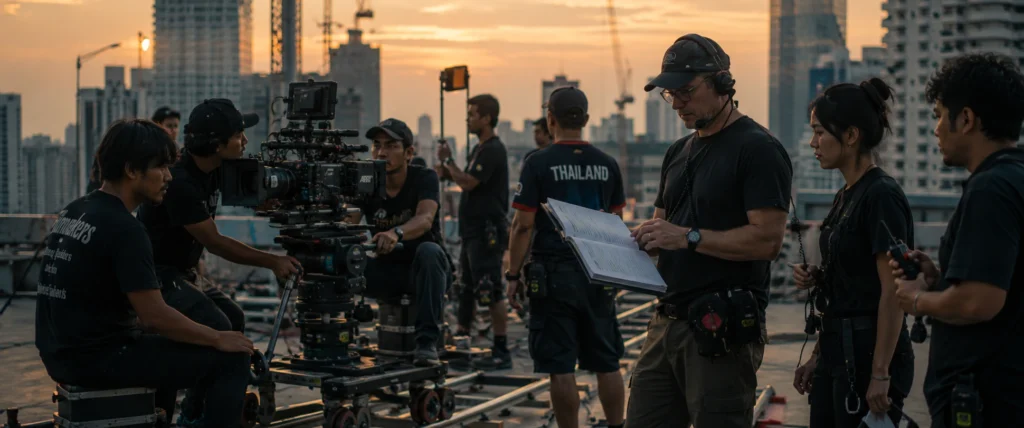
Hollywood productions Thailand: the state of play in 2026
The United States is currently the largest single-country investor in Thai film production. Between January and March 2026, Thailand hosted 162 international productions; the US led on investment value at approximately USD 9.5 million, ahead of India and France. The Thailand Film Office (TFO) confirmed a further wave of US-led projects after the European Film Market in February 2026, with combined slate budgets across the announced 2026–2027 pipeline exceeding THB 2.4 billion.
For Hollywood productions Thailand has become an unusual proposition in the region: cinematic scale, a revamped cash rebate, a one-permit-for-all-locations regime, and a Bangkok-based crew base that has been working to international standards for over a decade. This guide explains how US line producers, UPMs and executive producers actually structure a Thai shoot — from the TFO-registered service company down to USD-THB cashflow.
Why Hollywood productions Thailand go through a TFO-registered service company
A foreign production cannot file for the Thailand cash rebate directly. The rebate is administered by the Thailand Film Office under published criteria, and the application must be filed through a Thailand-registered production service company holding current TFO registration. That entity is also the contracting party for crew, vendors, locations and government bodies. Without it, a Hollywood production has no legal route to the rebate and no domestic vehicle to issue local invoices in baht.
For US producers, this shapes the operating model from day one. The Thai service company sits between the Hollywood production entity (typically the US LLC, LP or studio production company) and every Thai vendor on the shoot. It carries the local tax obligations, manages the rebate documentation trail, and signs off on Thai labour, immigration and customs paperwork. Choosing a service partner that has handled US-scale productions before is the highest-leverage decision a Hollywood production makes after greenlight.
The 2026 incentive framework Hollywood productions Thailand engage with
Thailand operates a tiered cash rebate administered by the TFO under criteria that are updated from time to time. Higher qualifying spend brackets unlock higher rebate percentages, and the framework includes additional bonus tiers tied to hiring Thai key-team positions, completing post-production in Thailand, filming in designated provinces, and producing content that supports positive representation of the country. The framework no longer caps total rebate value per project.
The mechanics are worth flagging early because they shape the budget conversation with a US studio or financier. Qualifying spend, supporting documentation, eligible Thai vendor invoices and audit trail standards all flow through the Thai service company. For a full breakdown of how the rebate is structured for 2026, see our Thailand Film Incentive 2026 guide. Always confirm the current rebate percentages and thresholds with the TFO directly before locking a budget; the framework is reviewed periodically and US producers should never plan against a number sourced from a third-party site.
What a service company actually delivers for Hollywood productions Thailand
The right Thai service company does more than open a bank account and hire drivers. For a Hollywood production, the scope typically covers six interlocking deliverables.
- Permit applications. Filing the script, location list, shoot schedule, crew manifest and equipment list with the TFO; coordinating provincial and site-specific clearances on top of the master permit.
- Crew sourcing. Bilingual heads of department, assistant directors who hand off cleanly to US ADs, camera and grip teams familiar with North American workflows, art and construction departments scaled to feature scope.
- Location scouting and contracting. Real recces, not file folders. Hold-fee negotiations, location releases, security plans, and traffic-management coordination with the relevant authorities.
- Visa and work permits. Processing the Non-Immigrant M Visa for foreign cast and crew, plus the corresponding work permit endorsements that legally allow them to perform paid work in Thailand.
- Equipment, customs and ATA Carnet. Coordinating temporary import of foreign camera, lighting and grip packages under the ATA Carnet system or equivalent customs bonds, plus sourcing Thai-based rental equivalents where carnet is impractical.
- Rebate documentation. Maintaining the audit trail from day one so the post-shoot TFO application has clean Thai vendor invoices, banking records, payroll documentation and proof of qualifying spend.
Crew, departments and US-standard workflow expectations
Hollywood productions Thailand depend on hits the rest of the region rarely matches: a crew base bilingual in English and Thai, comfortable with US-style script breakdowns, daily call sheets, sides, and continuity reporting. Production departments — camera, sound, grip, electric, art, costume, hair and make-up, locations, transport, catering — are sourced in Bangkok and travel out to locations across the country.
For US-scale productions, the practical question is depth. A Hollywood production with a 60–120-person base crew expects multiple qualified second-unit DPs, multiple key grips, full SFX rigging teams, stunt coordination, and an art department that can build to feature-film scale. Bangkok carries that depth. Provincial shoots typically draw a core crew from Bangkok and supplement with regional fixers, drivers and local production assistants.
Locations Hollywood productions Thailand commonly use
Bangkok itself doubles for global cities — high-rise canyons, modern transit, riverside districts, neon nightlife, hospital interiors, office blocks. Phuket and the Andaman coast cover marine, yacht and tropical-island work. Chiang Mai and the north handle mountain, river-valley and heritage-town settings. Kanchanaburi covers jungle, World War II history and remote river systems. Ayutthaya provides UNESCO-listed ruins and central-Thailand period coverage. Krabi and the south extend the marine and island slate.
Each location involves its own permit specifics. National parks have shooting fees, daily caps on crew numbers, restrictions on heavy equipment and protected wildlife zones. UNESCO sites at Ayutthaya restrict drones and require Fine Arts Department clearance for ruin proximity. Bangkok’s police and traffic authorities co-ordinate on road closures and street shoots. For deeper detail on individual provinces, our Thailand filming locations guide outlines a 25-site breakdown for producers.
Visas, work permits and equipment imports for US crew
US cast and crew working in Thailand on a paid production cannot enter on a tourist or visa-exempt entry. The legal vehicle is the Non-Immigrant M Visa (media/film) at a Royal Thai Embassy or Consulate-General overseas, supported by an invitation letter from the Thai service company and a TFO endorsement. Once in country, foreign crew also require a work permit endorsement that allows them to legally perform their role on a Thai-domiciled production.
Processing times vary by consulate; US producers should plan a minimum of three to four weeks of lead time on the visa step and have the service company file the supporting documents well ahead of departure. Equipment imports follow a parallel track. Camera, lighting, grip and specialist packages can move under the ATA Carnet for temporary import, with the Thai service company filing the bonded entry. Items not eligible for carnet require a customs bond or alternative temporary import procedure handled by a licensed Thai customs broker.
Bilingual workflow, time-zone management and reporting back to the studio
One of the practical realities of Hollywood productions Thailand is the 12-hour gap with Los Angeles and the 11-hour gap with New York. A studio executive who finishes the day at 7pm Pacific is asleep when the Bangkok unit starts shooting. Productions that run smoothly across that gap build daily reporting rhythms — call sheets and daily production reports issued in English ahead of the US morning, dailies handed off to a US-based post house overnight, weekly producer calls scheduled at the only window that works for both sides (usually a 7–9am Pacific / 9–11pm Bangkok overlap).
Bilingual production coordinators, first ADs and line producers carry that load. The Thai service company should issue all production paperwork in English by default. Any document that touches Thai government — permit applications, visa endorsements, work permits, tax filings — has a Thai-language counterpart filed in parallel. Both sets are retained for the rebate audit.
Post-production and finishing in Thailand
The 2026 framework includes a dedicated incentive route for animation, VFX and post-production work, designed so a Hollywood production can finish in Bangkok even if principal photography wraps in Thailand or elsewhere. Sound design, picture editing, colour grading, VFX and animation can all be commissioned through Thai post-houses against the post-production incentive, and the work qualifies on the basis of Thai service-fee invoices rather than a physical-shoot threshold.
For a Hollywood production, the decision is rarely binary. Many US productions split the post chain — sound and conform in Los Angeles, picture finishing or VFX in Bangkok, or vice versa. Our Thailand post-production rebate guide walks through how the finishing incentive interacts with the principal-photography rebate, how qualifying Thai post invoices flow back into the rebate calculation, and what audit trail the post-houses need to keep.
Banking, USD–THB flow and the rebate audit trail
The rebate is paid in Thai baht to the Thai service company after the TFO review, and is then transferred to the foreign production under the production service agreement. From a Hollywood production’s perspective, the cashflow looks like this: the US production company funds the Thai service company in USD under a production services agreement; the Thai service company spends those funds locally in baht against qualifying line items; at the end of the production those qualifying line items are bundled into the rebate filing; the rebate amount is paid back into the Thai service company in baht; the Thai service company remits the net to the production under the agreed terms.
Three practical points matter. First, the foreign exchange exposure between USD funding and THB spending sits on the production for the duration of the shoot. Second, the Thai service company is the audit trail — every qualifying invoice must be issued to it, every payment must clear from a Thai bank account it controls, and supporting documentation must be retained for the TFO review. Third, the period between principal photography wrap and rebate payment is months, not weeks; cashflow planning should not assume the rebate is in hand before the financial close.
How Overgrown supports Hollywood productions Thailand
Overgrown Productions is a Bangkok-based, TFO-registered full-service production company. We have served as the Thai production service partner on feature films, episodic content, commercials, documentaries and branded work for international clients across more than 15 years, with over 400 productions on the record. Our most recent Hollywood feature credit is the US chess thriller Contra, directed by Artisha Mann-Cooper, which we serviced through principal photography in Bangkok in May–June 2025. Our client roster includes Netflix, Vice, Al Jazeera, Universal, Warner Music, Reuters and the United Nations.
For Hollywood productions Thailand, our role is unchanged in shape across project sizes. We carry permits through the TFO; assemble crew, departments and locations to US production standards; coordinate Non-Immigrant M Visa and work permit endorsements for foreign cast and crew; handle ATA Carnet and customs work for incoming equipment; maintain the rebate audit trail across principal photography and post; and report production status in English to the studio or financing entity throughout. For producers comparing partners, our film fixer hiring guide outlines the questions worth asking any prospective service company before contracting.
Frequently asked questions about Hollywood productions Thailand
Can a US production claim Thailand’s cash rebate directly?
No. The rebate is administered by the Thailand Film Office and is paid only to a Thailand-registered production service company holding current TFO registration. A US production contracts that Thai service company under a production services agreement; the rebate is filed by the Thai company and remitted to the US production under the agreement.
What does “TFO-registered” actually mean for Hollywood productions Thailand?
TFO registration is the formal status that allows a Thai production company to file rebate applications and handle film permits on behalf of foreign productions. It is not optional — productions that try to route incentive paperwork through a non-registered local company face rejection of the application.
How long does it take to set up a Hollywood production in Thailand?
From greenlight to first day of principal photography, eight to twelve weeks is realistic for a feature with location scouting, crew assembly, permit applications, visa processing and equipment shipping. Smaller commercial and documentary builds can run faster — three to six weeks — depending on scope.
Do US crew need a visa to work on a production in Thailand?
Yes. Any foreign crew performing paid work in Thailand requires a Non-Immigrant M Visa (media/film) obtained at a Royal Thai Embassy or Consulate-General outside Thailand, plus a corresponding work permit endorsement. Tourist or visa-exempt entries do not permit paid work and create immigration risk for the production.
More questions about Hollywood Productions in Thailand
Can a Hollywood production import camera and grip packages temporarily?
Yes. Most professional camera, lighting and grip packages are eligible for temporary import under the ATA Carnet system or an equivalent customs bond. The Thai service company files the bonded entry with Thai Customs and is responsible for the corresponding re-export at the end of the shoot.
Are Thai crew comfortable with US-style call sheets and production reports?
In Bangkok, yes. The bilingual crew base has been working with US, UK and European feature, commercial and streaming productions for more than fifteen years. Call sheets, sides, daily production reports and continuity logs are issued in English by default; Thai-language counterparts cover government and labour filings.
Can Hollywood productions Thailand split post-production between Bangkok and Los Angeles?
Yes — and this is increasingly common. Thailand offers a dedicated incentive for animation, VFX and post-production performed in Thailand; productions frequently route picture finishing, VFX or sound to Bangkok against this incentive while keeping the remainder of post in the US. The Thai service company can administer the post-side rebate filing in parallel with the principal-photography filing.
What is the typical cashflow window between wrap and rebate payment?
Plan for months, not weeks. The rebate filing is prepared after wrap, reviewed by the TFO, and paid in baht to the Thai service company. US producers should not model the rebate as in-hand before the financial close of the production; treat it as a back-end recovery against budgeted Thai spend.
Plan a Hollywood production in Thailand
If you are a US line producer, UPM, executive producer or studio executive scoping a feature, episodic, commercial or documentary production in Thailand and want a TFO-registered service partner to carry the permit, crew, visa, equipment and rebate work, our Bangkok team is the point of contact. Write to info@overgrownproductions.com with the production brief — title, shoot window, scale, and the territories already in your servicing comparison — and we will respond with a fit assessment, a service-scope outline and a route to a working budget.