
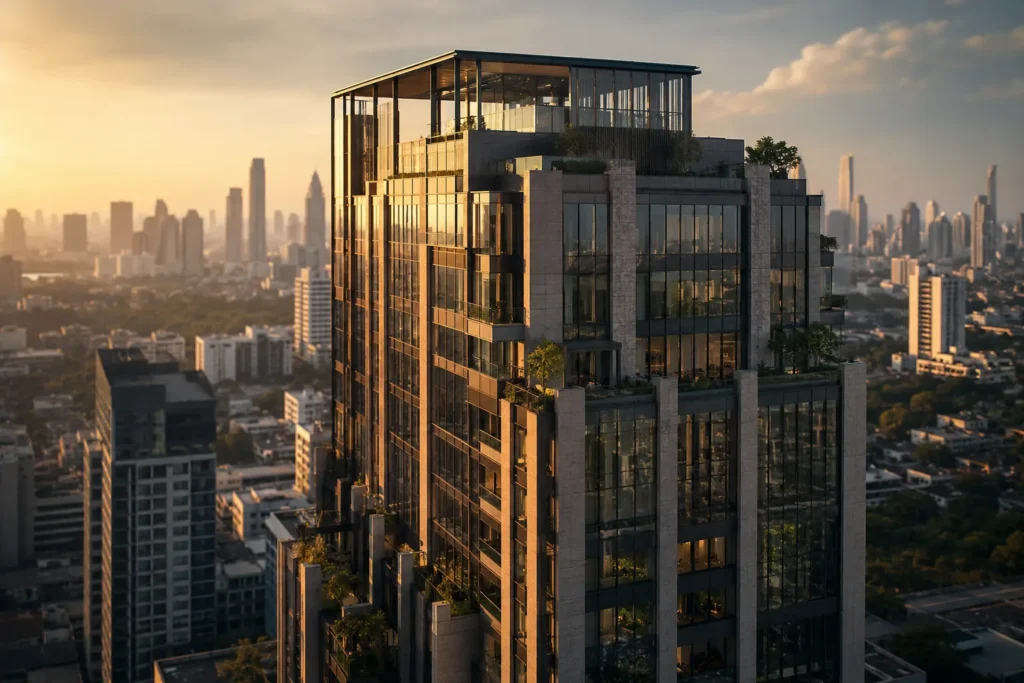
Architectural drone photography in Bangkok has moved a long way past the rooftop fly-by shot. Developers commissioning a new tower, architects packaging a portfolio for an international competition, hospitality groups marketing a beachfront resort that opens off Sukhumvit Road — all of them now expect aerial coverage that looks like a feature-film unit shot it. Static elevations and corporate establishing shots are no longer competitive. Bangkok is one of the densest, most photogenic skylines in Southeast Asia, and aerial coverage of buildings here demands a production approach that respects airspace rules, weather, sensor capability, and the colour science of Bangkok’s particular light.
This guide sets out how architectural drone photography Bangkok work is actually planned and executed — the equipment, the regulatory framework, the deliverables clients commission, and how an experienced production team approaches an architectural brief. It is written for the people who commission the work: developers, architects, real estate marketing teams, hospitality brands, advertising agencies, and the construction and engineering firms behind some of Bangkok’s most ambitious buildings.
Why architectural drone photography Bangkok work matters for serious projects
A building looks different from the air. Mass, scale, the way a structure sits inside its block, the relationship between the facade and the wider neighbourhood — all of that becomes visible from twenty metres up, and unmissable from sixty. Ground-level architectural photography captures detail, but the aerial frame is what communicates ambition. For a Bangkok project competing for international tenants, foreign investors, or hospitality bookings, that ambition has to be visible at a glance.
The shift to drone-first architectural coverage has been driven by three changes. Drone sensor technology has caught up with cinema and high-end stills. Regulatory frameworks in Thailand now make compliant commercial flying straightforward when handled by a registered operator. And the global expectation for marketing assets — driven by social, streaming, and immersive web — now favours moving aerial footage and high-resolution aerial stills over static ground photography. Architectural drone photography Bangkok briefs that would once have been a single afternoon are now production days with planned shot lists, lighting windows, and multi-camera coverage.
What architectural drone photography in Bangkok actually covers
The category is broad. On any given Bangkok project, architectural drone photography can include the hero exterior elevation shot, the orbit around the building, the descending reveal that ties the building to its neighbourhood, the rooftop amenity coverage, construction-progress documentation, facade detail captured from sustained hover positions, and the wide context shot that places the project in the city.
The deliverables typically split across stills and motion. Stills serve the architect’s portfolio, the developer’s sales brochure, awards entries, press releases, and the building’s permanent record. Motion serves the marketing campaign, the social cut-down, the investor presentation, and increasingly the integrated CGI/live-action work where the drone capture forms the live-action plate. A serious architectural brief asks for both, and the production needs to plan the shoot so each deliverable is captured at its optimum moment without compromising the other.
Equipment, sensors, and quality standards for architectural drone work
Equipment choice is not interchangeable. For high-end architectural drone photography Bangkok shoots, the workhorse platforms are the DJI Inspire 3 with its 8K full-frame X9-8K Air camera capable of ProRes RAW, the DJI Mavic 3 Pro with its Hasselblad-tuned main sensor for tight, fast-deploying briefs, and heavy-lift platforms like the DJI Matrice 350 RTK or Freefly Alta X when the brief calls for a cinema camera body in the air.
Sensor format matters because architectural work lives or dies on dynamic range, colour fidelity, and resolution. Bangkok skies are bright, exteriors are reflective, and the contrast between a glass facade in midday sun and the shaded street below can exceed twelve stops. A consumer-grade drone clips highlights and crushes shadows. A cinema-grade aerial platform with the right log profile preserves enough latitude that the architectural intent survives the grade.
RAW stills are non-negotiable for architectural deliverables. Compressed JPEG is acceptable for social cut-downs but not for archive or print. Motion capture should default to ProRes RAW or ProRes 422 HQ where the platform allows, with H.265 reserved for live-monitoring proxies. A production crew that defaults to 1080p H.264 is not equipped for this work.
Bangkok airspace, permits, and regulatory framework for drone operations
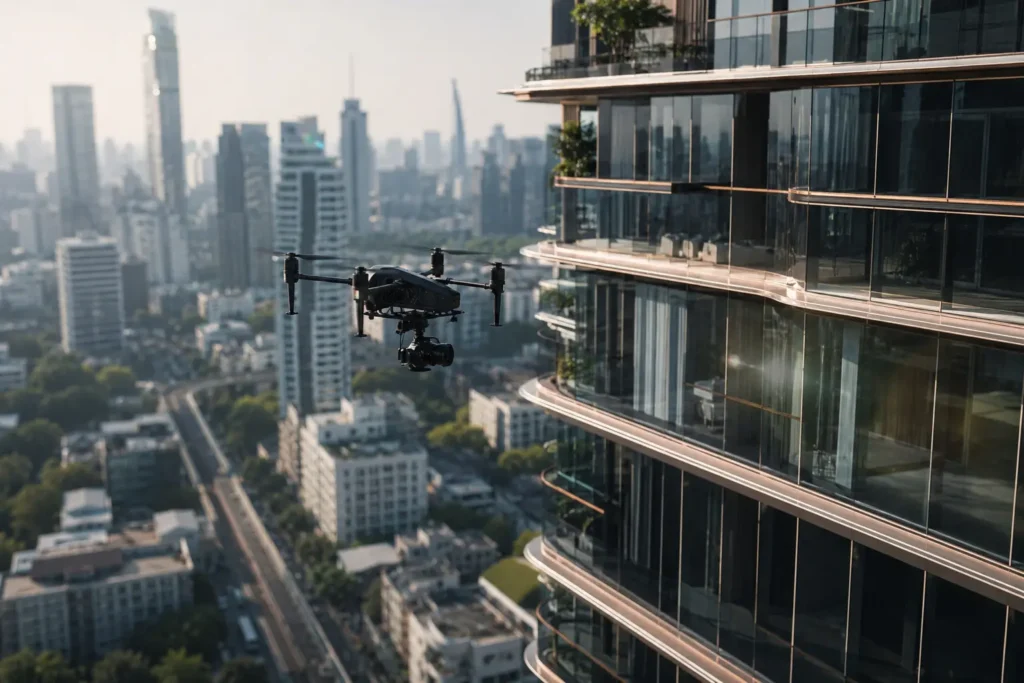
Drone operations in Thailand are governed by the Civil Aviation Authority of Thailand (CAAT) and require the drone equipment to be registered with the National Broadcasting and Telecommunications Commission (NBTC). Commercial operators must hold the relevant CAAT permissions, and flights in central Bangkok have layered constraints: airport proximity rules around Don Mueang and Suvarnabhumi, no-fly zones over the Grand Palace and government complexes, building-height considerations near sensitive infrastructure, and event-day restrictions during state functions.
None of this is prohibitive — it is procedural. A registered, compliant operator handles the CAAT and NBTC paperwork as part of pre-production, scopes the airspace constraints around the specific site, and submits flight notifications where required. For shoots near restricted zones the lead time extends. For routine architectural work on a private site away from restricted airspace, the regulatory step is straightforward but must still be done. The full regulatory picture is administered by the relevant Thai authorities and the rules are updated from time to time — operators are expected to stay current. Authoritative information is available from the Civil Aviation Authority of Thailand and the National Broadcasting and Telecommunications Commission.
Property-level permissions are a separate layer. Flying over the project site itself, on the developer’s own land, is straightforward. Flying over adjacent private property — even briefly, even at altitude — may require the neighbouring owner’s consent. Established production teams check this at scout stage and plan flight paths that avoid the question where possible.
Planning an architectural drone photography Bangkok shoot
A well-planned architectural drone shoot starts with the brief, not the drone. The first questions are about the building, the audience, and the use case. Is the deliverable a hero campaign image, a leasing brochure, an awards submission, a construction progress reel, or a finished marketing film? Each calls for different angles, different lighting conditions, and different post workflows.
From there a scout day on the building is invaluable. The scout establishes the sightlines from the air, the time of day when the facade is best lit, the surrounding buildings that frame or interfere with the shot, the safe take-off and landing points on the property, and the airspace constraints specific to that exact address. For an architectural drone photography Bangkok project on a constrained downtown site, the scout often dictates the entire shoot plan.
The shoot itself is typically a one- or two-day production with a dedicated pilot, a camera operator running the gimbal, a spotter, and a production lead managing the shot list and client approvals. Heavy-lift cinema platforms add a focus puller. The shot list is locked before flight day — improvising in the air burns battery and gives unpredictable results.
Weather, time of day, and seasonal considerations
Bangkok’s weather is not a footnote. Architectural drone work is a daylight discipline and the city’s light changes character through the day. Mid-morning and late-afternoon golden hour give modelled facade light, deep shadows that define mass, and a warm colour palette that grades beautifully. Midday delivers flat overhead light, hot highlights, and crushed shadows — usable for technical documentation but not for hero marketing frames.
Seasonally, Bangkok’s cool dry season from November through February delivers the clearest skies and the most reliable shoot days. The hot season tends towards haze that dulls long-lens compression. The rainy season — May through October — narrows the shooting window but produces some of the most dramatic skies of the year if a production can move quickly between storm cells. Architectural drone photography Bangkok teams that work year-round build slack into the schedule for weather contingency.
Wind matters as much as rain. Drone platforms are rated for specific wind ceilings — typically 10 to 15 metres per second for cinema platforms — and Bangkok’s high-rise corridors create vertical wind shear that can exceed ground-level forecasts. A scout reading of wind at altitude is part of professional flight planning.
Post-production: stitching, colour grading, and architectural retouching
The raw capture is only half the deliverable. Architectural drone photography Bangkok work demands a post pipeline that respects the architect’s intent and the developer’s brand. For motion, that means a colourist who handles log-encoded aerial footage, a workflow that conforms to the wider campaign LUT or grade, and a render pipeline that delivers in the client’s required mastering format. ProRes 422 HQ at the working stage; final masters in whatever the deliverable specifies — broadcast, streaming, social, or DCP.
For stills, post is more involved than the audience usually realises. Aerial stitches stitch wide-context shots from multiple frames; perspective correction aligns vertical facades; sky replacements bring weather-dependent shoots up to brand standard; controlled retouching cleans construction cranes, scaffolding, or neighbouring eyesores from the frame. The line between honest documentation and over-retouched marketing imagery is one the production team and the architect should agree upfront.
Common architectural drone deliverables — what clients actually use
The deliverable list for a serious architectural shoot is longer than the brief usually anticipates. Typical output from a one-to-two-day architectural drone photography Bangkok production includes the hero exterior elevation in stills and motion, three-to-five orbit variations at different heights, the reveal-ascent and descent moves, four-to-six rooftop and amenity coverage frames, a wide-context establishing shot, construction-progress comparison frames if relevant, and a social-media cut-down package edited from the motion plates.
Increasingly, clients also commission integrated CGI extensions where the drone plate forms the live-action base for visual effects work — finished building visualisations dropped into the aerial of the construction site, neighbouring planned developments composited in, or future landscape designs grown into the frame. That work bridges architectural drone photography and post-production VFX, and the drone capture has to be planned to support it.
Who commissions architectural drone photography Bangkok work
The client base divides into a few clear groups. Real estate developers commissioning marketing assets for residential or mixed-use launches are the largest. Architecture firms commissioning portfolio and awards-entry imagery for completed buildings are next. Hospitality brands marketing resorts, hotels, and branded residences sit alongside them. Construction and engineering firms commissioning progress documentation for stakeholder reporting are the technical end of the market. Advertising agencies producing campaigns for any of the above package architectural drone work into wider creative shoots.
Each of these clients has different decision-makers, different tolerance for shoot duration, and different deliverable expectations. A developer marketing team wants emotion, scale, and brand-consistent grading; an engineering firm wants documentation, scale references, and accurate timestamping; an awards submission wants three or four images that can stand alone in front of a jury. The production approach has to bend to the audience.
How Overgrown approaches architectural drone projects in Bangkok
Overgrown is a Bangkok-based, TFO-registered full-service production company with fifteen years of international production credits across feature film, commercial, documentary, and branded content. Architectural drone photography sits inside the commercial and branded-content side of the business, and the team approaches it with the same production discipline applied to international film work — scout, shot list, regulatory clearance, weather planning, cinema-grade capture, and a structured post pipeline.
On the equipment side, the team operates across the DJI Inspire 3 with X9-8K Air, the DJI Mavic 3 Pro, and heavy-lift platforms for cinema-camera aerial work where the brief requires it. Pilots are CAAT-registered, drones are NBTC-registered, and shoots are operated with proper insurance, redundant batteries, and on-site backups. The Bangkok production base means same-week or rapid-deployment briefs are achievable for clients that need fast turnaround.
For architects and developers planning a building reveal, an awards submission, a campaign launch, or a progress documentation cycle, the team will scope the shoot from the address up — site visit, airspace check, shot list, weather window, deliverables, post workflow. For producers planning a wider commercial shoot in Thailand, our Film Production Services Bangkok page outlines the full-service offering, and the Filming in Thailand guide covers the wider production context.
Frequently asked questions
Do you need a permit to fly a drone in Bangkok?
For commercial flights, yes. Operators must be registered with the Civil Aviation Authority of Thailand (CAAT), drone equipment must be registered with the National Broadcasting and Telecommunications Commission (NBTC), and specific airspace zones around airports, government complexes, and sensitive sites carry additional restrictions. A registered operator handles the paperwork as part of pre-production.
Which drones are best for architectural photography in Bangkok?
For high-end architectural drone photography Bangkok work, the workhorse platforms are the DJI Inspire 3 with the X9-8K Air camera for cinema-grade motion capture, the DJI Mavic 3 Pro with Hasselblad sensor for fast-deploying stills and motion briefs, and heavy-lift platforms like the DJI Matrice 350 RTK or Freefly Alta X when the brief calls for a cinema camera body in the air.
How long does an architectural drone shoot take?
Most architectural briefs run a one- or two-day production: a scout half-day plus a full shoot day, or two contiguous shoot days for buildings with complex sightlines, large amenities, or both hero stills and motion deliverables. Construction progress documentation cycles are shorter — typically half-day flights repeated on a monthly or quarterly cadence.
Can drones fly close to high-rise buildings in Bangkok?
Yes, with the right pilot and the right platform. Cinema-grade drones are rated for proximity work and experienced pilots fly close passes alongside facades and around corners safely. Wind shear in Bangkok’s high-rise corridors is the practical constraint — wind at thirty floors is often double the ground-level forecast — and flight planning has to account for it.
More questions about Architectural Drone Photography and Video in Bangkok
What about drone flights over neighbouring properties?
Flying directly over the project site is straightforward. Flying over adjacent private property may require permission from the neighbouring owner. A professional team checks this at the scout stage and plans flight paths that avoid the question where possible, or secures the necessary consent in writing before the shoot day.
Do you supply both stills and 4K/6K/8K video?
Yes. On most architectural drone photography Bangkok shoots both stills and motion are captured. Stills are delivered in RAW for archive and post, motion is captured in ProRes RAW or ProRes 422 HQ depending on the platform and finishing workflow, and deliverables are mastered in 4K, 6K, or 8K according to the brief.
How is architectural drone footage colour-graded?
Aerial footage is shot in a log profile to preserve dynamic range, then graded in post by a colourist working from the project’s wider brand LUT or campaign grade. Bangkok’s light has its own character — warm at golden hour, hazy in the hot season — and an experienced grade respects the architect’s intent while resolving the technical challenges the aerial frame introduces.
How quickly can a drone team be deployed in Bangkok?
For straightforward briefs on uncomplicated sites, same-week deployment is achievable. For shoots near restricted airspace, with cinema-grade heavy-lift platforms, or requiring multi-day scout-and-shoot, the lead time extends to two to four weeks. Construction progress cycles can be scheduled in advance on a monthly or quarterly cadence.
Commissioning an architectural drone production in Bangkok
For developers, architects, hospitality brands, and agencies planning aerial coverage of a Bangkok project, the Overgrown team will scope the shoot end-to-end — site visit, airspace clearance, shot list, weather window, equipment, capture format, post pipeline, and deliverables. Email info@overgrownproductions.com with the project address, the intended use of the deliverables, and the shoot window, and we will return a structured production proposal.