
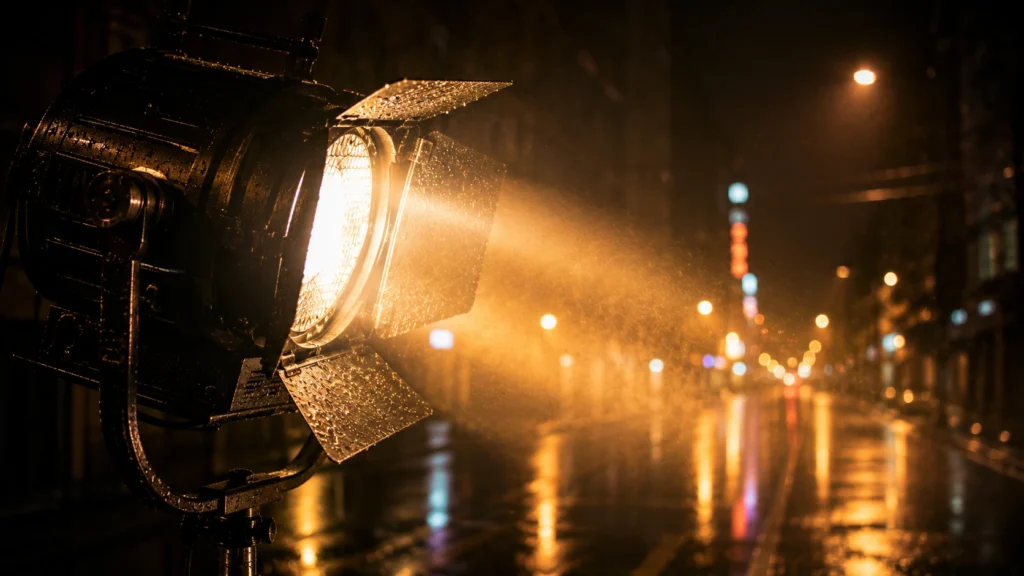
Night filming in Thailand produces some of the most distinctive frames a foreign production can bring home: Bangkok’s neon-washed streets, temple silhouettes under floodlight, coastal towns glowing against a black sea, and jungle exteriors where the only light is the one you build. For international line producers and directors of photography, the appeal is obvious. What is less obvious, until you are on the ground, is how much a night shoot in Thailand depends on planning that starts weeks before the first setup. This guide sets out how night filming in Thailand actually works: the permits, the locations, the lighting and power realities, the crew and safety considerations, and how the seasons shape your schedule.
Thailand’s momentum as a production base makes the timing right. Foreign productions brought a combined 4.03 billion baht into the country in the first half of 2026 alone, already more than half of the record set across the whole of 2025, with feature films leading by value. A deeper, more capable local infrastructure means night work that once required flying in every solution can increasingly be sourced and coordinated on the ground.
Why night filming in Thailand rewards the effort
Thailand offers a density of usable night environments that few production hubs match within a short travelling radius. In a single week a production can move from a high-rise city grid to a river-lit old town, to a fishing pier, to a rainforest interior — each with a different night character. The country’s tropical latitude also gives night exteriors a warm, humid atmosphere that reads beautifully on camera, with practical light sources — street food stalls, shophouse signage, temple lighting, market lanterns — that fill a frame without a single unit switched on.
For a cinematographer, that means night filming in Thailand can lean on real ambience rather than fighting it. The craft challenge shifts from manufacturing atmosphere to shaping and controlling what is already there. That is a very different, and usually cheaper, problem to solve.
Permits and approvals for night filming in Thailand
Every foreign shoot in Thailand runs through the Thailand Film Office (TFO), the government body that registers productions, issues filming permits, and coordinates with the authorities who actually control each location. Night work does not sit under a separate permit category, but it does raise the coordination bar. A daytime street scene and a 2am street scene in the same spot can involve very different sign-offs, because night filming touches road use, noise, lighting rigs on public land, and local residents trying to sleep.
In practice, a night shoot is approved as part of your overall permit package, with the specific location owner or authority — a district office, a park authority, a temple committee, a private venue — attaching its own conditions. Those conditions are set under published criteria that are updated from time to time, so the reliable approach is to submit the night elements early and let your production service company negotiate the detail. Our Thailand film permit guide explains the wider permit workflow that night work slots into.
Two categories deserve early attention. Road closures or lane control for night driving shots and stunts require coordination with local police and traffic authorities, and lead times matter. National parks and protected areas apply their own rules for after-dark access, wildlife disturbance, and lighting near sensitive habitats — the Department of National Parks publishes the framework, and access is never guaranteed on short notice.
Locations that make night filming in Thailand distinctive
Bangkok is the obvious anchor. Its layered skyline, elevated rail lines, canal districts, and dense street-level signage give a production a ready-made cyber-lit backdrop, and the city’s production locations are covered in depth in our Bangkok production locations guide. Away from the capital, the character changes quickly. River towns light their waterfronts and timber shophouses in a warm, low key. Coastal and island settings offer bioluminescent-dark seas behind lit foreground action. Temple compounds, where access is granted, can be lit for a scale and serenity that reads as production value on screen.
Choosing between them is a scouting decision as much as a creative one, because each night location carries a different logistical weight — power access, vehicle access for a lighting package, and community proximity all vary. Our Thailand location scouting process assesses night viability on the recce, not on the shoot day.
Lighting and power for night filming in Thailand
Night exteriors live or die on power and rigging, and this is where local capability has grown most. Productions can source generators, condors and cranes, large-format LED and tungsten packages, and the grip infrastructure to place them — often without a full carnet import for lighting, though camera and specialist gear frequently still travel in. Balancing an imported camera package against locally rented lighting and grip is a budgeting exercise your production service company should model early.
Thailand’s climate shapes the plan. High humidity and the chance of a late rain build affect cabling, unit placement, and cover requirements, so weather contingency belongs in every night schedule. Practical sources — the signage, stalls and street light already in the frame — are an asset, but they also need managing, because a shopfront that switches off at midnight can pull the floor out from under a wide shot. A good gaffer and a bilingual crew who can negotiate with venue owners in the moment are worth more than any single unit.
Sound, security and community for night filming in Thailand
Night shoots are neighbourhood events. Even a modest unit brings generators, lamps and vehicles into a residential or commercial area at hours when the surroundings expect quiet, so noise management and community liaison are not afterthoughts — they are what keeps a location open past the first hour. A local production coordinator who can speak to residents, businesses and the district office in Thai defuses the friction before it reaches your first AD.
Security also carries more weight at night. Cable runs, unattended gear, cast movement between a base and a set several streets away, and cash-handling all need a plan after dark. This is standard practice for an experienced Thai crew, but it is worth confirming it is scoped rather than assumed.
Crew and equipment for night filming in Thailand
The Thai crew base is deep enough to staff full night units — camera, grip, electric, art, and support — with department heads used to international standards and turnaround. Bilingual key crew are the pivot point on a night shoot, translating both language and local practice at speed. Foreign heads of department integrate easily; our Thailand film crew overview sets out how that mix is usually built.
Night rates, meal timing, and rest-turnaround between a night wrap and the next call are scheduling realities that affect budget and welfare alike. Building them in from the start — rather than discovering them mid-shoot — is part of what a full-service company does. Thailand’s cash rebate for qualifying foreign productions, administered by the TFO under published criteria that are updated from time to time, can apply to night-shoot spend like any other; the mechanics are set out in our Thailand film incentive 2026 guide.
Timing night filming in Thailand around the seasons
Thailand sits close to the equator, so twilight is short year-round — the usable blue-hour window that many night sequences depend on can be a matter of minutes, not the long dusk of higher latitudes. That compresses the magic-hour work and makes a tight shot list essential. Our best time to film in Thailand guide covers the seasonal picture in full.
The rainy season, broadly mid-year, brings dramatic wet-street reflections that many productions want — but also unpredictable downpours that can collapse a night schedule, so cover sets and contingency days earn their place. The cooler, drier months deliver the most reliable clear night skies and the most comfortable overnight working conditions for crew. Aligning your night-heavy blocks with the right window is one of the highest-leverage scheduling decisions on the whole shoot.
How Overgrown handles night filming in Thailand
We are a Bangkok-based, full-service production company registered with the Thailand Film Office, and night work runs through the same end-to-end structure as everything else we do: permits, locations, crew, equipment, and logistics under one team. On Contra, the US feature we serviced in Bangkok in 2025, and across projects such as the global motorsport series Lollipop Racing, we have built and run the night infrastructure that a demanding schedule needs. Over more than fifteen years and 400-plus productions we have delivered for clients including Netflix, Vice, Al Jazeera, Reuters, the United Nations, Universal and Warner Music.
For a foreign production, that means the difference between a night shoot that holds together and one that unravels at 3am is handled before you land: the district negotiated, the power sourced, the community briefed, the security scoped, and a bilingual crew ready to keep a complex set moving in the dark.
Night filming in Thailand: frequently asked questions
Do you need a special permit for night filming in Thailand?
There is no separate night permit category. Night work is approved as part of your overall filming permit through the Thailand Film Office, but the specific location authority — a district office, park authority, temple committee or private venue — attaches its own conditions covering noise, lighting and access. Submit the night elements early so those conditions can be negotiated in time.
Can you close a road for a night driving scene in Thailand?
Road closures and lane control for night driving shots or stunts are possible, but they require coordination with local police and traffic authorities and meaningful lead time. This is arranged through your production service company as part of the permit package, not on the day.
Is lighting and grip equipment available locally, or must it be imported?
Generators, condors, cranes, large-format LED and tungsten packages, and grip infrastructure can generally be sourced locally. Camera and specialist gear often still travel in under carnet. Balancing imported camera against locally rented lighting is a budgeting decision worth modelling early with your service company.
How does the tropical climate affect a night shoot?
High humidity and the possibility of a late rain build affect cabling, unit placement and cover requirements, so weather contingency belongs in every night schedule. Twilight is also short near the equator, which compresses blue-hour work and makes a tight shot list essential.
More questions about Night Filming in Thailand
What is the best time of year for night filming in Thailand?
The cooler, drier months generally deliver the most reliable clear night skies and the most comfortable overnight conditions for crew. The rainy season offers wet-street reflections many productions want, but the downpours are unpredictable, so build in cover sets and contingency days.
Does the Thai cash rebate apply to night-shoot spend?
Qualifying spend on a night shoot is treated like any other qualifying production spend under the cash rebate administered by the Thailand Film Office. Eligibility and mechanics follow the TFO’s published criteria, which are updated from time to time and set out in our Thailand film incentive 2026 guide.
Can foreign heads of department work alongside a Thai night crew?
Yes. Foreign heads of department integrate readily with a Thai crew, with bilingual key crew translating both language and local practice at speed. The local base is deep enough to staff full night units across camera, grip, electric, art and support to international standards.
Plan your night shoot in Thailand
If you are a line producer or director of photography weighing night work into a Thailand schedule, the earlier the night elements are on the table, the better the result. Our Bangkok team can assess night viability on the recce, secure the permits and locations, source the lighting and power, and staff the shoot with a bilingual crew who keep a complex set moving after dark. Write to us at info@overgrownproductions.com to talk through your night sequences and the schedule around them.
External references: Thailand Film Office incentive measures and the Department of National Parks framework for protected-area access.