
Why filming in Nan rewards producers looking for the unseen
Filming in Nan gives a production something most of Thailand can no longer offer: a corner of the country that has barely been photographed. Tucked against the Lao border in the far north-east of the Lanna region, Nan is one of the quietest provinces in Thailand, a valley of teak temples, terraced rice and mountain roads that sit well outside the usual Chiang Mai and Bangkok circuits. For a location manager chasing a look that has not already appeared in a dozen commercials, that scarcity is the whole point.
Nan reads on camera as an older, slower Thailand. The Old City is walkable and low-rise, the surrounding valleys are worked by hand, and the traffic that complicates shooting in larger northern hubs simply is not here. It is a location for productions that want authenticity and control in the same frame.
Getting to Nan: access and travel times
Nan is more remote than Chiang Mai or Chiang Rai, and planning around that distance is the first practical decision. Domestic flights connect Bangkok to Nan Nakhon Airport in roughly an hour and a half, with a limited daily schedule that needs to be locked early for crew and freight. The airport sits minutes from the Old City, so a based-in-town unit can be working within an hour of landing.
By road, Nan is a long but scenic drive: around six hours from Chiang Mai and a similar run from Chiang Rai, on mountain highways that reward a recce but punish a rushed schedule. Most productions base their core crew in Bangkok or Chiang Mai and move a compact unit into Nan, rather than trying to source a full crew locally.
Doi Phu Kha and the mountain interior
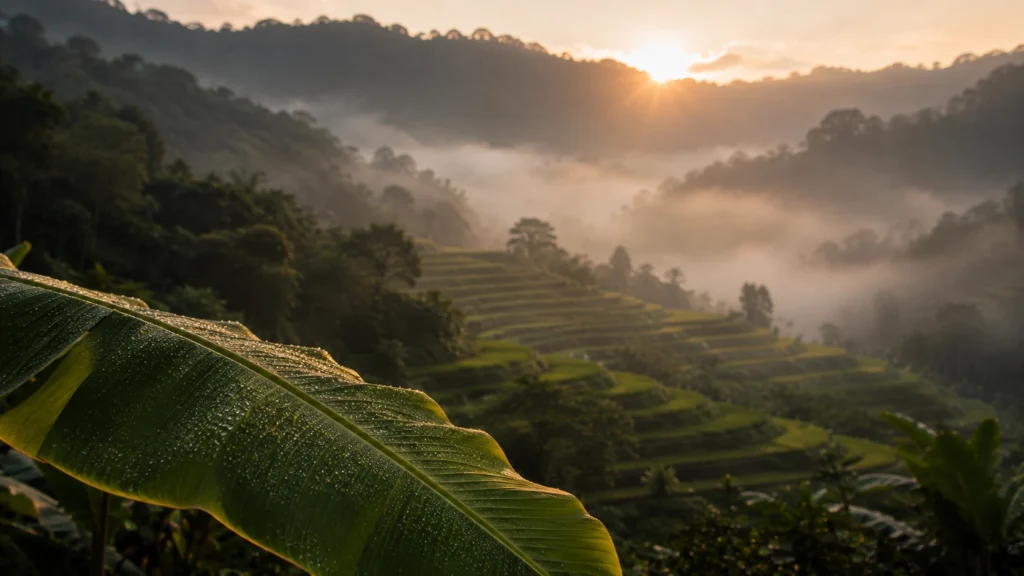
The signature landscape of Nan is Doi Phu Kha National Park, the largest national park in the north and the source of the province’s most cinematic imagery. Winding ridge roads climb to viewpoints that sit above a sea of morning fog in the cool season, with layered mountains running to the horizon and, in season, rare flowering trees found almost nowhere else.
The interior offers waterfalls, evergreen forest and hairpin passes that suit everything from a car film to a contemplative drama. Access is via the national park authority, and shooting inside protected boundaries carries its own permit layer, covered below. Weather and road conditions in the high country change quickly, so a location scout with local knowledge is worth more here than almost anywhere else in Thailand.
The Old City: Lanna temples and heritage architecture
Nan’s Old City is a compact grid of wooden Lanna and Tai Lue temples, many of them centuries old and still in daily use. Wat Phumin, built in the late sixteenth century, is the best known: a cruciform ordination hall raised on carved naga serpents and lined with Tai Lue murals, including the famous whispering couple that has become the emblem of the province.
Wat Phra That Chang Kham, Wat Ming Muang and the hilltop Wat Phra That Khao Noi, which overlooks the whole valley, complete a heritage cluster that is unusually intact. Filming inside or around active temples and any nationally registered monument requires coordination with the temple community and, for protected sites, the Fine Arts Department. These are living religious spaces, and access is granted on the basis of respect and clear scope.
Bo Kluea, terraced valleys and the Nan countryside
Beyond the city, the province opens into some of the least-photographed rural landscape in Thailand. The road to Bo Kluea passes terraced fields, river valleys and the switchback scenery around Sapan and the Sila Phet waterfall. Bo Kluea itself is known for its inland salt wells, where mountain brine has been boiled into salt by hand for generations, a genuinely unusual visual and a story location in its own right.
Rice terraces, the Nan River, wooden farming villages and quiet secondary roads give a unit room to work without crowd control or heavy permitting. For productions that need rural Southeast Asia that does not look staged, this countryside is the province’s strongest asset.
Working with Nan’s ethnic and hill-tribe communities
Nan is home to several ethnic and highland communities, including Tai Lue, Htin, Hmong and the Mlabri. Their villages, dress and crafts can be extraordinary on screen, but they are communities, not sets. Any filming that involves people, homes or ceremonies should be arranged in advance, with informed consent, fair compensation and a clear agreement on how the footage will be used.
We treat community filming as a relationship rather than a transaction, brokered through people the community already trusts. That approach protects the production, protects the community, and produces better, more honest material. Where filming touches cultural practice or sensitive subjects, we flag it early so the appropriate approvals and courtesies are in place before the camera arrives.
Permits for filming in Nan
A commercial shoot in Nan usually sits under more than one authority. Foreign productions work through the Thailand Film Office (TFO), which coordinates the master filming permit; provincial authorities handle location-specific approvals; the national park authority governs Doi Phu Kha and other protected areas; and the Fine Arts Department oversees registered heritage monuments and temple murals.
Because Nan combines national park, heritage and community locations in a small area, the permit stack can be more involved than a straightforward city shoot, and lead times matter. Our Thailand film permit guide sets out the general process, and we manage the full application on a production’s behalf as a TFO-registered service company. Border-province and protected-area specifics should be confirmed for each project, and we scope them at the recce stage.
Seasons and the best time for filming in Nan
The cool season, roughly November to February, is the prime window: clear skies, comfortable temperatures and the sea-of-fog conditions that make the Doi Phu Kha viewpoints so photogenic. This is peak visual value and the busiest travel period, so flights and accommodation need booking well ahead.
The hot season brings haze. Like much of northern Thailand, Nan is affected by agricultural burning from roughly late February into April, which can flatten light and reduce visibility across the mountains; sensitive exteriors are best planned around it. The rainy season, from about May to October, delivers deep green terraces and dramatic cloud but brings mud, slippery mountain roads and weather holds. We plan Nan schedules with weather contingency built in rather than assumed. For the wider national picture, see our guide to the best time to film in Thailand.
Crew and equipment for filming in Nan
Nan does not have a resident film crew of any depth, so the practical model is a Bangkok or Chiang Mai unit travelling in. We build bilingual English-Thai crews sized to the project, move equipment by road or air freight, and handle the logistics of working somewhere without a rental house on the corner. Anything not sourced in-country is imported under an ATA Carnet and cleared ahead of the shoot.
Accommodation and support services in the Old City are geared to tourism rather than production, so catering, power, transport and basic grip support are all things a professional service company brings with it. Planning for self-sufficiency is the difference between a smooth Nan shoot and an expensive improvisation. For scouting support, our location scouting in Thailand service covers the province.
The incentive picture: why secondary provinces matter now
Thailand runs a cash rebate for qualifying foreign productions, administered by the Thailand Film Office under published criteria that are reviewed from time to time. The current policy direction actively encourages filming beyond Bangkok and the established hubs, with additional weighting for productions that shoot in secondary provinces and put value into local economies. Nan sits squarely in that category.
With Thailand promoting a national push toward regional filming and a designated film-focused year ahead in 2027, a Nan shoot aligns with exactly the kind of production the incentive is being steered toward. We keep the specific percentages, thresholds and conditions in our Thailand film incentive 2026 guide, which we update as the criteria change, and we manage the rebate application as part of the service.
How we approach filming in Nan
Overgrown Productions is a Bangkok-based, full-service production company with more than fifteen years and over four hundred productions behind us, for clients including Netflix, Vice, Al Jazeera, Reuters, the United Nations, Universal and Warner Music. We have handled everything from the US chess thriller Contra, shot in Bangkok in 2025, to the global motorsport series Lollipop Racing.
For a province like Nan, that experience matters most in the planning: the recce, the permit strategy, the community introductions and the logistics of running a unit far from a rental house. We scout the province properly, build the permit stack across TFO, provincial, national park and Fine Arts authorities, source a bilingual crew, and run the shoot to international standards. The result is a remarkable and rarely-filmed location, delivered without the risk that usually comes with going somewhere new. To see how we run a full international production in Thailand, read our Contra case study, and browse the wider Thailand filming locations guide for how Nan fits the north.
Frequently asked questions about filming in Nan
Where is Nan and how do productions get there?
Nan is a province in the far north-east of Thailand, against the Lao border in the Lanna region. Domestic flights reach Nan Nakhon Airport from Bangkok in about an hour and a half, and the province is roughly a six-hour drive from Chiang Mai. Most productions base crew in Bangkok or Chiang Mai and move a compact unit in.
What are the standout filming locations in Nan?
Doi Phu Kha National Park for mountain roads and sea-of-fog viewpoints; the Old City’s wooden Lanna and Tai Lue temples, led by Wat Phumin and its famous murals; and the rural valleys toward Bo Kluea, with terraced rice, river scenery and the region’s traditional inland salt wells.
What permits are needed for filming in Nan?
Foreign productions work through the Thailand Film Office for the master permit, with additional approvals from provincial authorities, the national park authority for Doi Phu Kha, and the Fine Arts Department for registered heritage sites and temple murals. As a TFO-registered service company, we manage the full application.
When is the best time to film in Nan?
The cool season, November to February, offers the clearest skies and the sea-of-fog conditions on the mountain viewpoints. Avoid the late-February-to-April burning season, when regional haze can affect visibility. The rainy season delivers green terraces but brings weather holds and difficult mountain roads.
More questions about filming in Nan, Thailand
Is there a film crew based in Nan?
Not to any professional depth. The practical model is a bilingual English-Thai crew travelling in from Bangkok or Chiang Mai, with equipment moved by road or air freight and imported gear cleared under an ATA Carnet. A service company brings the catering, power, transport and grip support the province does not supply locally.
Can you film inside Nan’s temples?
Often yes, with the right arrangements. Active temples are living religious spaces, so access depends on advance coordination with the temple community, and registered heritage monuments and murals require Fine Arts Department approval. We arrange this respectfully and within a clearly defined scope before the shoot.
Does filming in Nan qualify for Thailand’s cash rebate?
Qualifying foreign productions can apply to the Thailand Film Office cash rebate, and current policy actively encourages filming in secondary provinces such as Nan. We keep the specific criteria in our Thailand film incentive 2026 guide and manage the rebate application as part of the service.
How do you handle filming with Nan’s ethnic communities?
As a relationship, not a transaction. Any filming involving people, homes or ceremonies is arranged in advance through trusted local contacts, with informed consent, fair compensation and agreement on how footage will be used. Culturally sensitive material is flagged early so the right approvals are in place.
External references: Thailand Film Office incentive measures and the Tourism Authority of Thailand guide to Nan province.
Plan a Nan shoot with a Bangkok team
If you are a line producer, location manager or director considering Nan for a feature, commercial, documentary or branded production, we can scout the province, build the permit strategy across every authority involved, source a bilingual crew and run the shoot end to end. As a Bangkok-based, TFO-registered service company, we handle the remote logistics so you can focus on the work. Contact our Bangkok team at info@overgrownproductions.com to start planning. Comparing regions before you commit? Start with our guide to filming locations in Thailand.