
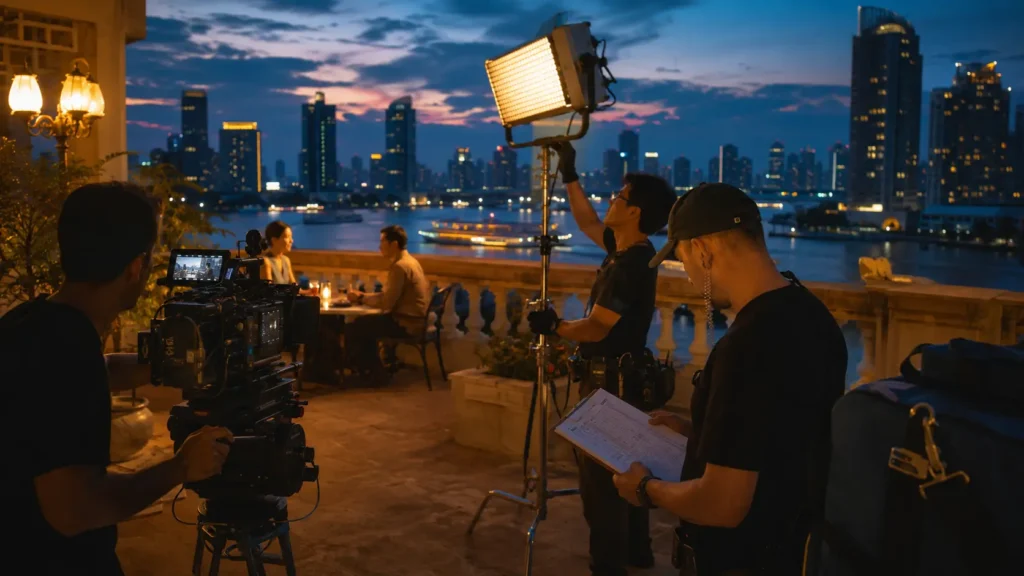
European productions Thailand: a 2026 moment at Cannes
European productions Thailand activity moved into open daylight at the 79th Festival de Cannes in May 2026. The Thailand Film Office opened a dedicated Thailand Pavilion at Booth 112 in the International Village, running from 12 to 23 May, with the Deputy Prime Minister and the Minister of Culture both presiding over the launch. Fifteen Thai production houses worked the Marché du Film in parallel, and the pavilion’s commercial pitch was aimed squarely at Western producers — particularly European feature, documentary and high-end television teams looking for a credible Asian shoot base outside the saturated UK and Eastern European tax-credit corridors.
For European producers, the message from Cannes was specific: Thailand is open, organised and incentivised. The TFO promoted a refreshed cash-rebate framework, a parallel 20% framework for foreign digital content production (animation, VFX and post-production at qualifying contract scale), and an explicit push to position Thailand as a co-production and service partner for European projects. We work this market daily from Bangkok. This guide explains how European productions Thailand workflows actually run — what a service deal looks like in practice, what a co-production looks like, how crew and equipment compare to European norms, and how Overgrown Productions structures shoots for line producers, UPMs and executive producers based in London, Berlin, Paris, Madrid, Rome, Amsterdam and Stockholm.
Why European productions Thailand make commercial sense in 2026
The financial logic for European productions Thailand sits on four pillars. The first is the cash-rebate framework administered by the TFO under published criteria, which has been progressively expanded since 2023 and most recently promoted at Cannes 2026. The second is below-the-line cost: skilled bilingual crews work at rates substantially below London, Berlin and Paris equivalents, and the gap is widest in grip, electric and art department, where Thailand has deep tradecraft. The third is locations — Thailand carries the topographic and architectural diversity of an entire region inside one fiscal jurisdiction, removing the cross-border logistics that drive up budgets when European productions chase the same look across multiple countries. The fourth is the calendar: Thailand’s dry season runs November through March, exactly the window when European location work is most expensive and weather-vulnerable.
Producers comparing Thailand against Hungary, Czech Republic, Spain’s Canary Islands or Morocco generally find the headline rebate competitive and the all-in delivered cost favourable once travel, freight and per diem are factored. The break-even spend point for an A-list European feature is consistently lower than producers expect on first pass. For the formal rebate criteria, eligible spend thresholds and the documentation TFO requires, our Thailand Film Incentive 2026 guide is the working reference; the rules are updated from time to time and we re-verify against the published TFO criteria before every quote.
The production gap European productions Thailand fill
European productions Thailand work tends to cluster around four creative needs. The first is “anywhere Asia” — scripts written as Singapore, Hong Kong, Vietnam, Myanmar or “pan-Asian city” that European producers want to shoot in one country with one permit regime. Bangkok stands in convincingly for almost any modern Asian megacity, with skylines, alleys, expressway interchanges, wet markets and gated residential compounds available within a thirty-minute radius. The second is jungle, river and ruin — sequences calling for tropical landscape, working temples, archaeological depth or boat work that the Mediterranean simply cannot deliver. The third is heat-and-water — beach, dive, marine and coastal sequences with reliable December–February weather while European coasts are unworkable. The fourth is scale at price — large set builds, crowd work, period costuming and stunt coordination at budgets that read as feasible inside a European financing plan.
What Thailand does not pretend to be is a winter-mountain or alpine substitute. For snow, ice or high-altitude work, we route productions elsewhere; for everything else from contemporary urban to historical Asia, the answer is here.
European productions Thailand: service deal or co-production
European productions Thailand structures fall into two architectures. The dominant route is a service deal: the European producer retains all rights, brings their key creative team, and contracts a Thai production service company — registered with the TFO — to execute the local shoot, payroll, vendors and rebate paperwork. This is how the majority of European features, high-end documentaries and commercials run in Thailand. Speed, control and IP cleanliness are the advantages.
The second route is co-production. Thailand has been progressively opening to bilateral co-production frameworks, and the Cannes 2026 push explicitly invited European partners to develop co-pro models with Thai houses. Co-productions can unlock Thai national funding lines, deeper local cultural sign-off, and tax positioning that pure service shoots cannot reach — but they require longer development runways, equity negotiation and creative compromise on Thai content elements. The choice is rarely automatic. Our Thailand co-production guide walks through the decision framework. For most European productions Thailand work landing in 2026 and 2027, a service-deal architecture with TFO-administered rebate is the cleaner answer.
Crew for European productions Thailand: bilingual, EU-aware, IATSE-fluent
The single biggest concern European producers raise on first call is crew. The honest answer in 2026 is that Bangkok-based heads of department are fluent in both the IATSE workflow and the European call-sheet rhythm, having served on enough US, German, French, Italian and UK productions over the last decade to internalise both. English is the working language across departments at the senior level. Thai is the working language below the line; bilingual ADs bridge the rooms cleanly.
For European productions Thailand specifically, the practical implications are these: a European DoP brings their own colour palette and operating preferences and finds a Thai gaffer and grip team able to deliver European-standard lighting plots with comparable kit; a European 1st AD finds Thai 2nd ADs running European-style call sheets and continuity in English; a European production designer finds Thai art department leads with deep set-building benches and the supplier network to execute period and contemporary builds at speed. The crew is large enough to staff two A-budget productions concurrently without thinning out, and on peak weeks the depth has been stress-tested across simultaneous foreign shoots.
Bangkok hub: equipment, post and vendors for European productions Thailand
Bangkok carries a deep camera, grip and lighting rental ecosystem covering the same packages European productions specify at home: ARRI Alexa 35, Mini LF, Sony Venice 2, RED Komodo and V-Raptor; full Cooke S7/i, Panavision, Zeiss Supreme and Master Anamorphic lens inventories; ARRI SkyPanel, Creamsource Vortex and Astera lighting; and the heavy grip — Technocrane, Scorpio, Stab-One and Russian Arm — to support European-style coverage at scale. Generator, walkie, comms and HMI inventories are sufficient for two simultaneous A-features.
Post is where the rebate framework most directly addresses European productions Thailand interest in 2026. The 20% cash rebate framework promoted at Cannes for foreign digital content production — administered by TFO under published criteria — encompasses animation, VFX and post-production work commissioned to qualifying Thai vendors at qualifying contract scale. For European producers running tight final-delivery schedules, completing finishing work, VFX shots, colour and online in Bangkok can materially improve all-in landed cost while keeping creative review inside European working hours via Streambox and equivalent secure pipelines.
Permits, visas and the TFO process for European productions Thailand
Every foreign production filming in Thailand requires a TFO permit. The application is filed by a Thai production service company registered with the TFO. The package includes the script or treatment, location list, crew list, equipment manifest and timeline. TFO routes the application across the relevant ministries and provincial authorities; for most location work the turnaround sits inside a fortnight, with sensitive sites — palace exteriors, working temples, military installations, national parks — requiring longer lead times and additional sign-offs. Our Thailand film permit guide covers the working process in detail.
For European cast and crew, the relevant visa is the Non-Immigrant M (Media) visa with a work permit obtained on arrival via the TFO process. We file end-to-end on behalf of European productions Thailand — passport, photographs, contract and TFO endorsement letter — so producers and HoDs land Bangkok with travel paperwork already cleared. ATA Carnet is the standard route for European productions shipping camera, lighting and grip from London, Frankfurt, Paris or Milan; we manage import clearance and the bond release on wrap.
Cash rebate and incentive framework for European productions Thailand
The cash rebate framework promoted by TFO at Cannes 2026 is the headline incentive driving European productions Thailand interest this year. The framework is administered by TFO under published criteria, with qualifying spend, qualifying-vendor rules, Thai-content uplifts and post-production uplifts. For digital content production — animation, VFX and post — a parallel framework was promoted at the Thailand Pavilion at Cannes targeting foreign producers commissioning Thai post houses at qualifying contract scale. The criteria are updated from time to time. Rather than quoting a number that may shift between today and your principal photography, we re-verify against TFO’s current published criteria for every quote and confirm eligible spend on a per-production basis. For the working framework as published, our Thailand film incentive rebate guide for foreign productions is the up-to-date reference.
Beyond the headline rebate, European productions Thailand benefit from a five-year personal income tax exemption for qualifying foreign talent, removed rebate caps for large productions, and zero customs duty on production equipment imported under ATA Carnet. The compound effect on a fully-loaded European feature budget is material; the rebate alone is rarely the whole story.
Locations European productions Thailand choose most often
European productions Thailand cluster around five working areas. Bangkok and the Greater Bangkok ring supply contemporary urban — finance-district skyline, expressway interchanges, residential gated developments, hospital and university interiors, wet markets, Chinatown, and Khlong Toei port. Phuket and Krabi supply the marine coastline — limestone karst, sand beaches, dive water and resort interiors — with reliable November–April weather. Chiang Mai supplies the northern uplands, working temples, hill-tribe village exteriors and the cooler dry-season climate that European productions favour for long location runs. Kanchanaburi supplies jungle, river, the Death Railway and the Erawan and Sai Yok national parks — the standard “Asian jungle” answer for European action and adventure scripts. Ayutthaya supplies UNESCO-listed temple ruins and royal-era architecture for historical and dynastic work. Each opens onto our location pages — Phuket, Chiang Mai, Kanchanaburi, Ayutthaya — with permit, seasonality and crew specifics per province.
What Overgrown brings to European productions Thailand
Overgrown Productions is a Bangkok-based full-service production company, registered with the Thailand Film Office, with fifteen years and more than four hundred productions through the books. We have serviced European broadcasters and commercial clients including Al Jazeera, the United Nations and Reuters, alongside US and global clients Netflix, Vice, Universal and Warner Music. Our crew is bilingual English–Thai, our heads of department have served on US and European productions and our infrastructure — office, edit suites and equipment partners — sits in central Bangkok with BTS access. We handle permits, visas, crew, equipment, transport, accommodation, locations, payroll and rebate paperwork end-to-end.
For European productions Thailand work specifically, we route accordingly: high-end documentary teams from London, Paris and Berlin get a field-producer-led structure with broadcaster-standard release and protection workflows; European feature productions get a UPM-led service-deal structure with parallel co-production options modelled where relevant; commercial productions from European agencies get a tight one-day to one-week build with a producer who has run the agency-client rhythm before. Recent feature work executed from Bangkok includes the US chess thriller Contra (May–June 2025) and the global motorsport series Lollipop Racing — both delivered on European-friendly creative review hours and with paperwork inside TFO’s normal corridors.
Talk to us about your European productions Thailand project
If you are scoping a European production for Thailand — feature, high-end television, branded content, documentary or commercial — we welcome the inbound conversation from the script-and-budget stage onwards. The earlier the engagement, the more leverage we have on rebate optimisation, location choice and crew booking against the high-season calendar. The Bangkok team replies in English to enquiries at info@overgrownproductions.com and can be on a Berlin, London, Paris, Madrid or Rome creative call inside twenty-four hours. For a neighbouring market with its own requirements, see our guide to Russian productions in Thailand.
European productions Thailand: frequently asked questions
Which European productions shoot in Thailand most often?
European productions Thailand work spans feature film, high-end television, commercials, music videos, branded content and documentary. The largest concentration sits in feature film and high-end television from the UK, Germany, France, Italy, Spain and the Nordics, followed by commercials from EU-headquartered agencies serving global brands. Documentary is consistently strong from London, Paris and Berlin broadcasters.
Is Thailand cheaper than Hungary, Czech Republic or Spain for a European feature?
The honest answer is “it depends on the script”. For contemporary urban, jungle, marine and temple looks, Thailand is consistently cost-competitive against Eastern European tax-credit destinations once travel, freight and per-diem are modelled in. For European-period or alpine scripts, the European destinations win. Most European producers comparing budgets find Thailand favourable on all-in landed cost for scripts that can use Asian geography.
Do European producers need a Thai co-producer to access the rebate?
No. The cash rebate framework is open to foreign productions running through a TFO-registered Thai production service company. A formal Thai co-production structure is a separate route that can unlock additional Thai national funding lines but is not required for rebate access. Most European productions Thailand work runs as a service deal.
What is the working language on a European productions Thailand set?
English at the senior level — every head of department, the 1st AD, the production manager and the line producer work in English. Thai is the working language below the line, with bilingual ADs bridging the rooms. European DoPs, directors and producers find the communication corridor cleaner than on most non-English-speaking shoots.
More questions about European Productions in Thailand
Can European crew bring camera, lighting and grip equipment to Thailand?
Yes. ATA Carnet is the standard import route for European productions and we manage the customs clearance, bond and wrap release end-to-end. That said, the Bangkok rental ecosystem covers the same camera, lighting and grip packages European productions specify at home, and bringing only specialist or signature items is often more economical than carneting a full kit.
What visa do European cast and crew need to film in Thailand?
The Non-Immigrant M (Media) visa is the correct route, paired with a work permit obtained through the TFO process. We file the paperwork end-to-end for European productions and brief crew on landing requirements ahead of departure from Heathrow, Frankfurt, Charles de Gaulle, Schiphol, Barajas or Fiumicino.
How long is the TFO permit lead time for a European production?
For most location work, two to three weeks from submission is the working window. Sensitive locations — royal architecture, working temples, military installations, national parks — require longer lead times and additional sign-offs. We brief European producers on permit timeline against shoot date at the quote stage so it lands inside the prep calendar.
What does the Thailand Pavilion at Cannes 2026 mean for European producers?
The Thailand Pavilion at Cannes 2026, hosted by the TFO at Booth 112 in the International Village, signalled an explicit policy push to attract European feature, documentary, commercial and digital-content productions to Thailand. The framework is operationally live: permits, rebate and crew infrastructure are running today, and the pavilion was a positioning move rather than a forward announcement. European producers can engage Thai production service companies on 2026 and 2027 shoots immediately.